Part 2: What Is an AI Agent?
This is Part 2 of a seven-part series on AI foundations for business leaders. Part 1 covered models; this part covers agents, and Parts 3 and 4 cover model configurations and how to choose the right one. Links to every part are at the end of this article.
In Part 1: What Is an AI Model?, we looked at what a model actually is: a data-trained system that can understand language and generate responses. This post builds directly on that foundation, so if the word "model" still feels fuzzy, it is worth reading Part 1 first. To understand an AI agent, you must first grasp the underlying engine.
Once you understand the model, the next concept becomes much easier.
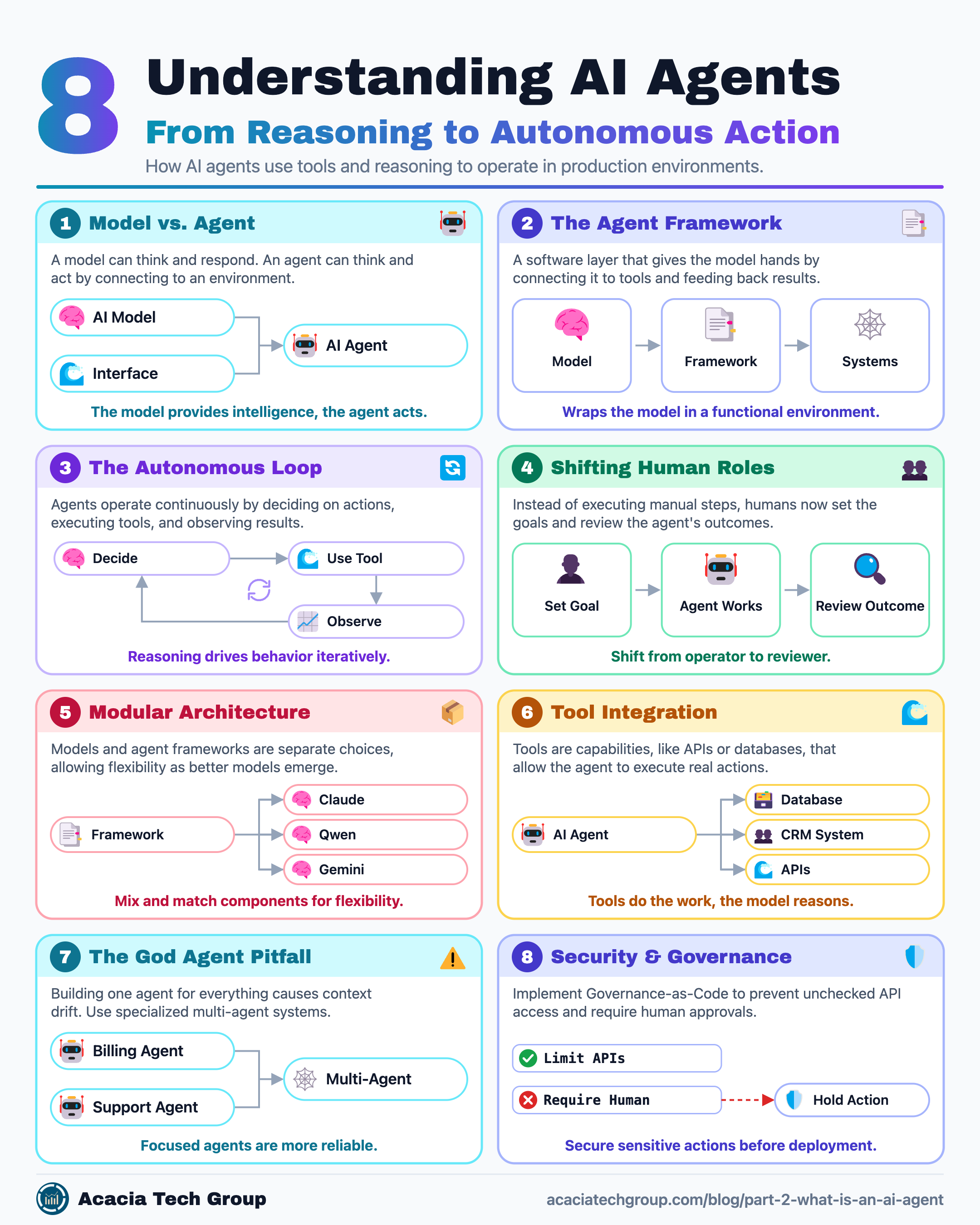
A model can think and respond.
An agent can think and act.
That is the difference. To understand what an AI agent is, see it as a system that uses reasoning to drive behavior.
Everything else in this post — tools, loops, agent frameworks — is really just a way of filling in what that single sentence means in practice.
A normal model interaction may look like:
You
 ↓
Model
 ↓
Answer
You ask a question, the model answers, and the interaction ends. If something needs actually to happen — a file edited, a database queried, an email sent — you do it yourself.
An agent interaction may look like:
You
 ↓
Model
 ↓
Decides what to do
 ↓
Uses a tool
 ↓
Observes result
 ↓
Decides what to do next
 ↓
Uses another tool
 ↓
Completes task
Notice that the model is still in the middle of everything. Nothing here replaces the model — the agent pattern wraps the model in an environment where it can do more than talk.
The model is still providing the intelligence.
The agent lets it interact with other systems.
AI Model vs Agent
Think of the model as a highly capable employee sitting at a desk.
The employee might know:
Python
databases
finance
architecture
writing
troubleshooting
But imagine that employee has:
No computer
No browser
No terminal
No access to files
No access to applications
The employee can give you advice but cannot actually perform the work. When comparing an AI model vs. an agent, the model is the intellect, while the agent is the intellect plus the interface.
This is exactly the situation a raw AI model is in. It is brilliant, but it is locked in a room with only a telephone line to you. Every action it recommends still requires a human to carry it out.
Now give the employee:
Laptop
Terminal
File access
Browser
Database access
APIs
Enterprise applications
The employee can now take action.
That is roughly what an agent framework does for an AI model. An agent framework is the software layer that gives the model hands: it connects the model to tools, executes the actions the model chooses, and feeds the results back so the model can decide what to do next.
An Example: Fixing Software
Suppose a Python application is broken.
If you use a normal chatbot, the process may look like:
You copy the error
      ↓
AI suggests a change
      ↓
You edit the file
      ↓
You run the program
      ↓
Another error appears
      ↓
You copy it back to AI
You are effectively acting as the agent.
You do the work between each AI response—copying errors, editing files, running programs, and relaying results. The AI advises; you operate.
With a coding agent:
Agent reads files
      ↓
Runs application
      ↓
Sees error
      ↓
Inspects code
      ↓
Modifies file
      ↓
Runs tests
      ↓
Sees another failure
      ↓
Makes another change
      ↓
Tests again
The model decides what should happen. The agent framework lets it perform those steps through a continuous agent loop. The human's role shifts from "do the work" to "describe the goal and review the outcome" — which is a fundamental change in how the work gets done.
Claude vs. Claude Code
This is a useful real-world comparison.
You can think of:
Claude
as the model experience — a chat interface where you talk to the model and it responds.
And:
Claude Code
as an agent-oriented coding environment built around Claude models; under the hood, it uses the same model family, but wraps it in a framework that can read your files, run commands, and edit code directly.
Similarly:
Qwen
is the model.
While something such as:
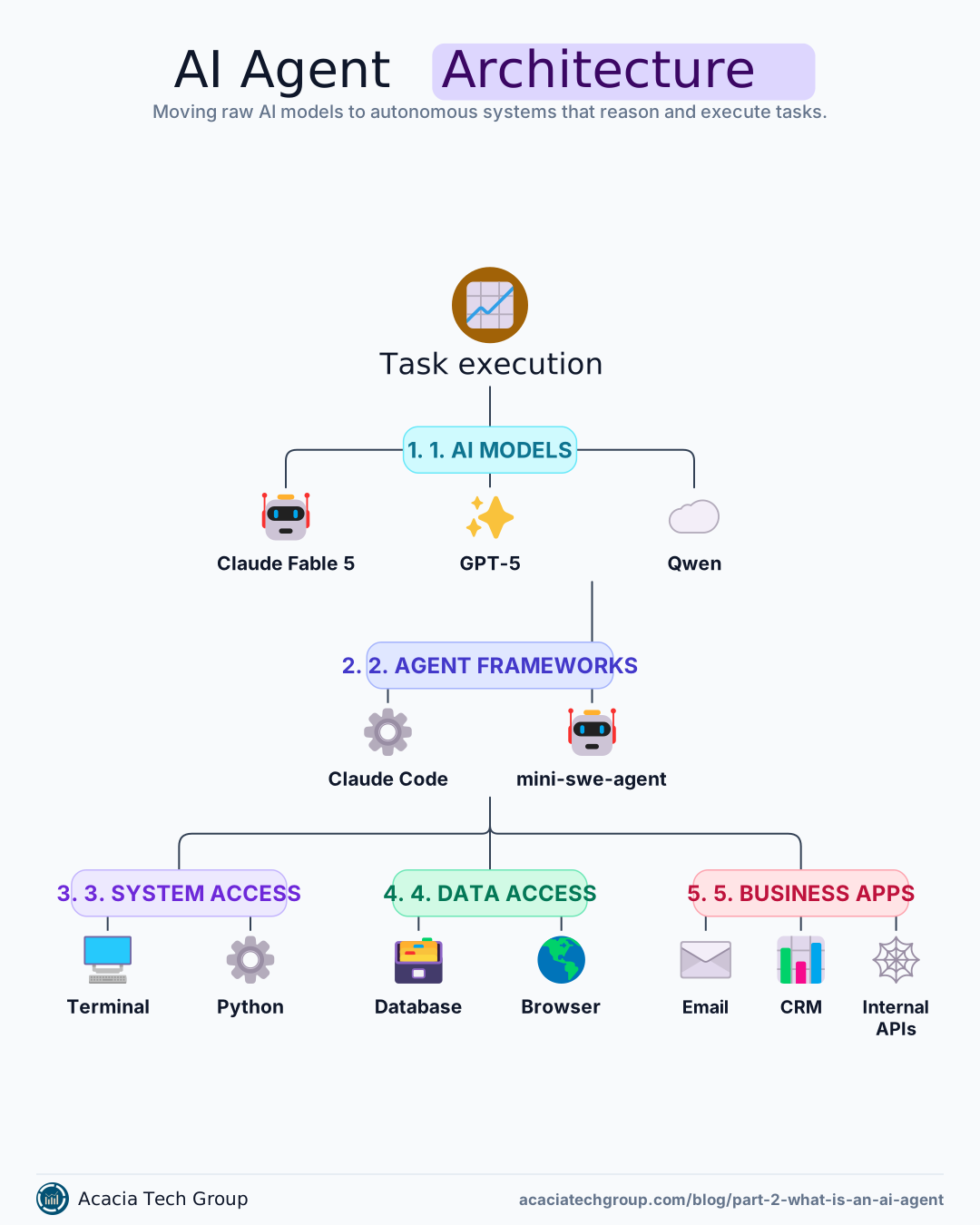
mini-swe-agent
can provide an agent framework around Qwen.
Recent market shifts have significantly altered these systems' economics. In mid-2026, releases such as Claude Fable 5 and GPT-5 have reset performance benchmarks. At the same time, ultra-cheap options like Gemini 2.5 Flash-Lite have lowered the barrier for high-volume, lower-complexity agentic tasks.
So:
Qwen
+
mini-swe-agent
is conceptually similar to:
Claude model
+
coding agent environment
The exact products are different, but the architecture is similar. The key takeaway is that "model" and "agent" are separate choices. You can mix and match models with agent frameworks, and you can swap the model behind an agent as better or cheaper models become available — a flexibility that matters a lot when you are designing real systems.
The adoption of these systems is accelerating rapidly. According to a Q1 2026 Gartner survey, 80% of enterprise applications now embed at least one AI agent, up from 33% just two years earlier. However, moving from pilot to production remains a hurdle, as only 31% of organizations have successfully scaled an agentic system in a live environment.
A common deployment mistake is the "God Agent" architecture, where teams try to build a single agent to handle every business function from billing to tech support. This often leads to context drift and more hallucinations; a more reliable approach is to use multi-agent systems where specialized agents handle focused responsibilities.
Tools Make Agents Useful
Tools make agents much more powerful. When discussing what an AI agent is, tools are the critical component that allow for autonomy.
In this context, a tool is simply a capability the agent can use: a function it can call, an API it can request, a system it can access. Each tool usually has a short description, and the model decides — based on the goal — which tool to use and with what inputs.
Implementation Tip: To optimize agent performance, developers are moving toward machine-readable documentation formats. Using tools like Fern to generate llms-full.txt files allows agents to consume clean, language-specific API schemas, which significantly reduces token consumption and prevents broken integrations caused by outdated documentation.
Security Note: To maintain compliance, organizations should implement Governance-as-Code layers. These ensure that agents do not have unchecked access to APIs and require human approval for sensitive actions, such as processing financial transactions.
Security remains a primary barrier to deployment; a survey of 900+ organizations found that 88% had suspected or confirmed AI agent security incidents in the past year. Furthermore, only 14.4% of firms report that all their agents go live with full IT or security approval, highlighting a critical gap in organizational oversight.
For example:
AI Agent
   │
   ├── Database
   ├── Browser
   ├── Python
   ├── Terminal
   ├── Email
   ├── CRM
   └── Internal APIs
Now imagine asking:
Find customers with invoices more than 60 days overdue and prepare a summary.
The agent could potentially:
Query the database.
Identify overdue invoices.
Analyze the results.
Generate a report.
Draft an email.
The model itself does not directly perform all of these actions.
It decides which tools to use and how to interpret the results. The tools do the doing; the model does the reasoning. You can see this pattern running live in our invoice and accounts-payable automation demo, where an agent processes invoices end to end, and in our Azure AI agent architecture walkthrough.
Beyond internal automation, companies are deploying agents in customer-facing roles with measurable results. For example, Salesforce uses Einstein AI as a sales assistant to analyze CRM data and prioritize leads, reportedly driving a 30% increase in lead conversion and a 20% reduction in sales cycle time.
Salesforce: Uses Einstein AI as a sales assistant to analyze CRM data and prioritize leads, reportedly driving a 30% increase in lead conversion and a 20% reduction in sales cycle time.
GreenLight Biosciences: Implemented AdaptiveFilters, an agentic system that helps domain experts filter and prioritize complex datasets within specialized scientific workflows.
Zendesk: Employs Answer Bot to handle Tier-1 support queries by integrating directly with knowledge bases to resolve common queries autonomously.
Agents Work in Loops
One of the most important ideas behind agents is the agent loop.
A simplified version of this loop looks like:
Goal
 ↓
Think
 ↓
Act
 ↓
Observe
 ↓
Think again
 ↓
Act again
 ↓
Finish
This differs greatly from generating a single response. This iterative process is a hallmark of agentic AI systems.
The model may need to adjust its approach as things unfold.
For example:
Try command
      ↓
Command fails
      ↓
Read error
      ↓
Change approach
      ↓
Try again
This ability to operate through multiple steps is what makes agentic AI systems interesting.
It is also what makes them different to design for. A single response is either right or wrong. An agent loop can recover from mistakes—but it can also wander, retry forever, or take an expensive path if it lacks clear goals, good tools, and sensible limits. That is why production agent systems put guardrails around the loop: step limits, human approval for sensitive actions, and clear stopping conditions.
Operational efficiency varies significantly by model choice and task complexity. As of mid-2026, coding-agent benchmarks show a wide range in cost per solved task, with frontier models like GPT-5 averaging $0.147 per success, while hybrid approaches using models like DeepSeek R1 paired with Sonnet can achieve a 79% pass rate at just $0.012 per task.
Operational efficiency varies significantly by model choice and task complexity. As of mid-2026, becoding-agent benchmarks show a wide range in cost per solved task: frontier models like GPT-5 average $0.147 per success, while hybrid approaches using models like DeepSeek R1 paired with Sonnet can drive costs as low as $0.012 per task.
This think-act-observe pattern has a formal name in the research literature — the ReAct (reasoning and acting) pattern — and nearly every modern agent framework is some variation of it.
Why This Matters
For most organizations, the practical value of AI is not in a model that answers questions — it is in systems that complete work. Agents bridge the two. Once a model can query your systems, update records, and route work, it stops being a novelty and becomes part of your operations.
That is also why the definition of an AI agent matters when evaluating vendor claims: many products marketed as "agents" are single-response chatbots with a few integrations, while true agentic AI systems plan, use tools, and adapt over multiple steps. To see how far the pattern can go, our field guide to 29 real agent types maps the six design patterns that show up across finance, customer care, insurance, HR, and operations.
Key Takeaways
A model thinks and responds; an agent thinks and acts. The agent is the model plus tools, wrapped in a loop.
Models and agent frameworks are separate choices — you can pair models like Claude or Qwen with different agent environments and swap them over time.
The agent loop (think-act-observe) lets agents recover from errors and handle multi-step work, but production systems need guardrails.
In Part 3, we will look at the design decisions that make agents reliable enough for real business workflows — state, memory, and guardrails. For a preview, see How to Treat State When Building Agentic AI.
Frequently Asked Questions
What is the difference between an AI model and an AI agent?
A model thinks and responds: you give it text, it gives you text back. An agent wraps that model in a loop and gives it tools, so it can take actions, observe the result, and keep going until the task is done.
Do I need a different model to build an agent?
No. Most agents run on the same general-purpose models you already use. What makes an agent is the surrounding framework, the tools it can call, and the guardrails around it, not a special model.
Are AI agents reliable enough for real business workflows?
They are, when the workflow is scoped and supervised. Reliable production agents have a limited set of tools, clear stopping conditions, log every action, and include a human approval step wherever the action is costly or irreversible. See our interactive support-triage demo for what that looks like in practice.
What does an agent cost to run compared with a single model call?
More, because each loop iteration is another model call plus tool time. Budget for several times the cost of a single request, and cap iterations so a stuck agent cannot run up an unbounded bill.
Further reading
The 2026 Guide to AI Agents — A comprehensive collection of expert insights and educational explainers on how agents autonomously design workflows.
Prepare APIs for AI agents — Technical strategies for making internal systems machine-readable to reduce agent token consumption and errors.
AI Agent Node Documentation — A practical look at how agents are constructed using chat models and tool nodes in enterprise automation frameworks.
The Complete AI Foundations Series
Part 2: What Is an AI Agent? (you are here)
Part 6: Local AI in Practice — Email, Files and Document Automation
Part 7: The Hybrid Strategy — When to Stay Local and When to Go Cloud
Go deeper: the AI agents glossary entry, the interactive RAG demo, the Azure AI agents demo, and our comparison of data lakehouse vs. data warehouse for the platform these systems run on.