Part 1: What Is an AI Model?
This is Part 1 of a seven-part series on AI foundations for business leaders: models, agents, model configurations, and how to choose the right combination. Links to every part are at the end of this article.
If you are new to AI, the word model can sound more complicated than it really is. Vendors, headlines, and even engineers often use it without explaining it—as if everyone already knows. This guide fixes that. No math, no jargon, just a clear mental model you can build on.
At a high level, what is an AI model? It is a system trained on large amounts of data so it can recognize patterns and generate useful responses.
A helpful analogy: think of a new employee who has read millions of documents, emails, and books before their first day. They have never seen your specific question before, but they have seen so much that they can usually give you a sensible answer anyway. That employee is the model.
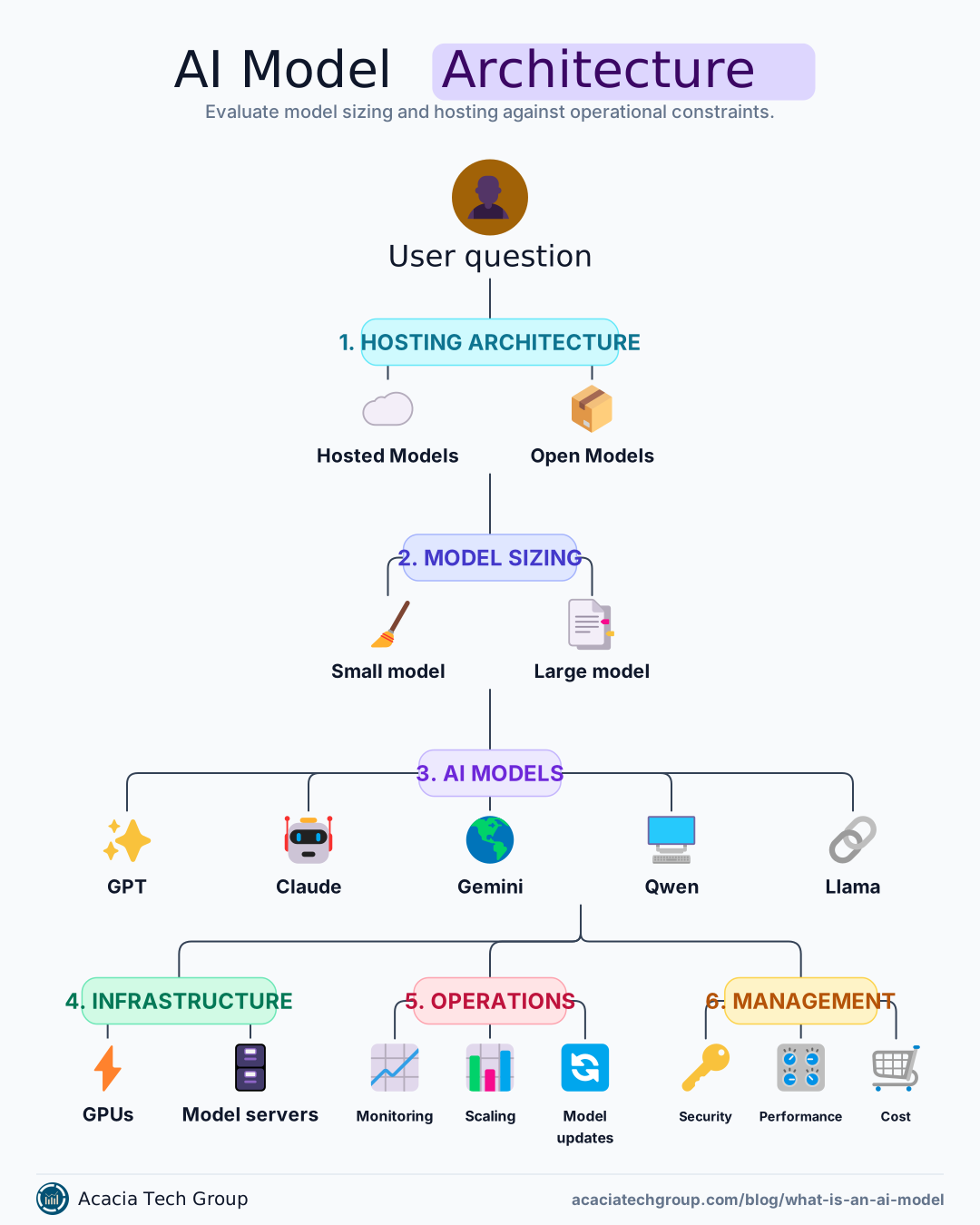
Models such as:
GPT
Claude
Gemini
Qwen
Llama
All belong to this general category. Different organizations make them, and they differ in size and style, but they all work on the same basic principle: learn patterns from data, then use those patterns to respond.
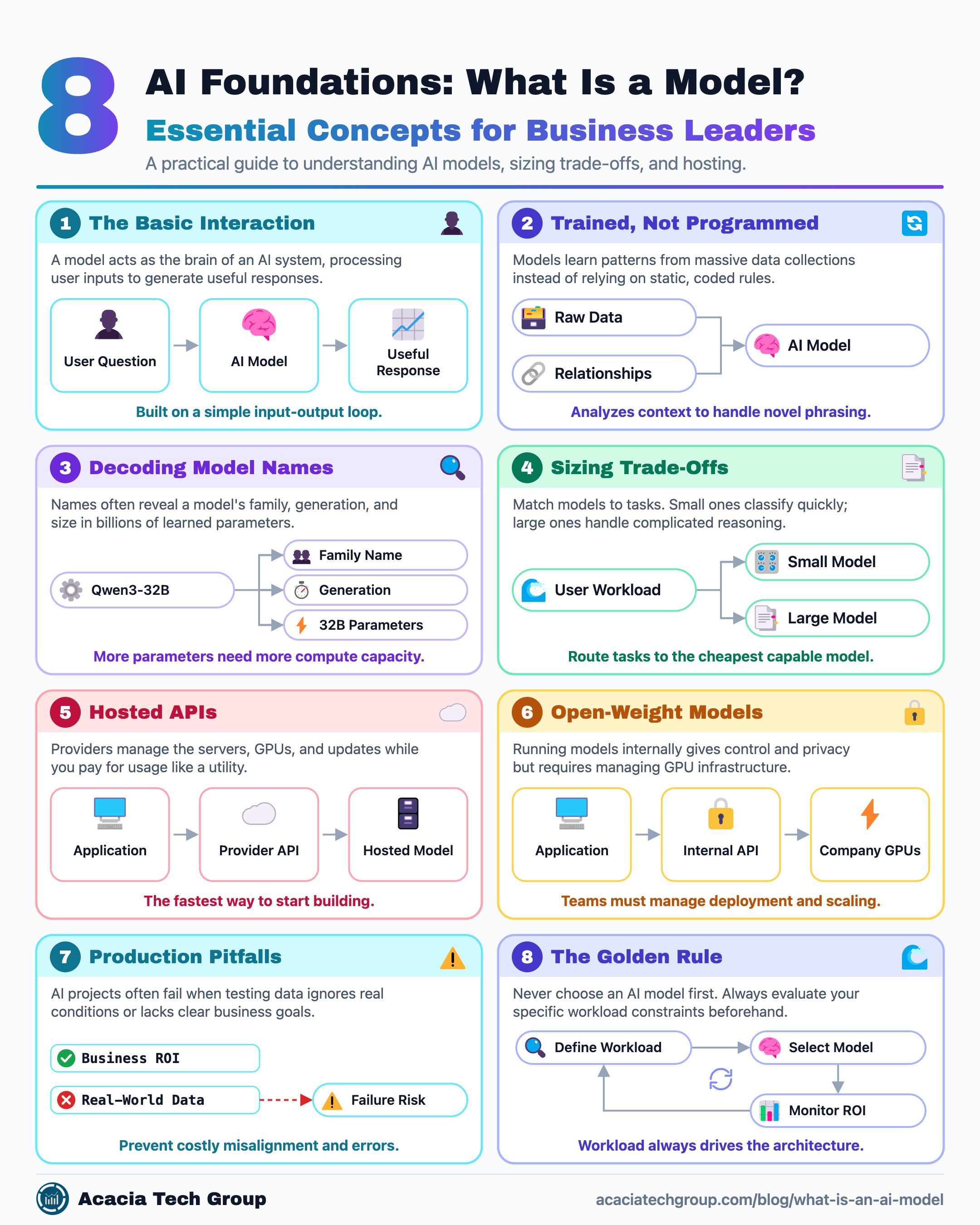
You can think of the model as the brain of an AI system.
It receives information, analyzes it, and produces a response.
User question
     ↓
AI model
     ↓
Response
If you ask:
What is the capital of Egypt?
the model receives your question, processes it, and returns:
Cairo.
That is the simplest form of interaction. Everything else you hear about — chatbots, copilots, agents — is built on top of this same loop: input in, response out.
Models Are Trained, Not Programmed One Question at a Time
An important concept to understand is that developers do not normally create a model by programming every possible answer.
Instead, developers train the model on very large collections of text, code, images, and other information.
During training, the model learns patterns.
For example, it learns relationships such as:
Paris → France
Cairo → Egypt
Python → programming language
SQL → databases
But the model is learning much more than simple facts.
It also learns patterns involving:
language
writing
software development
mathematics
reasoning
business concepts
technical documentation
relationships between ideas
This allows the model to respond to questions it has never seen before.
That is an important difference from traditional software.
Traditional software might contain logic such as:
IF customer_status = "Gold"
THEN discount = 10%
A person wrote every rule in traditional software. If a situation was not anticipated, the software has no answer. A language model works differently.
It analyzes the request's context and generates what it believes is the most appropriate response. This is why it can handle phrasing it has never encountered. It can also be confidently wrong—it predicts a plausible answer, not a guaranteed one.
A Common Pitfall: Many projects suffer from ROI misalignment where the AI journey begins without a clear business goal. Executives should avoid the mistake of assuming training data perfectly reflects real-world conditions, as this can lead to models that perform well in tests but fail in practical production environments.
Why Are There So Many Models?
When you visit a site such as Hugging Face, you may see names like:
Qwen3-8B
Qwen3-14B
Qwen3-32B
At first, this can look intimidating.
But the names usually tell you something about the model.
For example:
Qwen3-32B
can roughly be read as:
Qwen     = model family
3        = generation
32B      = approximately 32 billion parameters
You may also see suffixes like A3B or FP8. These describe how the model is built or packaged — for example, how much of it activates per request, or a compressed version that runs on cheaper hardware. The core idea stays the same: the family, generation, and size tell you what you need to know.
The market is shifting toward specialized variants. For example, on April 20, 2026, Alibaba released Qwen 3.6 Max-Preview. This flagship model moved away from the family's historical open-source approach to a closed-weight, API-only model to achieve top scores on coding and agent benchmarks.
AI model parameters are numerical values learned during training.
You don't need to understand the math behind them to grasp the basic concept.
A useful simplification is:
More parameters usually give the model greater capacity, but they also require more computing resources.
Small Models vs. Large Models
Imagine three employees:
Junior analyst
Senior engineer
Enterprise architect
You wouldn't necessarily ask the enterprise architect to do every simple task. It would be slow, expensive, and wasteful.
The trade-offs between small and large language models work similarly.
A smaller model might be excellent for:
classifying documents
extracting names and dates
summarizing short text
answering simple questions
A larger model may be better for:
complicated reasoning
software architecture
difficult coding problems
strategic analysis
multi-step investigations
So:
Small model
↓
faster
cheaper
less infrastructure

Large model
↓
more capable
more expensive
more infrastructure
The goal is not always to use the biggest model.
The goal is to use the right model for the job. In practice, well-designed AI systems often use several models of different sizes, routing each task to the cheapest model that can handle it well.
Hosted Models vs. Open Models
Another important difference is how models are provided: hosted vs. open-weight models.
With products such as Claude or ChatGPT, the provider manages most infrastructure for you.
You generally see:
Your application
      ↓
API
      ↓
Claude or GPT
The provider manages:
GPUs
model servers
optimization
scaling
capacity
model updates
You send a request and pay for what you use, like a utility.
With open-weight models such as Qwen or Llama, organizations can often run the model themselves.
That architecture might look like:
Application
     ↓
Internal model API
     ↓
Qwen
     ↓
Company GPU infrastructure
This provides much more control.
But it also creates more responsibility. Navigating AI infrastructure for executives involves weighing these operational trade-offs.
The organization may need to manage:
GPU infrastructure
model deployment
monitoring
scaling
upgrades
security
performance
cost
Operationalizing these models also requires distinct development and production environments. Failing to separate them can lead to unfinalized changes going live, which creates significant reputational risk and unexpected errors in business-critical services.
Neither approach is automatically better.
They solve different problems. Hosted APIs are usually the fastest way to start. Running your own models makes sense when data privacy requirements are strict, volumes are very large, or you need deep customization.
In a real-world supply-and-demand optimization application, Uber integrated AI systems to manage dynamic pricing. This allows the service to distribute vehicles effectively during high-demand periods by using pricing models that benefit both riders and drivers.
A Simple Example
Suppose a healthcare company wants to classify incoming documents.
Every day it receives:
Claims
Invoices
Referrals
Clinical notes
Authorizations
A relatively small AI model may be perfectly capable of identifying the document type.
Using an extremely large reasoning model for every document would likely increase cost without adding meaningful value.
However, imagine asking:
Review our healthcare data architecture, identify potential failure points, evaluate regulatory risks, and recommend a three-year modernization strategy.
That is a much more difficult request.
A more capable reasoning model may make sense.
This leads to one of the most important principles in AI architecture:
Do not choose a model first. Understand the workload first.
Key Takeaways
What is an AI model? It is a trained system that recognizes patterns and generates responses — not a database of pre-programmed answers.
Model names usually encode the family, generation, and size (parameter count); bigger means more capacity but more cost.
In the hosted vs open-weight models comparison, hosted options trade control for convenience, while open-weight models trade convenience for control.
Match the model to the workload — the biggest model is rarely the right default.
Frequently Asked Questions
What is a parameter in an AI model?
A parameter is a numerical value the model learns during training. To understand AI model parameters, think of them as the "connections" that encode patterns the model has learned. More parameters generally mean more capacity and more computing cost.
Is ChatGPT a model or a product?
ChatGPT is a product. Underneath it sits a GPT-family model. The same applies to Claude and Gemini — the name you interact with is the product, and the model is the engine inside it.
Do I need a large model for my use case?
Usually not. When comparing small vs large language models, tasks like document classification, extraction, and short summarization run well on small models at a fraction of the cost. Reserve large reasoning models for genuinely complex, multi-step problems.
Further reading
AI Model Documentation Standards: A Deep Dive — A look at why recording architecture and operational deployment is now a requirement for transparency and compliance.
The CLeAR Documentation Framework for AI Transparency — A guide for practitioners and policymakers to understand principles for documenting datasets and AI systems.
Introduction: Spring AI Reference — Technical documentation for engineering teams on building portable AI applications with structured outputs and model context protocols.
What is the difference between hosted and open-weight models?
When comparing hosted vs. open-weight models, hosted models (like Claude or GPT) are accessed through an API, and the provider manages the infrastructure. Open-weight models (like Qwen or Llama) can be run on your own hardware, giving you more control but also more operational responsibility.
Where does a model fit in a larger AI system?
The model is the brain, but production systems add retrieval, guardrails, and orchestration around it. See our guide to Retrieval-Augmented Generation (RAG) for how models connect to your own data, and our AI agents glossary entry for where models fit in agentic systems.
References and Further Reading
The Complete AI Foundations Series
Part 1: What Is an AI Model? (you are here)
Part 6: Local AI in Practice — Email, Files and Document Automation
Part 7: The Hybrid Strategy — When to Stay Local and When to Go Cloud
Go deeper: the AI agents glossary entry, the interactive RAG demo, the Azure AI agents demo, and our comparison of data lakehouse vs. data warehouse for the platform these systems run on.