Part 7: The Hybrid Strategy: When to Stay Local and When to Go Cloud
This is Part 7 of our beginner series on AI models and agents. Parts 5 and 6 covered running local models and automating with them; this final part covers the strategy. Catch up: Part 1: What Is an AI Model?, Part 2: What Is an AI Agent?, Part 3: Understanding AI Model Configurations, and Part 4: Choosing the Right Model and Agent.
Where the Token Savings Come From
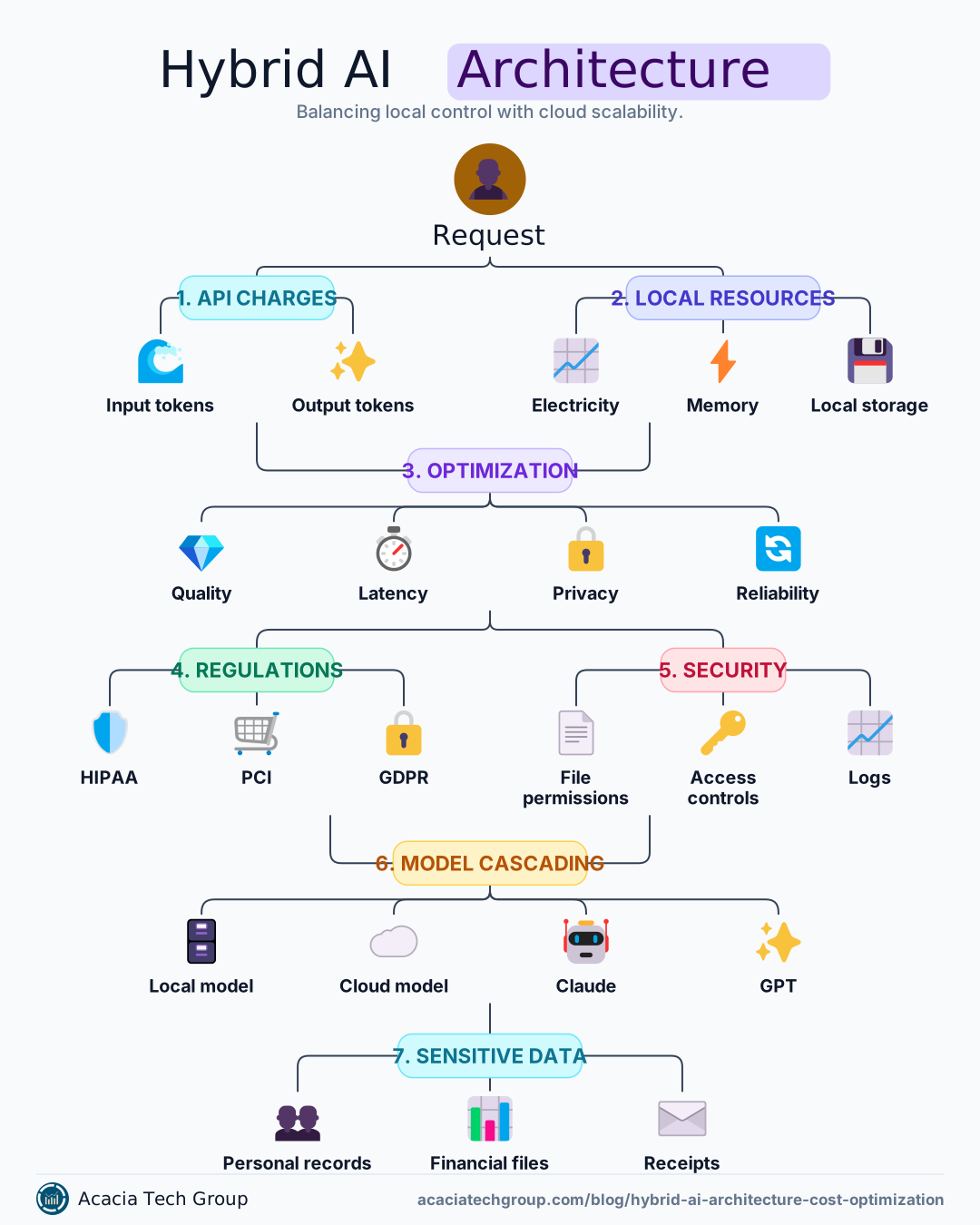
Hosted AI APIs usually charge based on some combination of:
Input tokens
+
Output tokens
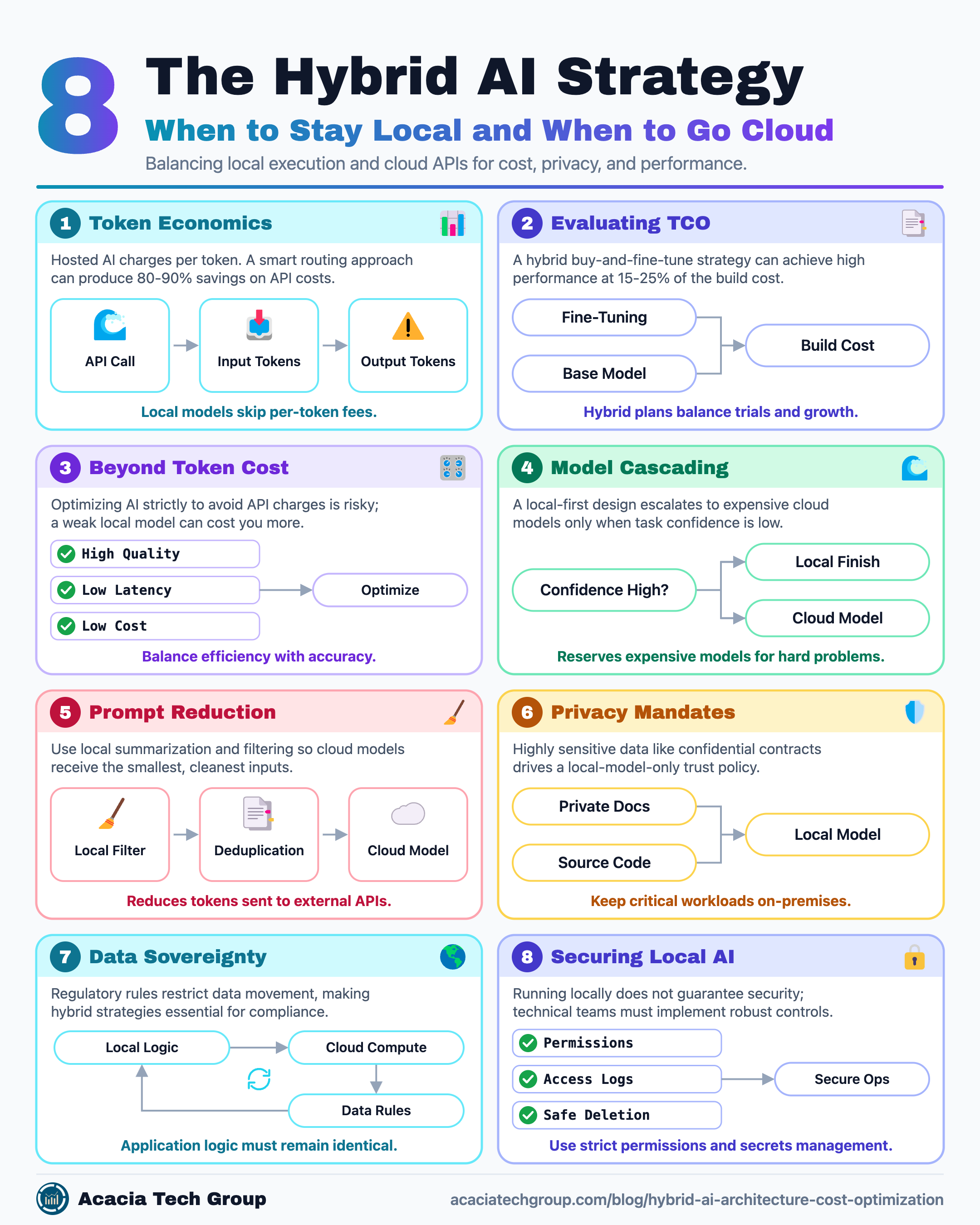
If a workflow processes thousands of routine items, those calls can accumulate. By implementing a hybrid AI architecture, you can significantly reduce these overheads. According to AT&T, a smart routing approach can produce 80–90% savings in specific applications by directing work to more efficient models instead of using frontier models for every query [7].
With local inference:
1,000 classifications
       ↓
Local model
       ↓
No per-token API charge
There is still a cost.
You are using:
your computer
electricity
memory
local storage
your engineering time
But the marginal cost of one more local inference is very small. This is particularly attractive for high-volume, repetitive workloads. While local models appear free, total cost of ownership (TCO) is shifting. As of May 2026, benchmarks show frontier cloud models can cost between $2 and $15 per 1 million tokens. For many enterprises, a hybrid AI architecture strategy of buying and fine-tuning can achieve 80% to 90% of a custom-built model's performance at only 15% to 25% of the total build cost.
As we look at the mid-2026 landscape, the financial gap between tiers has widened. While local models cost $0 per token after hardware acquisition, the cloud frontier tier has reached $50 per million output tokens. For high-volume enterprise document review, efficient mid-tier architectures like Jamba Large 1.7 can save money at $2.00 per million input tokens and $8.00 per million output tokens.
For a 3-year scale-up, a bespoke "Bring Your Own Storage" (BYOS) model can reach about $95,000 in total cost of ownership, compared with $390,000 for per-resolution pricing. As of May 2026, many organizations are shifting to hybrid pricing models (base plus usage overage), with 41% adoption as the industry standard for balancing trial costs with long-term growth.
While cloud models are variable-cost, hybrid cloud environments are now a mainstream enterprise approach. Beyond token savings, organizations using these distributed setups report 25–30% overall cost savings and a 30% faster deployment by balancing local control with cloud scalability.
Do Not Optimize Only for Tokens
The goal should not simply be:
Avoid API charges.
A weak local model that makes poor decisions can cost more than a good hosted model. AI cost optimization should balance efficiency with accuracy.
The right comparison is:
Quality
+
Latency
+
Privacy
+
Reliability
+
Operating cost
For example:
Email newsletter classification
        ↓
Local 4B model

Complex legal interpretation
        ↓
High-capability cloud model
That is a much healthier architecture. A specific example of this hybrid pattern in action is Booking.com, which developed an AI Trip Planner that integrates internal recommendation models with LLMs to provide personalized itineraries. By combining in-house models for specific data with structured API orchestration for conversational tasks, they significantly improved recommendation accuracy and booking conversion rates.
Another significant deployment is Priceline's AI travel assistant, Penny, which uses a hybrid approach. The system uses WebSockets to facilitate seamless bi-directional communication, integrating real-time voice capabilities with business function calling and content moderation to ensure natural, safe interactions.
A Hybrid Model Strategy
One of the strongest designs is local-first, cloud when necessary.
Request
   ↓
Local model
   ↓
Confidence high?
 /            \
Yes            No
 ↓              ↓
Finish        Cloud model
For email:
"Amazon receipt"
      ↓
Local model
      ↓
Receipts
But a complex executive recruiting message may be routed to Claude, GPT, or another stronger hosted model for deeper analysis. This is known as model routing or model cascading.
It lets inexpensive models handle routine work while reserving expensive models for difficult problems. This routing approach also serves as a repatriation hedge. Organizations can use identical application logic regardless of the underlying infrastructure, letting them capitalize on subsidized cloud pricing now while keeping the option to move workloads back on-premises if cloud costs rise or token pricing cycles shift. Beyond simple routing, organizations can use prompt-reduction techniques—such as local summarization, intelligent filtering, and deduplication—to ensure that when cloud models are used, they receive the smallest, cleanest, and most relevant inputs possible [5].
Designing a Routing Policy
To implement model cascading effectively, your system should follow a clear decision rule: escalate only when a transfer is permitted and the added value justifies the cost and latency. A robust policy first rejects paths that violate mandatory privacy rules, then checks whether local execution meets minimum quality requirements before evaluating whether cloud escalation provides meaningful gain.
Local Models Are Especially Useful for Privacy
When considering local vs. cloud AI, local execution creates a major privacy advantage. A hybrid model lets you keep highly sensitive data and critical workloads on-premises while still using the public cloud for less sensitive operations [3].
For example:
Private document
      ↓
Local model
      ↓
Summary
You don't have to send the document to an external inference provider.
That can be attractive for:
confidential business documents
personal records
local source code
financial files
unpublished documents
Privacy is often a non-negotiable trust decision, not a financial one. For tasks involving unpublished contracts or private repositories, many practitioners adopt a "local model, full stop" policy. This ensures sensitive data never leaves the machine's boundary, regardless of potential cloud performance benefits.
Sovereignty Note: Organizations are increasingly seeking sovereign AI infrastructure, with Gartner reporting a 305% rise in sovereignty inquiries. However, these designs often fail if sovereignty rules regarding data movement collide with the unified management planes required for hybrid systems to function.
Data sovereignty considerations are increasingly driving infrastructure choices. According to Gartner research, inquiries about sovereign AI have risen 305%. This shift emphasizes the need for workload classification that accounts for varying legal areas and jurisdictional control.
Caution on Repatriation: While hybrid designs offer a repatriation hedge against cloud price hikes, they often fail if data sovereignty rules collide with the unified management planes required to run local and cloud systems together. Engineering teams must ensure application logic remains identical across environments to avoid being locked into a specific provider's infrastructure.
Beyond sovereignty, regulatory compliance is a primary driver for staying local. Specific industry regulations like HIPAA, PCI, and GDPR may strictly prohibit using public cloud infrastructure for certain analytical workloads, making a hybrid strategy essential for legal operations.
However, running locally does not automatically secure an application.
The surrounding automation still needs:
appropriate file permissions
credential protection
access controls
logs
secrets management
safe deletion policies
Beyond standard security, technical teams should implement hardware-level protections. Validated frameworks like the Lenovo Hybrid AI platform integrate GPU-rich servers with autonomous ransomware protection and unified file storage to eliminate data silos. While local infrastructure provides security, it often requires high capital investment (CapEx) for specialized server rooms, cooling systems, and redundant power paths [1].
Where Claude Still Makes Sense
Deciding between local vs cloud AI shouldn't be an ideological decision.
Claude, GPT, Gemini, and other frontier hosted models may still be better for:
deep reasoning
difficult architecture problems
complicated research
large coding projects
long-context analysis
ambiguous instructions
novel situations
high-stakes work
The Risk of Being Wrong: When deciding where to route a task, evaluate the cost of an incorrect output. High-stakes work, such as tricky cross-function logic or final reports, warrants the higher tier, as pretending a smaller local model can match frontier reasoning often produces "confident wrong answers."
Recent architectural shifts have also introduced efficient mid-tier options. For instance, the Jamba Large 1.7 model, released in mid-2026, uses a hybrid Mamba-Transformer architecture. It handles long documents (up to 256K context) with linear scaling, making it a cost-effective choice for heavy document-review pipelines where standard attention-based models can become too expensive or slow.
A 2025 Flexera study found that while 70% of organizations have adopted a hybrid strategy, 27% of cloud spend is still estimated as wasted. This inefficiency largely stems from a lack of cost governance, with only 22% of organizations reporting effective financial visibility across their multi-cloud environments.
The local model handles the routine work.
The cloud model handles the hard work.
That is a much more useful objective than trying to replace one with the other. A robust hybrid AI architecture ensures that performance never suffers for the sake of savings. In fact, hybrid systems can cut average latency by up to 40% compared to cloud-only setups, since local models handle most requests instantly without network overhead [10].
A Practical First Project
For someone starting on a Mac, I would build this in stages, adding model-routing logic to the application.
Stage 1 — Run a Model
Install Ollama and try:
ollama run qwen3:4b
Test it interactively.
Stage 2 — Create One Classification Task
Give it 50–100 examples of something you already understand well.
For example:
email → category
Measure how often it gets the answer right.
Stage 3 — Call the Local API
Create a small Python application:
Python
  ↓
Ollama API
  ↓
Qwen
  ↓
JSON result
Stage 4 — Connect a Real Data Source
Connect Gmail or a local folder, but begin read-only.
Stage 5 — Generate Recommendations
Let the system produce:
Recommended labels
Recommended file moves
Recommended names
Do not execute them yet.
Stage 6 — Add Approved Actions
After measuring accuracy for AI cost optimization:
Recommendation
      ↓
Approve
      ↓
Action
Stage 7 — Automate Low-Risk Actions
Only after confidence is high:
High-confidence routine item
       ↓
Automatic action
Keep consequential actions under human control.
The Larger Architecture
What starts as:
Mac
 ↓
Ollama
 ↓
Qwen
can evolve into a robust system using model cascading:
Further reading
What Is Hybrid AI? Architecture & Decision Matrix — A deep dive into the AI Assist pattern for building air-gapped workloads with cloud fallback.
Enterprise Hybrid AI Architecture: 5 Layers Explained — An overview of how to coordinate AI agents alongside deterministic automation and governance.
AI Model Benchmarks & Pricing: May 2026 — Detailed performance data on linear-scaling architectures like Mamba for long-document processing.
                         Personal AI Platform
                                  ↓
                             Local Router
                                  ↓
            ┌─────────────────────┼─────────────────────┐
            ↓                     ↓                     ↓
       Local small model     Local coding model     Cloud model
            ↓                     ↓                     ↓
      Routine work           Local automation       Hard problems
            │                     │                     │
            └─────────────────────┼─────────────────────┘
                                  ↓
                                Agents
                                  ↓
                 Gmail / Files / Apps / APIs
At that point, you are no longer simply "running a chatbot locally."
You are building a small personal AI architecture. Integrating model cascading ensures even the most complex queries reach high-reasoning models while simple tasks stay local.
As these architectures scale, interoperability becomes critical. A truly effective hybrid cloud strategy requires standardized technology that enables data and application portability. Without a unified design, organizations struggle with data management, a top hybrid challenge cited by 54% of IT leaders.
Key Takeaway
The most compelling reason to run an open-weight model locally is not simply that it is free.
It is that local models create another execution tier.
Small, repetitive, private tasks
              ↓
          Local model

Complex, ambiguous, high-value tasks
              ↓
          Cloud model
The combination can reduce API usage, improve privacy, and make AI automation economically practical for workloads that would otherwise consume large numbers of cloud tokens. Effective AI cost optimization requires this tiered approach.
When measuring success, shift focus from token savings to cost per successful task. This metric accounts for both the lower cost of local models and the potential cost of errors; a cheap model that frequently fails can be more expensive than a frontier model that gets it right the first time [5].
The important design principle is:
Use the smallest and simplest model that reliably performs the task, and escalate to a stronger model when the task requires it.
That approach applies equally well to a personal Mac, an enterprise AI gateway, or a large-scale agent platform. A major pitfall in hybrid AI architecture design is neglecting the physical requirements of local infrastructure. Modern AI setups often require 50–150 kW per cabinet to support dense GPU clusters. Without direct-to-chip liquid cooling and redundant power paths, local components in a hybrid system may fail to deliver the performance enterprise-scale workloads require.
Another pitfall arises when sovereignty rules on data movement collide with the unified management planes hybrid systems require to function. If these legal and technical requirements aren't aligned during the design phase, cross-border data flows needed for elastic cloud capacity may be legally blocked.
The Complete AI Foundations Series
Part 6: Local AI in Practice: Email, Files and Document Automation
Part 7: The Hybrid Strategy: When to Stay Local and When to Go Cloud (you are here)
Further reading
What Is Hybrid AI? Architecture & Decision Matrix (2026) — Explains the "AI Assist" pattern for air-gapped operations and repatriation hedging.
Sovereign Hybrid AI Architectures for Critical Industries — Analyzes the 305% rise in sovereignty inquiries and how to avoid engineering failures in hybrid designs.
What Is Hybrid AI Architecture? A Practical Guide — A deep dive into classification-aware routing and context storage strategies.
References
Cloud vs Self-Hosted AI: A Practical Guide to Making the Right Choice (2026)
Saving Tokens and Reducing Cost: A Practical Hybrid LLM Strategy
Deploying AI Agents to Production: Cloud, Self-Hosted, or Hybrid?
Local AI vs Cloud AI for Agents: The Hybrid Routing Strategy That Saves Money
On-Premise vs Hybrid vs Cloud: Choosing the Right IT Infrastructure