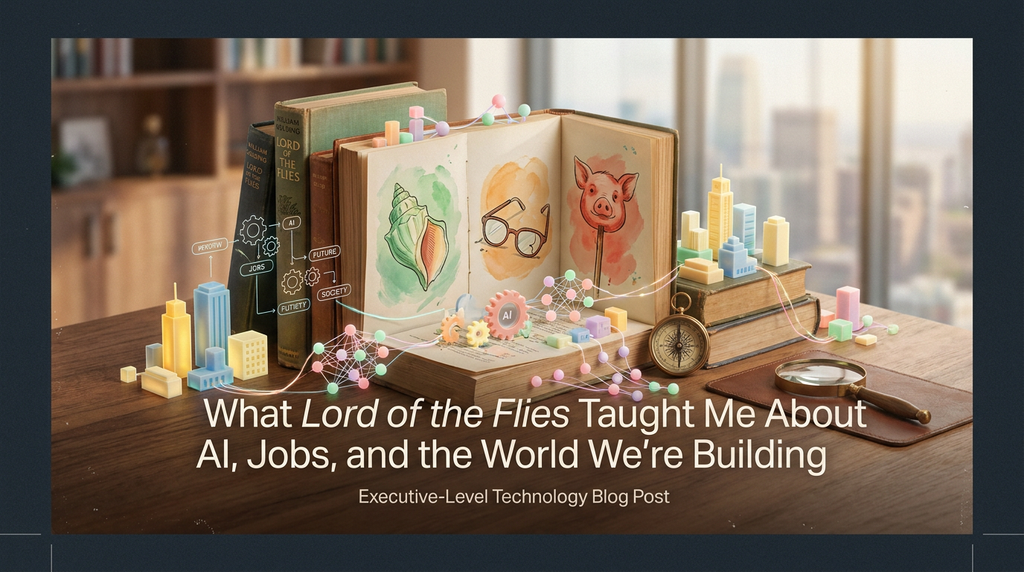
I sat down on a Friday night, opened Netflix, and watched Lord of the Flies. By the time the credits rolled, I realized I hadn't been watching a story about boys on an island at all. I had been watching a mirror one held up to the wars in the headlines, the AI and job-displacement layoffs in my inbox, and the uneasy mood I've been carrying into every executive conversation lately.
I read the book in school decades ago and remembered the conch, the fire, the pig's head on a stick. What I didn't remember was how directly it speaks to what we're living through now. The parallels between Golding's island and our current moment with AI and job displacement are uncomfortably exact.
1. Fear Drives Behavior
In the novel, fear of the "beast" drives the boys to make irrational and destructive decisions. They never see it. They never confirm it. But the fear of it is enough to unravel everything they've built.
Today, fear surrounding how AI and job displacement might manifest is creating the same reactions:
panic,
misinformation,
distrust,
and rushed decision-making.
Just as the boys allowed fear to overpower reason, organizations and societies are overreacting to AI without carefully planning workforce transitions, reskilling, or managing the AI adoption risks. In boardrooms this year, the loudest argument for cutting headcount wasn't a business case; it was the fear of being seen as behind. That's the beast talking.
2. Collapse of Social Structure
The island begins with rules, cooperation, and shared responsibility. There's a conch. There's a vote. There's a plan. Over time, those systems quietly break down — not in one dramatic moment, but in a hundred small concessions.
A similar concern exists with rapid AI workforce transformation:
traditional career paths may disappear,
Organizational structures may shift,
and workers may feel abandoned if leadership focuses only on efficiency and automation.
The lesson is that technology without thoughtful governance can destabilize social systems. The career ladder that a friend of mine climbed for two decades no longer exists at his old employer. Nobody announced its removal. It just stopped being there.
3. Power Concentration
Jack gains power in the story by exploiting fear and offering immediate rewards, such as hunting, protection, and a sense of belonging. He doesn't win because he's right. He wins because he offers certainty in a frightening moment.
In today's world, AI could concentrate power among:
large tech companies,
governments,
or organizations with massive data and computing resources.
The story warns that when power grows without accountability, ethical behavior erodes. This is why ethical AI leadership is so critical; without it, we are seeing a small number of players control the models, the compute, and, increasingly, the rules. Regulators are improvising, and workers are told to "adapt." It is the same pattern, just with bigger spears.
4. Loss of Human Connection
As the boys become more savage, empathy and rational thought disappear. They stop seeing each other as people and start seeing each other as obstacles.
With AI, many fear a future where:
human judgment becomes secondary,
workers are treated as replaceable,
and decisions become purely data-driven.
The novel reminds us that civilization depends on preserving humanity, ethics, and empathy — not just efficiency. I think about the executives I've heard talk about its impact on the AI workforce transformation, and about the way the boys eventually talked about each other: as costs, as variables, as lines on a chart.
5. The "Beast" Is Internal
One of the book's biggest lessons is that the real danger was never an external monster. It was the darkness inside the boys themselves.
Applied to AI: AI itself may not be the true threat. The real risk is how humans choose to use it.
The danger comes from:
greed,
lack of ethical AI leadership,
poor leadership,
misuse of technology,
or ignoring societal consequences.
The Real Lesson for Leaders
For executive and leadership discussions, this is the strongest connection of all:
Technology does not automatically destroy society. Unmanaged human behavior around technology does.
I closed my laptop, and the world outside hadn't changed. The wars were still being fought. Many were still struggling to navigate AI layoffs, as emails were being drafted somewhere. AI models were still training. But I felt clearer about my own work and about what I think every leader's work is right now.
It isn't about outrunning the technology or ignoring AI adoption risks. It's about making sure that as the structures around us shift, we don't become the boys with the spears.