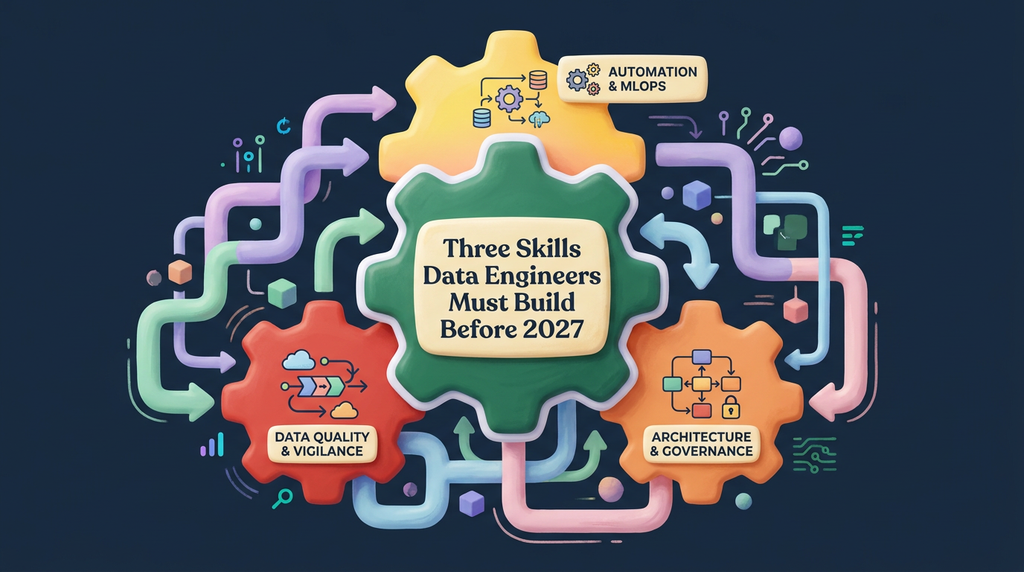
The data engineering role is undergoing its most significant transformation since the shift from on-premise warehouses to cloud-native lakehouses. AI agents in data engineering are no longer experimental curiosities. They are actively writing SQL, validating schemas, and proposing pipeline optimizations. For data engineers, the question is no longer whether agents will reshape the discipline, but who adapts quickly enough to master the modern data engineering skills needed to shape their deployment.
At Acacia Tech Group, we have spent the last year helping enterprise teams rearchitect their data platforms around a concept we call Context Data Products. These are not generic datasets dumped into a catalog. They are structured, semantically rich, and governed data products that carry enough context for both human analysts and autonomous agents to reason effectively. Building them requires a new set of engineering instincts.
For those looking to refine their data engineering skills to stay ahead of this shift, three areas deserve focused attention.
1. Data Contracts as Code
The era of implicit schema agreements is ending. Data contracts as code ensure that when one team changes a column type, and three downstream dashboards break, the problem is addressed before it becomes technical debt. Defining schemas, quality rules, and service-level agreements programmatically is becoming essential because agents can only enforce what engineers articulate clearly.
Tools like dbt for transformation testing, Great Expectations for data quality validation, and OpenLineage for lineage tracking provide the foundation. But the tooling is not the skill. The skill is learning to think in contracts: What does this dataset promise to its consumers? What freshness does it guarantee? Who owns it when something breaks? A Context Data Product demands well-defined contracts that codify freshness, ownership, and quality thresholds. Without that codification, agents have no guardrails, and human engineers spend their days in reactive debugging rather than proactive design.
dbt (data build tool) — A transformation framework that lets data engineers write modular SQL models, test them automatically, and document lineage. Think of it as bringing software engineering discipline (version control, testing, CI/CD) to the analytics warehouse.
Great Expectations — An open-source data validation library. Engineers define "expectations" (e.g., "this column should never be null," "values should be unique") in code, and the tool runs those checks against datasets to catch data quality issues before they reach consumers.
OpenLineage — An open standard for metadata and lineage collection. It tracks how data flows from source to destination across pipelines, giving teams (and agents) a real-time map of dependencies, schema changes, and impact scope when something breaks.
What to practice now
Write a dbt test suite that covers schema, uniqueness, and freshness in a single pull request.
Define an SLA in code (e.g., "this table must be updated within 15 minutes of source change") and monitor it.
Document lineage from source to consumer using OpenLineage or a compatible tool, and expose it to downstream teams.
2. Agentic Thinking
The most valuable data engineering skills in 2027 will not involve writing the most complex SQL. Instead, value will come from knowing which work to hand off and which work to keep. This is agentic thinking: viewing your work as orchestration rather than implementation. Which pipeline steps are deterministic and repetitive? Those are agent candidates. Which require business context, regulatory judgment, or cross-domain negotiation? Those stay human-owned.
As Zach Wilson's widely circulated 2026 Data Engineer Roadmap puts it, the new advantage is not writing complex SQL but knowing what to build and why. That shift in mindset changes how you scope tickets, review pull requests, and design systems. It means you stop optimizing for query elegance and start optimizing for decision boundaries: where does the agent stop and the engineer begin?
In practice, this looks like designing pipelines with explicit hook points for automated validation, building modular transformations that an agent can refactor safely, and maintaining semantic documentation that lets an AI system understand intent, not just syntax.
What to practice now
Audit one existing pipeline and label each step as "agent-safe" or "human-required."
Write a design doc that explicitly defines the boundary between automated and human-reviewed decisions.
Experiment with an AI coding assistant on a non-production transformation, and observe where it succeeds and where it hallucinates assumptions.
3. AI-Ready Data Design
Understanding embeddings, vector stores, and retrieval-augmented generation (RAG) architectures is no longer optional for senior data engineers. AI-ready data design ensures that the pipelines built today will feed AI systems effectively, not just dashboards. Engineers who are not designing Context Data Products, datasets that carry the semantic context agents need to reason, are building for yesterday's consumers.
AI-ready design means more than adding a vector column to a warehouse table. It means asking: Does this dataset include the relationships, metadata, and descriptive context an agent needs to answer a business question accurately? Is the documentation structured enough to ground a large language model? Are the quality signals strong enough for an agent to trust what it retrieves?
This is where Context Data Products become critical. They are engineered to bridge the gap between raw operational data and AI-consumable knowledge. They include semantic annotations, provenance metadata, and quality attestations that both humans and machines can interpret.
What to practice now
Build a small RAG prototype over one internal dataset and identify what context is missing.
Study how embeddings are generated, stored, and queried in a vector database like Pinecone or pgvector.
Redesign one dataset's documentation with AI consumption in mind: structured, explicit, and semantically rich.
The Bigger Picture
These core data engineering skills — contracts as code, agentic thinking, and AI-ready design — are not independent. They reinforce each other. Data contracts as code create the structure that agents can navigate. Agentic thinking defines where human judgment adds value. AI-ready data design ensures the outputs of your pipelines are consumable by the systems that will dominate enterprise analytics within the next two years.
The engineers who invest now will not merely keep their jobs. They will define the standards that their organizations adopt. The ones who wait will find themselves maintaining pipelines designed for a paradigm that no longer exists.
"The shift is not that agents replace engineers. It is that engineers who use agents replace engineers who do not."