For nearly a decade, dbt has been the default answer to a simple question: how do we bring software engineering discipline to SQL transformations? It earned that position. But when evaluating dbt vs. SQLMesh, a new contender has matured enough that serious data teams should evaluate it on its merits. This isn't a verdict that everyone should act on tomorrow. It is an honest look at where SQLMesh is genuinely better, where dbt still wins, and how to think about the decision for your organization.
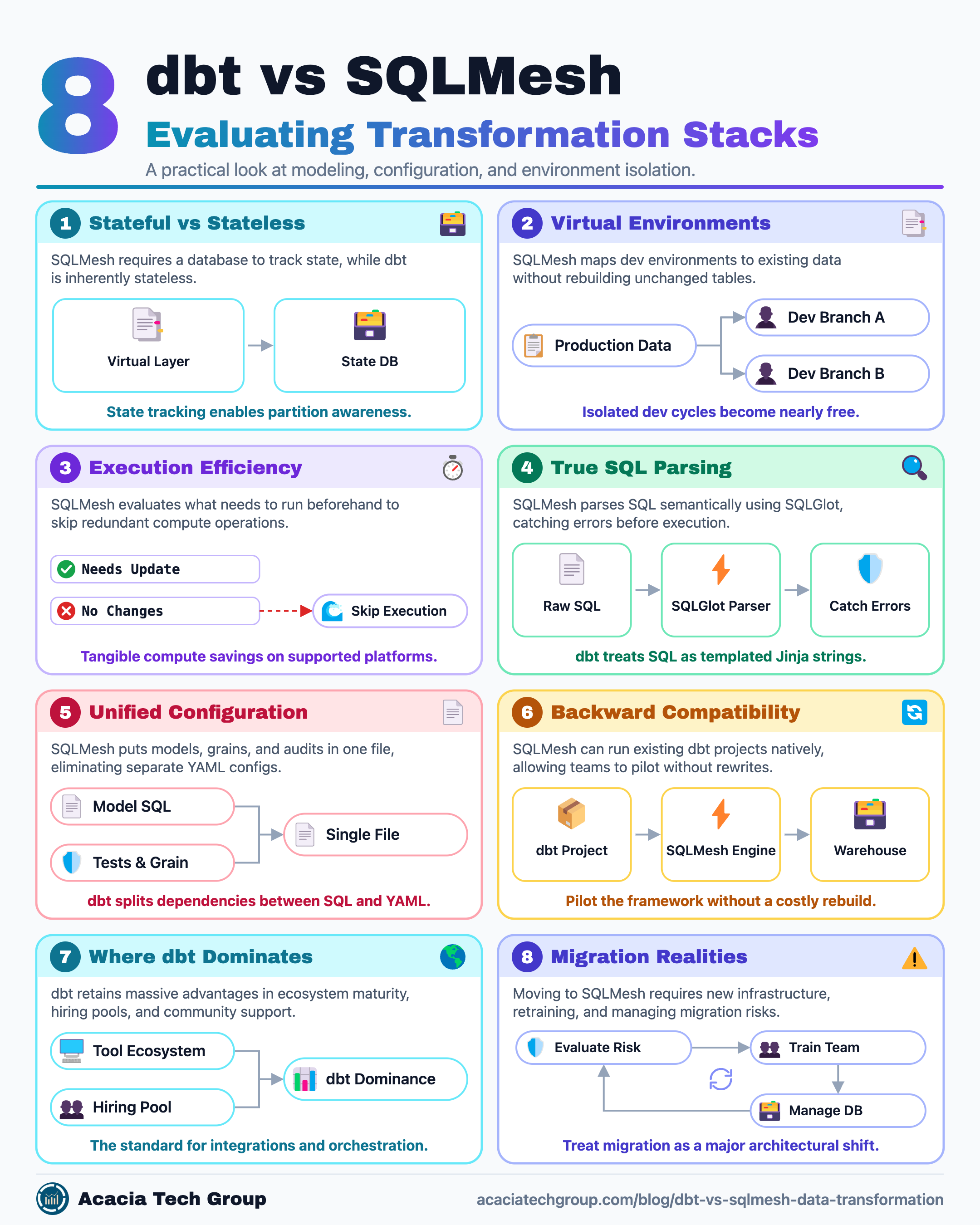
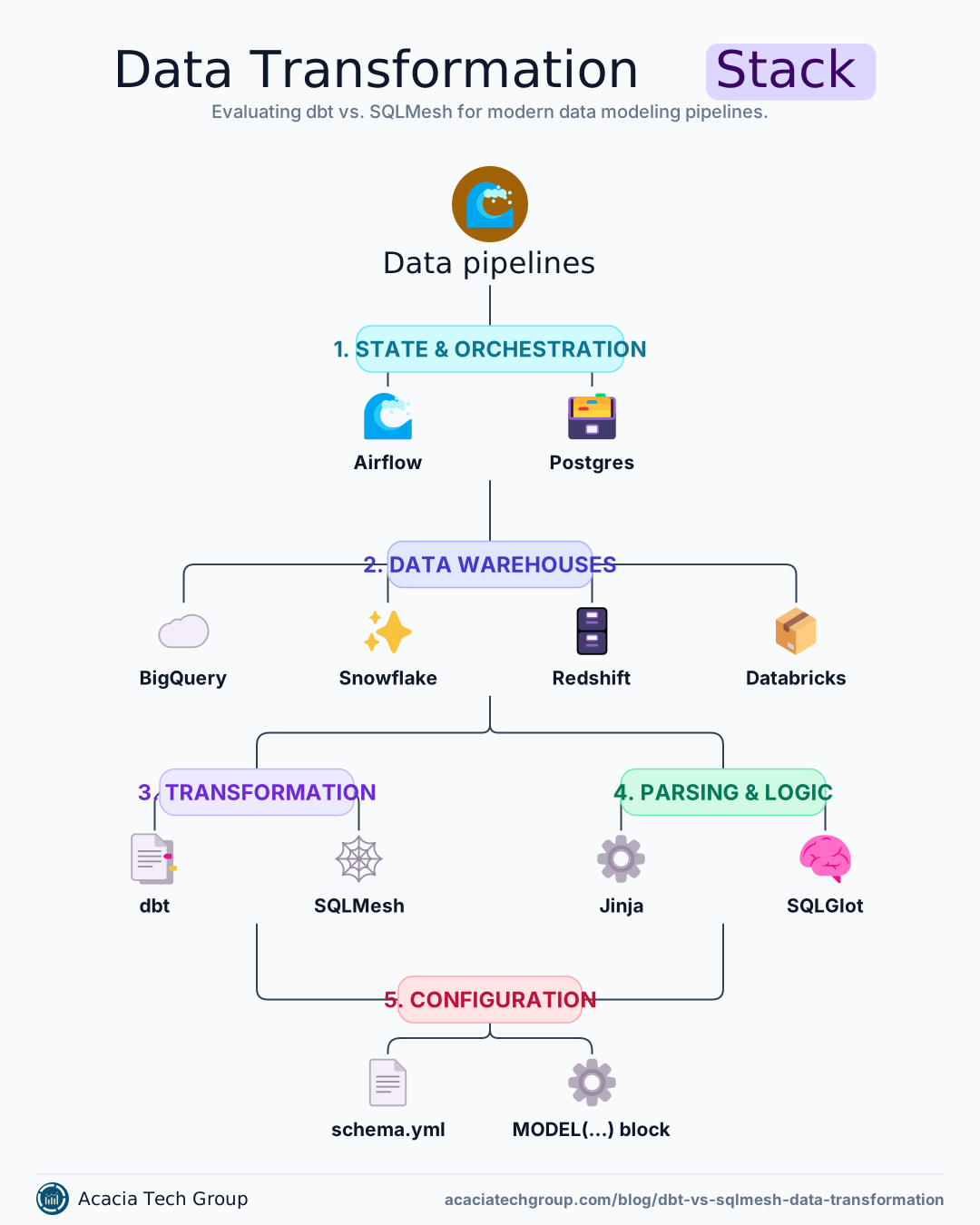
A fundamental, often-overlooked difference is that SQLMesh is stateful while dbt is not. To manage its virtual layer, SQLMesh requires a database (such as Postgres) to track state. This enables native, partition-aware processing but adds a new infrastructure requirement teams must manage.
SQLMesh was contributed to the Linux Foundation in March 2026, ensuring it remains an open-source framework under neutral governance.
At Acacia Tech Group, we advise enterprise and public-sector teams on the architecture decisions that quietly determine cloud spend, delivery speed, and risk for years. Data transformation tools sit at the center of these decisions. Here is how we frame the dbt vs SQLMesh question for leaders who have to live with the outcome.
Why SQLMesh Is Getting Attention
The case for SQLMesh rests on three technical arguments. They do not carry equal weight, and treating them as if they do is how teams talk themselves into migrations they later regret. We will cover them in order of how well they actually hold up.
1. Virtual Environments: The Strongest Argument
This is the most compelling reason to consider SQLMesh, and the pain point it solves is real and well documented in the dbt community. In a typical dbt workflow, spinning up a development environment means rebuilding tables, which is slow and expensive on compute-billed warehouses. The predictable consequences follow: teams share a single, crowded dev environment, developers step on each other's work, and testing gets cut to save time and money.
SQLMesh's virtual environments address this directly. Rather than rebuilding everything, it reuses already-computed tables and materializes only what has genuinely changed, mapping environments to underlying data through a virtual layer. As a result, creating an isolated dev environment becomes nearly instant and nearly free. For organizations where warehouse bills and developer velocity are board-level concerns, this is a tangible, measurable win.
The business translation: faster, cheaper, and safer development cycles. If your dev rebuilds are slow and your warehouse invoice is climbing, this single capability may justify a pilot on its own.
Recent 2026 benchmarks indicate larger teams can see significant savings, with reports of a 70% cost reduction when moving away from certain dbt Cloud tiers. Furthermore, in specific benchmarks, SQLMesh execution can be roughly 9x faster than dbt Core, offering a path to meaningful reductions in warehouse compute spend.
2. Execution Plan Efficiency: Promising but Narrow
In the dbt vs SQLMesh debate, SQLMesh reasons about what needs to happen before it runs, avoiding redundant computation. The most common example is BigQuery partition overwrites, where dbt may reprocess more than necessary and SQLMesh does not. The scenario is concrete, and the savings are real where they apply.
The caution is equally important: this is largely one scenario on one warehouse. Whether the same advantage holds across Snowflake, Redshift, Databricks, or other targets depends on the engine and the workload, and whether dbt's behavior is a fundamental design limitation or a fixable implementation detail remains unsettled. Treat this as a reason to benchmark on your own platform, not as a general law of efficiency.
3. Real SQL Understanding: Accurate but Often Overstated
SQLMesh parses and understands SQL through SQLGlot, while dbt primarily treats SQL as templated strings via Jinja. In principle, this means SQLMesh can catch certain classes of errors, such as referencing a non-existent column, before anything runs against the warehouse. The technical distinction is real and meaningful.
It is also frequently overstated. dbt provides pre-execution checks through dbt compile and has steadily improved its own static analysis. The argument for SQLMesh here is valid, but the day-to-day gap is narrower than advocacy posts suggest. The honest version of the dbt vs SQLMesh comparison is: SQLMesh gives you stronger guarantees by default, and dbt requires more discipline to reach a comparable place.
A Concrete Example: The Same Model in Both Tools
The architectural differences are easier to grasp with code. Here is the same customers model written in dbt and then in SQLMesh.
dbt
Dependencies are declared with Jinja functions (ref and source), and tests, grain, and documentation live in a separate schema.yml file.
models/customers.sql
select
  c.customer_id,
  c.customer_name,
  count(o.order_id) as order_count
from {{ source('raw', 'customers') }} as c
left join {{ ref('orders') }} as o
  on o.customer_id = c.customer_id
group by 1, 2
models/schema.yml
models:
  - name: customers
    columns:
      - name: customer_id
        tests:
          - unique
          - not_null
SQLMesh
Dependencies are plain SQL table references; SQLMesh parses the query to build the DAG automatically. Model name, kind, grain, and audits are declared in one MODEL(...) block at the top of the same file, with no separate YAML.
models/customers.sql
MODEL (
  name analytics.customers,
  kind FULL,
  grain customer_id,
  audits (unique_values(columns = customer_id), not_null(columns = customer_id))
);

select
  c.customer_id,
  c.customer_name,
  count(o.order_id) as order_count
from raw.customers as c
left join analytics.orders as o
  on o.customer_id = c.customer_id
group by 1, 2
The contrast captures the broader theme: dbt leans on Jinja templating and external configuration files, whereas SQLMesh understands the SQL itself and keeps configuration co-located with the model. SQLMesh is also backward compatible with existing dbt projects, letting teams pilot the tool without a total rewrite.
Whichever transformation tool you choose, the modeling methodology underneath drives long-term maintainability. If you are weighing approaches for historized, enterprise-scale warehouses, see our deep dive on Data Vault 2.0.
Where dbt Still Wins
Any balanced evaluation of data transformation tools has to take dbt's strengths seriously, because they determine whether a tool succeeds in a real organization.
Ecosystem maturity. Years of compounding investment have produced a deep package ecosystem, the dbt-core/dbt-cloud split, integrations with observability tools like Monte Carlo and Great Expectations, and BI partnerships. SQLMesh cannot close that gap quickly.
Hiring and skills. The pool of engineers who already know dbt is large. Adopting SQLMesh means training, and training costs time and money.
Community and documentation. When something breaks at 2 a.m., the odds that someone has already solved your dbt problem in public are very high.
Accumulated trust. dbt is a known quantity to auditors, vendors, and leadership. That counts for more than feature comparisons admit.
Despite the rise of alternatives, dbt maintains a dominant footprint. Following the June 1, 2026 merger with Fivetran, dbt has introduced a Rust-based engine to improve performance. Furthermore, a 2026 survey found that 44% of Airflow users pair their orchestration with dbt, underscoring the deep integration that remains dbt's primary advantage.
What the Hype Tends to Skip
The most one-sided dbt vs SQLMesh write-ups gloss over four factors that often dominate the real decision.
Migration cost and risk. "Migration is real work" is an understatement for teams already running dbt in production. Rewriting macros, replacing packages, retraining people, and re-validating outputs across a 200-model project is a serious engineering undertaking with genuine risk. This calculus, not the feature list, is usually what determines whether a switch makes sense.
SQLMesh's own rough edges. Every production system has them. The plan-and-apply workflow SQLMesh borrows from infrastructure tools is powerful, but it adds coordination overhead in large teams. New does not mean frictionless.
The scale assumption. Much of the case against dbt assumes large projects, long runtimes, and expensive warehouse bills. For smaller teams and simpler pipelines, many of those pain points never materialize, and dbt may remain the right choice. Don't let a post written for teams at the scaling ceiling make you anxious about a setup that works fine.
Organizational factors. Tool decisions are rarely purely technical. Procurement, vendor relationships, existing cloud commitments, and team skill sets frequently matter as much as feature parity. The best technical choice isn't the best choice if the organization can't adopt it.
A critical shift in the vendor landscape occurred on October 14, 2025, when Fivetran acquired Tobiko Data (the creators of SQLMesh), followed by a completed merger with dbt Labs on June 1, 2026. This consolidation means a single entity now controls both major SQL transformation frameworks, a significant factor for long-term architectural planning.
How to Decide
The practical takeaway in the dbt vs SQLMesh discussion is straightforward. SQLMesh has reached the point where it is worth serious evaluation, especially in two situations:
You are building a new data platform. With no migration cost, the virtual environment and efficiency advantages are close to free upside. Pilot it.
You are feeling specific, named pain. Expensive, slow dev environments; painful incremental models; and breakage discovered too late are exactly the problems SQLMesh was built to solve. If those are your problems, evaluate it seriously.
Real-World Example: Avios successfully executed a migration to SQLMesh to overcome centralized bottlenecks. By moving to domain-based ownership and SQLMesh processing patterns, the organization decommissioned legacy systems and scaled its data value across the business.
If you are already invested in a healthy, working dbt deployment, the bar is higher. The right move is almost always a contained pilot on a real workload, measured against your own warehouse and your own bills, rather than a wholesale switch driven by a compelling narrative. Read the strongest SQLMesh arguments as a reason to test, not a mandate to migrate.
dbt was good, and for many teams it still is. In important ways, SQLMesh is an architectural step forward. The leadership skill is knowing which of those statements matters most for your team, your scale, and your risk tolerance right now.
Further reading
dbt to SQLMesh Migration: Complete Transition Guide — A detailed look at how code, tests, and incremental models translate between the two philosophies.
dbt vs SQLMesh: Modern Data Team Comparison — Analysis of performance, features, and how orchestration platforms integrate with both tools.
SQLMesh vs dbt 2026 — A perspective on where the line falls for teams choosing between ecosystem stability and operational safety.
Top DBT Alternatives & Competitors in 2026 — Evaluates the transformation landscape following major market consolidation.