Most AI agents fail for the same reason a Swiss Army knife makes a terrible chef's knife: they're built to do everything, so they do nothing reliably.
Walk into most stalled AI initiatives, and you'll find the same design. A single, sprawling agent is asked to extract data from a document, reason about it, call three external tools, hold a conversation with a user, and write the result back to a system of record — all inside one prompt, one context window, one tangled control flow.
It demos beautifully. Then it meets production AI environments.
Under real load — messy inputs, edge cases, concurrent users, tools that time out — the monolith becomes fragile. One weak link poisons the whole chain. You can't debug it, because everything is entangled. You can't scale it, because every capability shares the same bottleneck. And you can't improve one part without risking all the others.
The fix isn't a smarter mega-prompt. It's a robust AI architecture.
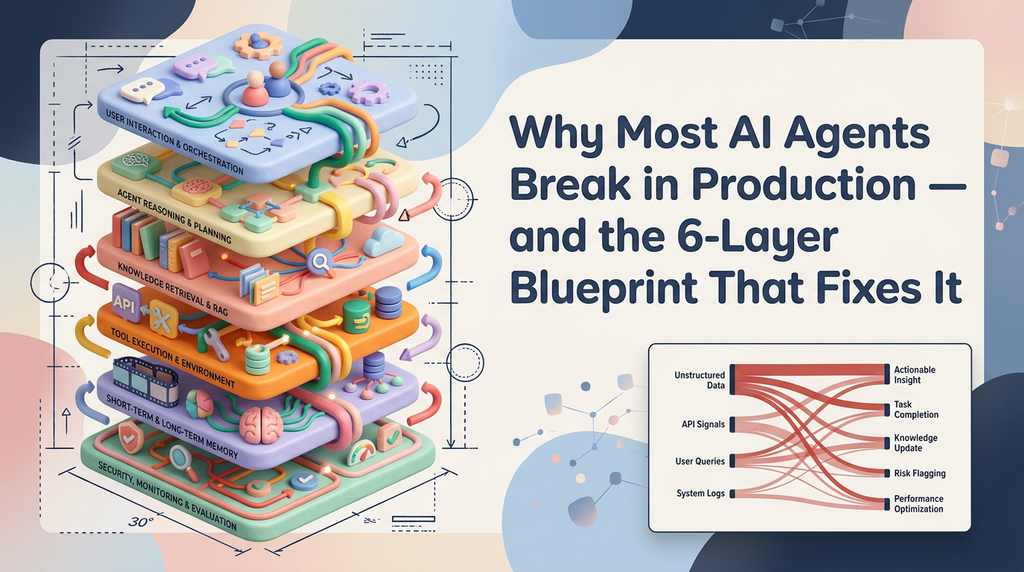
The teams shipping durable AI have stopped chasing "one AI to rule them all" and started building agentic workflows: a coordinated team of specialized AI agents, each with one clear job, sitting on top of a properly layered platform. Think less lone genius, more well-run operation with clean handoffs.
Here's the blueprint — built the way the data actually flows, from the ground up.
Layer 1 — LLMs and Models: the reasoning engines
At the foundation sit the models. These are the reasoning engines that power everything above them: extraction, classification, language understanding, and decision logic.
The key mental shift is to treat models as interchangeable components rather than the product. Different jobs want different engines — a fast, cheap model for classification; a stronger model for multi-step reasoning; a specialized model for extraction. When models are a foundational layer rather than the center of your AI architecture, you can swap, upgrade, or mix them without rewriting the business logic on top.
Layer 2 — Data Layer: the source of truth
Models reason, but they can't invent facts about your business. The data layer supplies the raw material: CRMs, transactional databases, historical quotes, application logs, and the operational systems that run the company.
This is the layer most AI agents projects underinvest in — and it's why they hallucinate. An agent is only as trustworthy as the data beneath it. If your quotes, records, and history aren't accessible, clean, and up to date, no amount of upstream prompt engineering will save you. Everything above depends on this layer being solid.
Layer 3 — Context Layer: from raw data to grounded knowledge
Raw data isn't yet usable context. The context layer is where vector stores and knowledge graphs turn scattered records into structured, searchable, and connected entities.
Vector databases make unstructured content — documents, notes, past conversations — semantically retrievable, so AI agents can find what's relevant rather than what matches a keyword.
Knowledge graphs capture the relationships between entities — this customer, that contract, those policies — so agents understand how facts connect, not just that they exist.
Together, this layer gives your agents three things a bare model lacks: memory, grounding, and factual awareness. It's the difference between an agent that guesses and one that knows.
Layer 4 — Orchestration Layer: the coordination hub
If specialized AI agents are the team, the orchestration layer is the operations manager. Frameworks like LangChain and LlamaIndex make the runtime decisions that keep the whole system coherent:
Which agent should handle this request?
What context does it need pulled from the layers below?
Which tools does it get to call, and in what order?
How do results flow back and hand off to the next step?
This is where agentic workflows actually become coordinated. Two decision paths run through it constantly: choosing the right tool for the job, and retrieving the right data for the moment. Get this layer right, and the system runs smoothly under pressure; get it wrong, and you're back to chaos, just distributed across more moving parts.
Layer 5 — App Layer: where people meet the workflow
At the top is the interface — the surface where users actually engage. They ask questions, submit tasks, upload documents, or trigger a workflow, and receive agent-generated results.
The critical design principle here is that complexity stays hidden. A user submitting a request shouldn't know (or care) that six agents, two databases, a vector store, and a knowledge graph just collaborated to answer them. Clean interface on top, sophisticated machinery underneath.
Layer 6 — Specialized Agents: the team of experts
This is where the philosophy pays off. Instead of one overloaded generalist, you deploy a roster of focused agents, each owning a single, well-defined responsibility. In an insurance workflow, that might look like:
Agent | Job |
|---|---|
Quoting Agent | Generate accurate insurance quotes |
Negotiation Agent | Handle back-and-forth on terms |
Contract Execution Agent | Draft and finalize documents |
Policy Issuance Agent | Issue the policy |
Customer Service Agent | Answer questions and support users |
Claims Agent | Submit and process claims |
CRM Agent | Write results back to the system of record |
Each component of these agentic workflows is modular, autonomous, and replaceable. Because responsibilities are cleanly separated, you can test one agent in isolation, upgrade its model, tighten its prompt, or swap it out entirely — without touching the rest of the system.
Why this architecture wins
The value isn't philosophical — it's operational. Splitting work across a layered platform and a team of specialized agents delivers exactly what monolithic automation can't:
Scalable — bottlenecks live in individual agents you can scale independently, not in one shared choke point.
Controllable — clear boundaries mean you can observe, debug, and govern each step. When something breaks, you know where.
Reliable — one agent failing degrades one capability, not the entire system. No single point of collapse.
Evolvable — models, tools, and agents are components you can replace as the technology moves, without a rewrite.
Monolithic AI agents optimize for the demo. Layered agentic workflows optimize for what actually matters: production AI running at scale for years.
The question worth asking about your own AI initiative isn't "how smart is our agent?" It's "is our agent a Swiss Army knife — or a coordinated team standing on a solid AI architecture?" The answer usually predicts whether it will survive contact with the real world.
At Acacia Tech Group, we help enterprises design and build agentic workflows on data platforms engineered for production AI — not just demos. If you're moving from AI experiments to systems you can actually depend on, let's talk.