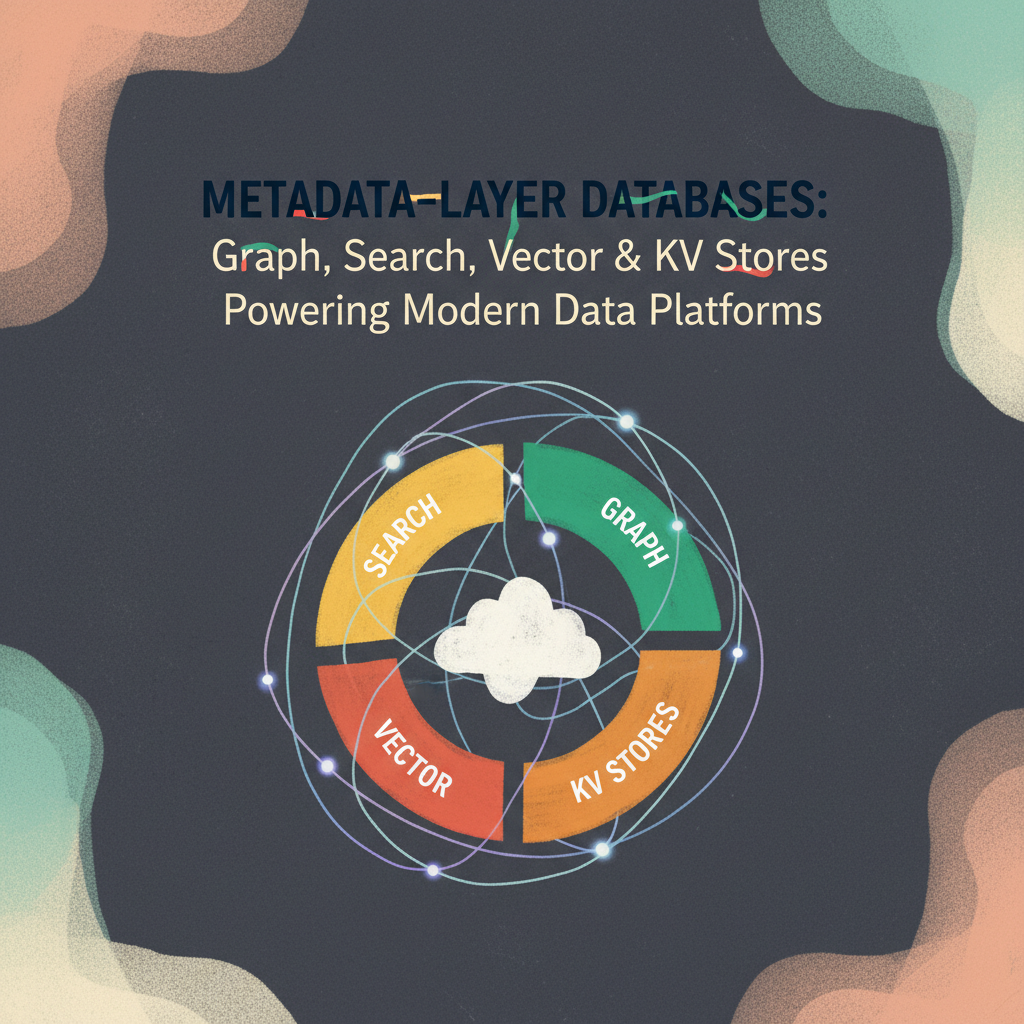
A practical, skimmable guide to the specialized metadata databases that power modern lineage, search, and AI platforms.
⚡ Quick Picks: Which database fits your goal?
- Map data lineage & relationships → Graph DB (Neo4j, JanusGraph)
- Define a shared business vocabulary → Knowledge Graph (on Neo4j or RDF stores)
- Power semantic search or AI retrieval (RAG) → Vector DB (Qdrant, Pinecone, Weaviate)
- Enable fast keyword/faceted discovery in a catalog → Document/Search DB (Elasticsearch, OpenSearch)
- Track metadata changes & audit history over time → Time-Series DB (InfluxDB, TimescaleDB)
- Capture high-volume metadata events from pipelines → Wide-column DB (Cassandra, ScyllaDB)
- Consolidate several metadata shapes in one store → Multi-model DB (ArangoDB)
- Build GenAI experiences with grounded answers → Knowledge Graph + Vector DB (GraphRAG)
Why metadata needs specialized databases
Metadata is no longer just a sidecar to your data warehouse. It powers lineage, governance, discovery, semantic search, and AI retrieval. Each of those workloads has a different access pattern, and no single database does them all well. In a robust data catalog architecture, platforms often use a combination of metadata databases to handle these diverse requirements effectively.
This post walks through the most useful database types for metadata platforms, with a short "When to use" recommendation after each one.
Quick comparison
| Database type | Think of it as | Business question it answers | Examples |
|---|---|---|---|
| Graph DB | A map of connections | How is everything related? | Neo4j, JanusGraph |
| Knowledge Graph | A business dictionary with meaning | What does this term mean, and where is it used? | Built on Neo4j, RDF stores |
| Vector DB | A similarity engine | What else looks like this? | Qdrant, Pinecone, Weaviate |
| Time-Series DB | A timeline recorder | What changed, and when? | InfluxDB, TimescaleDB |
| Document/Search DB | A smart filing cabinet | Where is the thing I'm looking for? | Elasticsearch, OpenSearch |
| Multi-model DB | A Swiss Army knife | Can one store handle several shapes of metadata? | ArangoDB |
| Wide-column DB | A high-speed event log | Can we capture millions of metadata events per second? | Cassandra, ScyllaDB |
Graph databases: Neo4j & JanusGraph
Graph-based metadata databases store nodes (datasets, columns, jobs, people) and the relationships between them as first-class citizens. This makes them ideal data lineage tools where multi-hop questions — "which dashboards depend on this column?" — are fast and natural to ask.
- Neo4j is the mature default with Cypher query language and a strong ecosystem.
- JanusGraph scales horizontally on top of Cassandra/HBase for very large graphs.
When to use: column-level lineage, impact analysis, access-path traversal, and any "follow the relationships" question across your data estate.
Knowledge graphs
A knowledge graph is a modeling discipline built on top of a graph DB (or RDF store). It adds business semantics: a "Customer" isn't just a node — it's defined, owned, and linked to policies, glossary terms, and source systems.
When to use: business glossaries, governed taxonomies, regulatory traceability, and giving non-technical users a shared vocabulary across domains.
Multi-model: ArangoDB
ArangoDB stores documents, graphs, and key-value pairs in one engine with a single query language (AQL). Useful when your metadata is heterogeneous and you don't want to operate three different databases in your data catalog architecture.
When to use: small-to-mid platforms that need graph traversal and flexible document storage without the overhead of separate systems.
Search: Elasticsearch & OpenSearch
Inverted indexes make these the gold standard for keyword discovery, faceted filtering, and ranked search across catalogs of datasets, columns, and documentation. They function as a high-performance semantic search database for structured metadata.
When to use: data catalog search bars, "find me all tables tagged PII," log/audit exploration, and anywhere users type a query and expect ranked results.
Vector: Qdrant (and friends)
Vector databases store embeddings — numerical representations of meaning — and find items that are semantically similar, not just textually similar. They are the retrieval engine behind most RAG and AI assistant features.
When to use: semantic search ("find datasets like this one"), AI copilots over your catalog, recommendation, and deduplication of near-duplicate assets.
Time-series: InfluxDB, TimescaleDB
Optimized for append-heavy, timestamp-indexed data. In a metadata context, they shine at tracking change over time.
When to use: data quality metrics, freshness/SLA monitoring, pipeline run history, and any "trend over time" view in your observability stack.
Wide-column: Apache Cassandra
Built for massive write throughput and linear horizontal scale. Not for traversal — for capture.
When to use: ingesting high-volume lineage events, audit logs, and access traces that later get rolled up into a graph or search index.Putting it together: a typical metadata stack
- Capture events with Cassandra or Kafka.
- Model relationships with data lineage tools like Neo4j (lineage + knowledge graph).
- Index for discovery in Elasticsearch/OpenSearch.
- Embed for AI in Qdrant for semantic search and RAG.
- Track health in a time-series DB for SLAs and quality trends.
This is the pattern behind modern catalogs like DataHub, OpenMetadata, and Atlan — and it's a sensible blueprint whether you buy or build using specialized metadata databases.
GraphRAG: where graphs and vectors meet
The most interesting recent pattern, GraphRAG, combines a knowledge graph (for structure and truth) with a vector DB (for semantic recall). The graph keeps the AI grounded in real relationships; the vectors let it find the right starting points. Together they produce answers that are both relevant and explainable.
How to choose
- Start with the question your users keep asking, then pick the database shape that answers it cheaply.
- Resist the urge to standardize on one engine — metadata workloads genuinely differ.
- Plan for two or three specialized stores behind a unified API, not a single monolith.
Pick the right tool for each job, wire them together cleanly, and your metadata layer becomes the backbone of governance, discovery, and AI — not another silo to maintain.