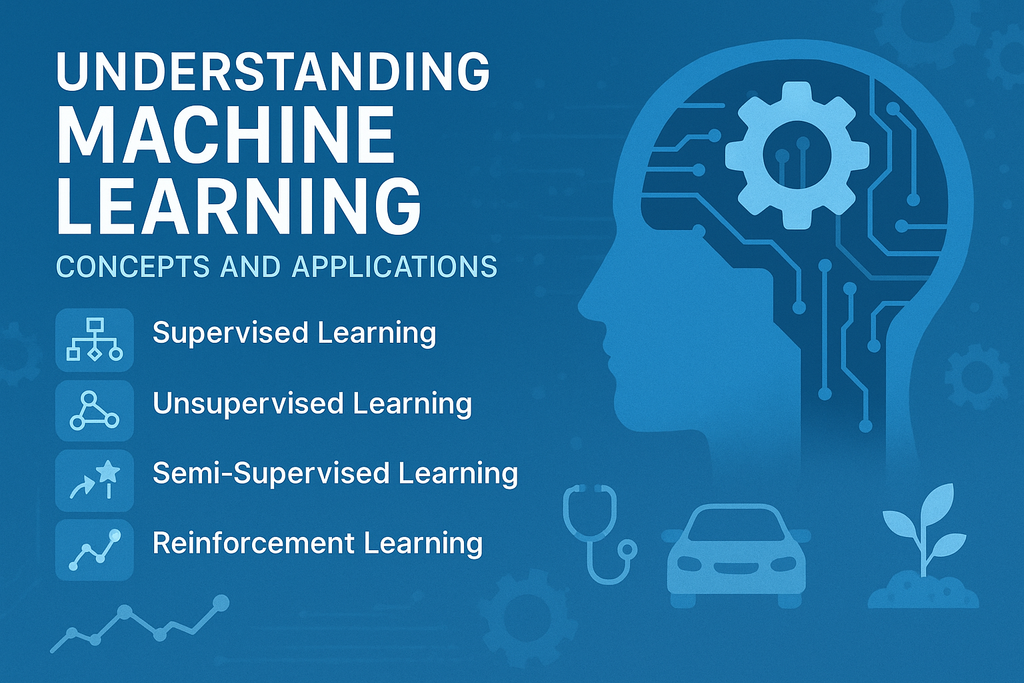
Machine learning (ML) is a subset of artificial intelligence (AI) that allows systems to improve performance through experience rather than explicit programming. By analyzing data, machine learning algorithms identify patterns and make decisions with minimal human intervention. This article explores fundamental machine learning concepts and their diverse real-world applications.
Key Concepts in Machine Learning
1. Supervised Learning
Supervised learning involves training a model on a labeled dataset—each training example is paired with an output label. The model learns to anticipate the output based on the input data. Common algorithms include linear regression, logistic regression, and support vector machines. Applications include spam detection, image recognition, and credit scoring.
2. Unsupervised Learning
In unsupervised learning, the model is trained on data without labeled responses. The system identifies patterns and structures independently. Primary techniques include clustering and association. Applications range from customer segmentation to anomaly detection.
3. Semi-Supervised Learning
Semi-supervised learning lies between supervised and unsupervised approaches. It uses a small amount of labeled data combined with a large pool of unlabeled data for training. This method is valuable when labeling data is expensive or time-consuming—common in medical imaging and speech recognition.
4. Reinforcement Learning
Reinforcement learning (RL) is based on agents learning to make choices by performing actions in an environment to maximize cumulative rewards. It’s widely used in robotics, gameplay, and autonomous vehicles. RL systems learn optimal strategies through trial and error, improving over time based on feedback.
Applications of Machine Learning
1. Healthcare
Machine learning is transforming healthcare by improving diagnostics, predicting disease outbreaks, and personalizing treatment plans. ML algorithms can analyze medical images to detect conditions such as cancer early, while predictive analytics can identify potential outbreaks based on data trends.
2. Finance
In finance, machine learning enhances fraud detection, risk management, and algorithmic trading. ML models analyze transaction patterns to detect fraudulent activity in real time, while risk models assess credit scores and loan applications with greater accuracy.
3. Marketing
Machine learning personalizes marketing strategies by analyzing customer behavior and preferences. Recommendation systems—like those used by Amazon and Netflix—suggest products or content based on user history. Predictive analytics also helps target the right audience with personalized ads and optimized campaigns.
4. Autonomous Vehicles
Self-driving cars rely heavily on machine learning to perceive their environment, make real-time decisions, and navigate safely. ML algorithms process sensor and camera data to detect objects, predict movements, and avoid collisions. Companies such as Tesla and Waymo are pioneers in developing these autonomous technologies.
5. Natural Language Processing (NLP)
NLP enables machines to understand and respond to human language. Applications include chatbots, language translation, and sentiment analysis. Voice assistants like Siri and Alexa leverage NLP to interpret and execute user commands effectively.
6. Agriculture
Machine learning optimizes agricultural practices by analyzing data from satellites, sensors, and climate sources. Predictive models assist in crop yield estimation, disease detection, and precision farming, leading to efficient resource use and higher productivity.
Conclusion
Machine learning is reshaping industries by automating complex tasks, improving decision-making, and enabling new opportunities. Its applications span healthcare, finance, marketing, autonomous systems, and beyond. By understanding these core principles and applying them thoughtfully, organizations can drive innovation, enhance efficiency, and unlock competitive advantages through data-driven intelligence.