Part 4: Choosing the Right Model and Agent
This series has built the picture up piece by piece. In Part 1: What Is an AI Model? we defined what an AI model actually is. In Part 2: What Is an AI Agent? we saw how an AI agent turns a model's intelligence into action by connecting it to tools. In Part 3: Understanding AI Model Configurations, we looked at model configurations—size, quantization, context, and specialization.
Now we can put everything together. Developing a robust enterprise AI architecture is not about finding the largest model and using it for everything.
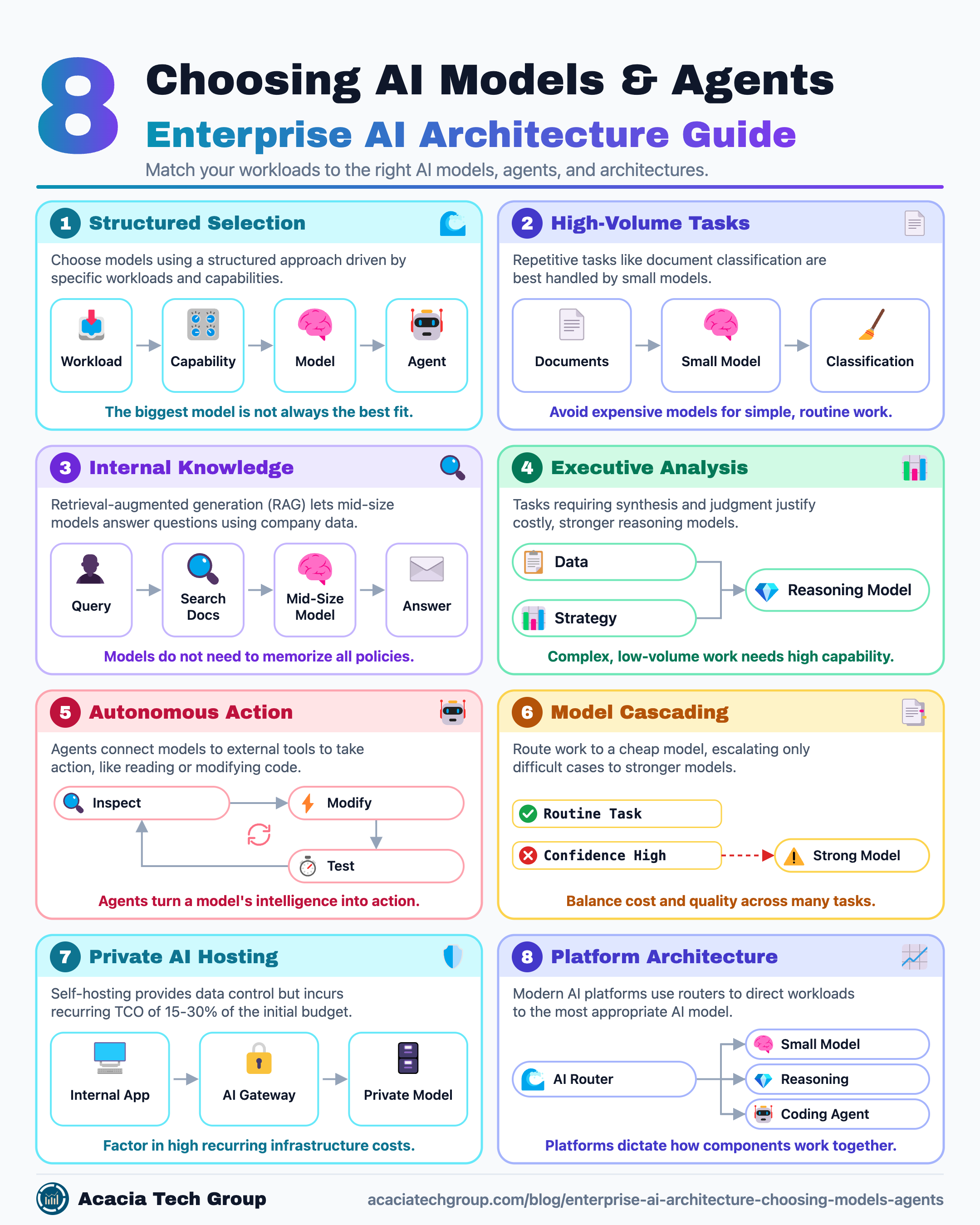
Instead, choosing an AI model should follow a structured approach:
Understand workload
      ↓
Determine capability required
      ↓
Select model
      ↓
Decide whether tools are needed
      ↓
Add agent if necessary
      ↓
Measure results
Let's look at a few practical scenarios.
Scenario 1: Classifying Documents
Suppose an organization receives millions of documents.
The goal is to classify each document as:
Invoice
Claim
Referral
Contract
Other
This task is:
repetitive
high volume
relatively straightforward
A smaller model may be a good fit.
Document
   ↓
Small model
   ↓
Classification
There is probably little reason to use the most expensive reasoning model.
Scenario 2: Internal Knowledge Assistant
Now imagine employees asking questions such as:
What is our travel reimbursement policy?
The system could use:
Employee question
      ↓
Search company documents
      ↓
Retrieve relevant section
      ↓
Mid-size instruct model
      ↓
Answer
This is commonly called retrieval-augmented generation, or RAG.
The model does not need to memorize all company policies.
Instead, the system retrieves the relevant information and gives it to the model.
Scenario 3: Executive Analysis
Consider:
Review our financial performance, technology investments, operating risks, and growth strategy and provide three possible strategic scenarios.
This is very different.
The request requires:
synthesis
reasoning
comparison
judgment
scenario development
A stronger reasoning model is more appropriate.
The number of requests may also be relatively small so that the additional model cost may be justified.
Scenario 4: Coding Assistant
A developer asks:
Why are these tests failing?
A coding model can help explain the problem.
But an agent can go further:
Read repository
     ↓
Run tests
     ↓
Inspect failures
     ↓
Modify code
     ↓
Run tests again
This is where an AI agent architecture becomes valuable.
The important design decision is not simply:
Which coding model?
It becomes:
Which combination of model, agent framework, tools, and environment gives us the best results?
Scenario 5: Processing Millions of Transactions
Imagine an organization needs AI to review millions of transactions for anomalies.
Using an expensive model for every transaction could become prohibitively expensive.
A better architecture might be:
Transaction
     ↓
Small model
     ↓
High confidence?
  /           \
Yes            No
 ↓              ↓
finish       stronger model
                  ↓
             human review
This is sometimes called model cascading.
The inexpensive model handles routine work.
The expensive model handles difficult cases.
Scenario 6: Sensitive Enterprise Data
Some organizations may not want to send certain information to a public AI provider.
They may decide to run an open model within their own environment.
For example:
Internal application
       ↓
Private AI gateway
       ↓
Self-hosted Qwen
       ↓
Company infrastructure
This provides more control over:
data location
security
logging
model versions
infrastructure
But the organization must now operate the model infrastructure itself.
A common pitfall in private hosting is underestimating total cost of ownership (TCO). While it avoids public API fees, annual operating costs for enterprise AI infrastructure in 2026 are estimated at 15–30% of the initial implementation budget. High-volume inference or the need for dedicated GPU capacity can push these recurring costs substantially higher than initially planned.
Scenario 7: Autonomous Technical Agent
This brings us back to benchmark environments such as Terminal-Bench.
Imagine giving an AI system a technical assignment:
Analyze these files, fix the application, run the tests, and produce the required output.
The architecture might be:
Task
 ↓
Qwen model
 ↓
mini-swe-agent
 ↓
Sandbox computer
 ↓
Files / Terminal / Tools
 ↓
Verifier
 ↓
Pass or Fail
The model wasn't built specifically for that task.
Instead, the benchmark is testing whether a general-purpose model can use its existing capabilities to solve an unfamiliar problem.
That's similar to giving a capable engineer a new assignment and seeing whether they can figure it out.
A practical instance of this architecture is found at Salesforce, which developed an internal AI agent that analyzed over 100,000 architecture documents. This system was designed to identify compliance gaps and automate pre-reviews of designs, ensuring new technical assignments aligned with internal standards before human review.
The Bigger Picture
One of the most important changes happening in modern enterprise AI architecture is that organizations are moving away from the idea of having:
ONE MODEL
FOR EVERYTHING
The future is more likely to look like:
                    AI Platform
                        ↓
                  Model Router
                        ↓
       ┌────────────────┼────────────────┐
       ↓                ↓                ↓
 Small model     Reasoning model    Coding model
       ↓                ↓                ↓
 High volume     Complex problems    Software work
And some workloads may use:
Vision model
Embedding model
Speech model
Local private model
The AI platform decides which model is appropriate.
Models Are Components, Not Complete Solutions
A model is only one component of an AI system.
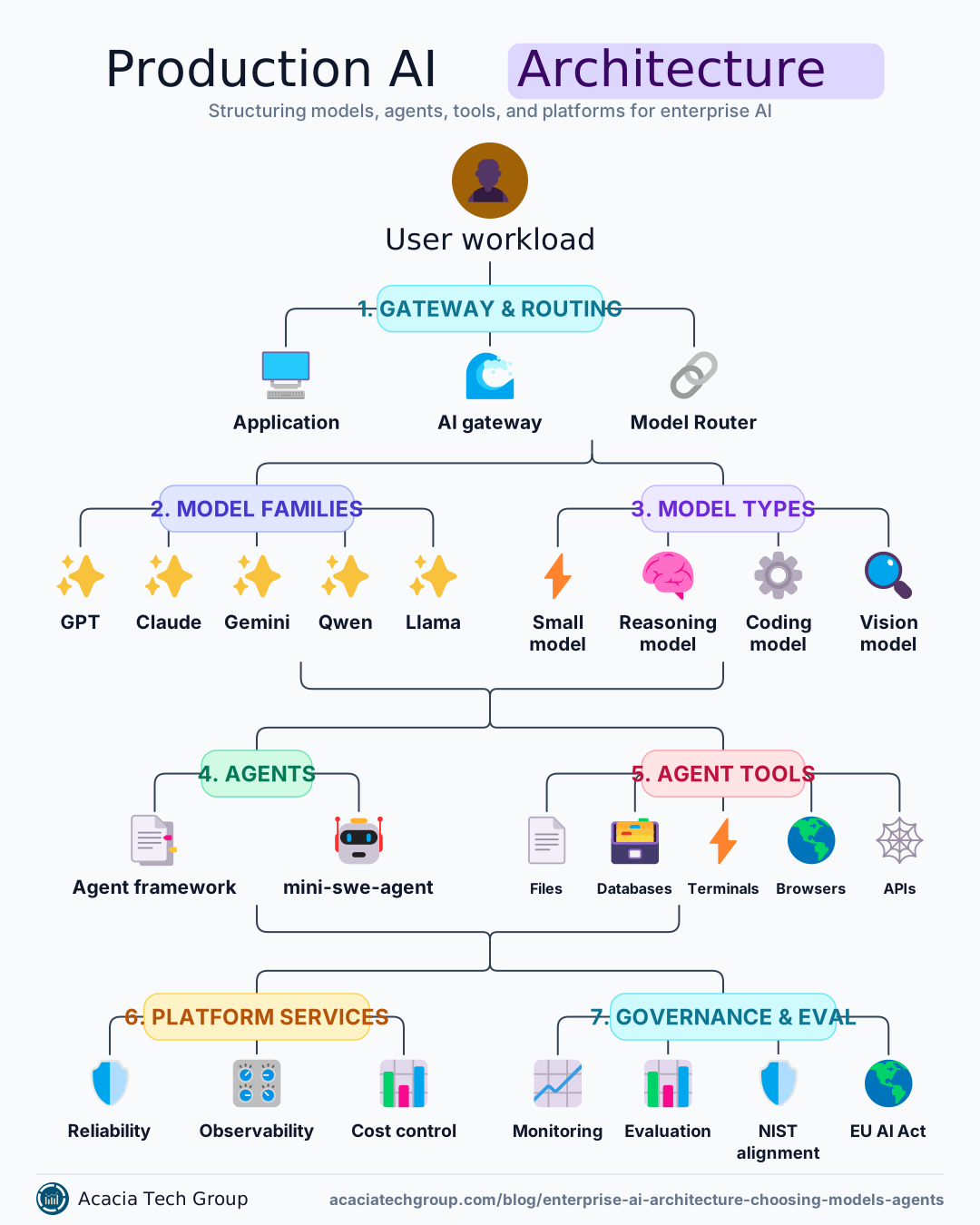
A production AI solution may contain:
User
 ↓
Application
 ↓
AI gateway
 ↓
Model
 ↓
Agent
 ↓
Tools
 ↓
Enterprise systems
 ↓
Monitoring
 ↓
Evaluation
 ↓
Governance
The model provides intelligence.
The agent provides action.
The surrounding platform provides:
security
reliability
governance
observability
cost control
integration
Governance costs are a significant factor in the TCO of these systems. As of 2026, expert CFO benchmarks indicate that AI governance expenses can range from $15,000 for basic NIST alignment to $2.5 million for full EU AI Act compliance, particularly as only 26% of firms currently keep pace with regulatory requirements.
That is why evaluating only the model does not tell the whole story.
The quality of the complete AI system depends on how all of these pieces work together.
Final Takeaway
If you are beginning to explore models and agents, remember these four ideas:
A model is the intelligence. GPT, Claude, Gemini, Qwen, and Llama are examples of model families.
Different model configurations serve different purposes. Model size, architecture, quantization, context, and specialization affect capability, cost, and deployment requirements.
An agent allows the model to take action. Agents connect models to tools such as files, databases, terminals, browsers, and APIs.
The best AI architecture rarely depends on one model. Different workloads may need different models and different levels of autonomy.
The practical question is no longer simply:
Which AI model is best?
A better question is:
Which model, agent, tools, and deployment approach are best suited to the work I am trying to accomplish?
That is the foundation for understanding modern AI platforms.
Frequently Asked Questions
Should I always use the biggest AI model available?
No. Match the model to the workload. High-volume, straightforward tasks like document classification often work well with smaller, cheaper models, while complex synthesis and reasoning justify a stronger model. Using the largest model for everything raises cost without improving results.
What is model cascading?
Model cascading routes work through an inexpensive model first and escalates only the difficult, low-confidence cases to a stronger model or human review. It keeps routine processing cheap while preserving quality on the hard cases.
When do I need an agent instead of just a model?
You need an agent when the task requires action, not just an answer — reading files, running tests, calling APIs, or modifying code. A model provides intelligence; an agent connects that intelligence to tools so it can complete multi-step work.
When should an organization self-host an AI model?
Self-hosting an open model makes sense when information cannot leave your environment for security, privacy, or compliance reasons, or when you need full control over logging, model versions, and infrastructure. The trade-off is that you operate and maintain the model infrastructure yourself.
When selecting models for these scenarios, performance benchmarks for agent-specific workloads are critical. As of early 2026, Claude Sonnet 4 leads in tool calling accuracy at 95%, followed by GPT-4o at 91%. Organizations prioritizing speed might consider Llama 3.3 70B, which offers a significantly lower average latency of 0.5s compared to the 1.2s response time of more complex reasoning models. These benchmarks demonstrate that the "best" model depends entirely on whether the priority is multi-step reasoning or execution speed.
This is Part 4 of our beginner series on AI models and agents. Read the rest: Part 1: What Is an AI Model?, Part 2: What Is an AI Agent?, and Part 3: Understanding AI Model Configurations.
The Complete AI Foundations Series
Part 4: Choosing the Right Model and Agent (you are here)
Part 6: Local AI in Practice — Email, Files and Document Automation
Part 7: The Hybrid Strategy — When to Stay Local and When to Go Cloud
Go deeper: the AI agents glossary entry, the interactive RAG demo, the Azure AI agents demo, and our comparison of data lakehouse vs. data warehouse for the platform these systems run on.
Further reading
Enterprise AI Architecture — A detailed look at the 2026 standard reference architecture and its five co-dependent layers.
Navigating AI: Why Reference Architectures Guide Enterprise Success — How to build modular platforms that avoid vendor lock-in.
What Is Enterprise AI? — Real-world examples of AI integration in retail and automotive manufacturing.