RAG Explained: Giving Language Models a Library Card
Large language models have a peculiar blind spot. They can write a sonnet about mitochondria, explain quantum entanglement to a ten-year-old, and refactor your Python — but ask one about a drug approved last month, or your company's expense policy, and it will either admit ignorance or, worse, invent something plausible.
The problem isn't intelligence. It's access. An LLM knows only what it absorbed during training, frozen at a fixed point in time, with no way to look anything up.
Retrieval-augmented generation — RAG — fixes this by giving the model a library card.
What RAG Actually Is
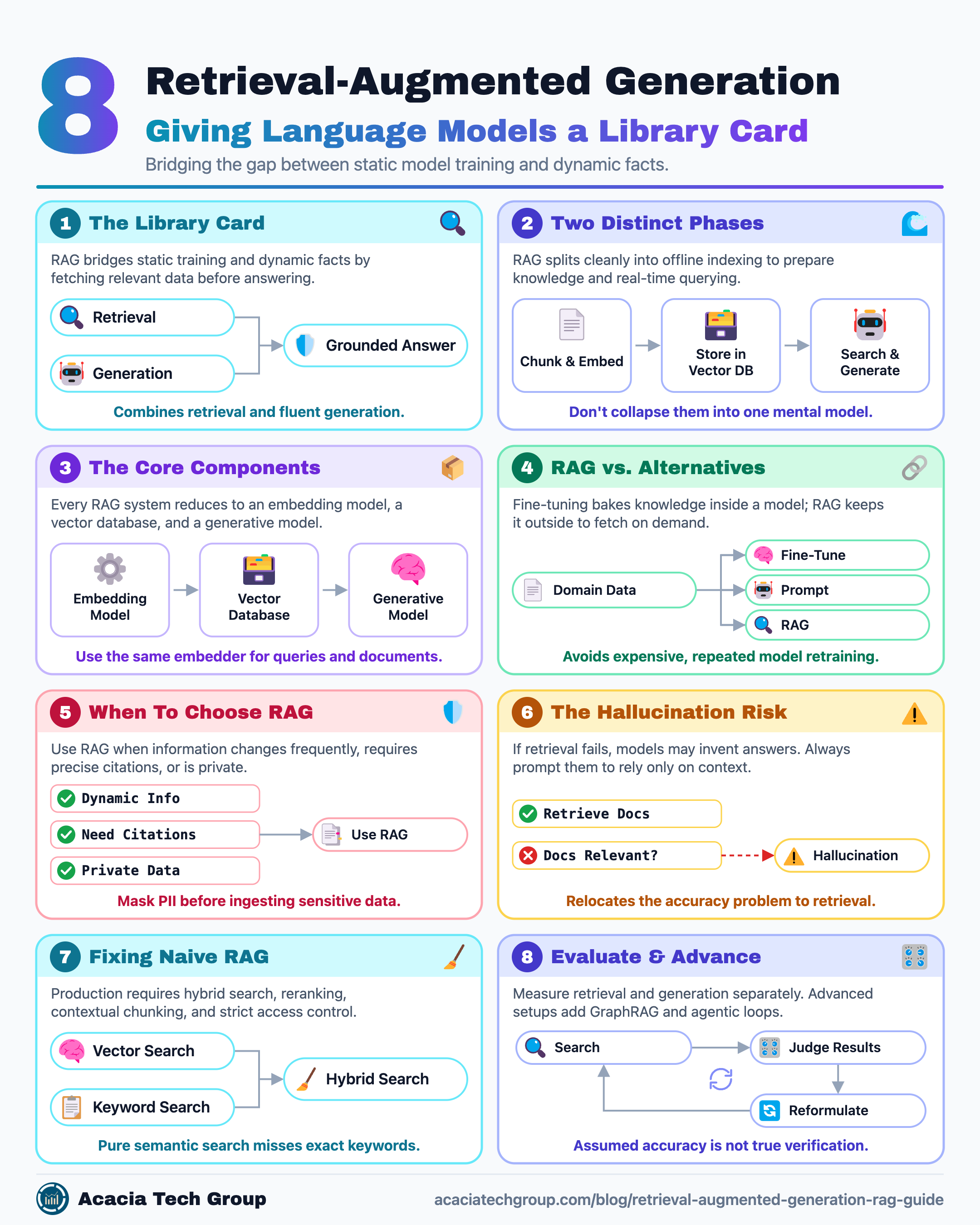
RAG combines two individually mature capabilities that are collectively transformative: retrieval and generation.
Retrieval finds relevant information. Generation turns it into fluent, contextual prose. Neither is new. Together, they produce answers that are grounded in real data and pleasant to read—a combination neither component achieves alone. This RAG framework for LLMs bridges the gap between static training and dynamic facts. According to recent surveys, over 60% of organizations are now developing AI-powered retrieval tools to improve reliability and personalize outputs.
The clearest way to think about it is a library.
The vector database is the library itself, holding everything the system knows. The retrieval model is the librarian, who takes your question and returns the handful of documents that actually bear on it. The generative model is the expert who reads those documents and explains the answer in plain language.
Ask a standalone LLM a question, and it answers from memory. Ask a RAG system, and it goes and checks first.
How It Works
RAG splits cleanly into two phases that run at completely different times. Most confusion about RAG comes from collapsing them into one mental model.
Phase one: indexing (done once, offline)
Before the system can answer anything, it has to prepare the knowledge base.
Documents are split into chunks. A five-hundred-page textbook is useless as a single unit — you need the paragraph about heart failure, not the book that contains it. Chunks of roughly 300 to 800 tokens, with a little overlap between neighbors, are typical.
Each chunk becomes an embedding. An embedding model converts text into a list of numbers—commonly 384 or 768 of them — that capture its meaning. Text with similar meaning produces numerically similar vectors. This mechanism makes semantic search possible: "heart attack" and "myocardial infarction" land near each other despite sharing no words.
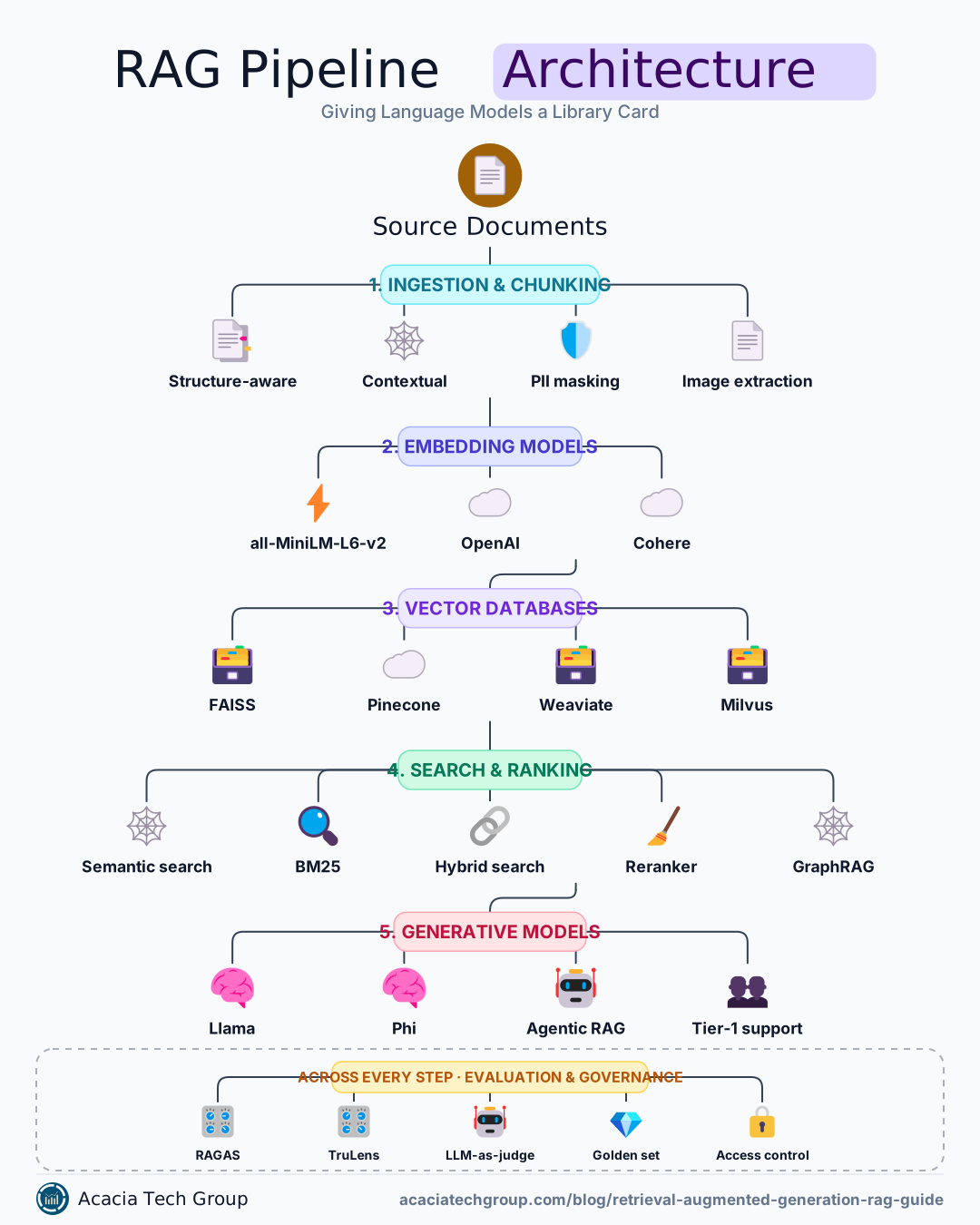
The vectors go into a vector database. Systems like FAISS, Pinecone, Weaviate, and Milvus are built for one job: given a vector, find the nearest ones fast.
Phase two: querying (every time someone asks)
The question is embedded using the same model, so the query and documents live in the same mathematical space.
Similarity search finds the closest chunks. The vector database returns the top k matches. Naive implementations take three to five directly; production systems often retrieve 50-100 candidates and use a reranker to narrow down to the three to eight most relevant results. This step is critical because attention patterns in context windows can lead to a 'lost in the middle' effect, where the model ignores information placed in the center of a long prompt.
A prompt is assembled from the retrieved chunks plus the original question.
The LLM generates the answer grounded in the supplied context rather than its own recollection, significantly reducing LLM hallucination.
The critical detail: use the same embedding model on both sides. Query and documents have to be measured in the same space, or the geometry is meaningless. It's one of the most common silent failures in RAG systems.
The Three Components
Every RAG system, however elaborate, reduces to three parts.
The embedding model turns text into vectors. Open-source options like all-MiniLM-L6-v2 are fast, free, and self-hostable. Cloud APIs from OpenAI or Cohere offer higher quality at a per-token cost. For specialized domains, a model trained on that domain — biomedical, legal, financial — usually beats a larger general-purpose one.
The vector database stores and searches those vectors. FAISS is excellent for local development and small corpora, but it runs in memory and offers no first-class metadata filtering or persistence layer. Pinecone and Weaviate add persistence, real-time updates, and filtering. Milvus offers similar capability while staying self-managed.
The generative model writes the answer. Self-hosted open-weight models like Llama or Phi keep data in-house and carry no per-token fee (though GPU and serving costs are real). Hosted APIs deliver higher quality with less operational burden, at a usage fee and a network round trip. The trade-off is almost always accuracy against latency and control.
RAG vs. The Alternatives
RAG isn't the only way to make an LLM useful on specialized material. Understanding what it displaces clarifies when it's the right choice.
Fine-tuning
Train the model further on domain data — medical guidelines, legal precedent, internal documentation — until it speaks the language natively.
What you gain: genuine fluency in the domain. Consistent tone. Fast inference with no retrieval step.
What it costs: the knowledge is baked into the weights. When guidelines change, you retrain — expensive, slow, and repeated indefinitely. A model fine-tuned last quarter has never heard of anything approved since.
Prompt engineering
Craft careful instructions to steer the model's existing knowledge toward better answers.
What you gain: immediate results, no training, no infrastructure.
What it costs: the knowledge ceiling doesn't move. Better instructions produce better use of what the model already knows — but they can't add a single new fact. Ask about something past the training cutoff and no prompt will help.
RAG
Retrieve relevant documents at query time, then generate from them.
What you gain: current information, because updating means adding a document rather than retraining. Substantially reduced hallucination, because answers are anchored to real text. And source attribution — you can show exactly which passage supported which claim.
What it costs: infrastructure. Somebody has to build, populate, and maintain the knowledge base, and retrieval quality becomes a thing you now have to care about.
Cost per query by architecture
While infrastructure setup carries fixed costs, operational expenses in 2026 depend heavily on pipeline complexity. A Naive RAG implementation typically costs approximately $0.001 to $0.01 per query. In contrast, more advanced Agentic RAG architectures—which use self-correcting loops to recover from poor retrieval—can cost 10x more, ranging from $0.01 to $0.10 per query because of more LLM reasoning cycles.
That's the whole distinction in one line: fine-tuning and prompting put knowledge inside the model; retrieval-augmented generation keeps it outside and fetches it on demand. Everything else follows.
When You Actually Need RAG
Reach for RAG when one or more of these is true.
Your information changes. Prices, policies, regulations, research, inventory, documentation. Anything you'd have to retrain for is a strong RAG signal.
Maintaining currency is a requirement. When external data becomes stale, RAG allows for asynchronous updates via automated real-time processes or periodic batch processing, ensuring the model's 'library' stays current without the need for constant retraining.
You need citations. Legal, medical, financial, and compliance contexts often require showing where an answer came from. RAG gives you this almost for free — you retrieved the passage so that you can point at it. This auditability is a primary driver for the 57% of large enterprises in regulated sectors expected to deploy RAG architectures by 2026. Fine-tuning cannot provide this traceability at any price.
LLM hallucination reduction is critical. A wrong answer about a movie plot is embarrassing. A wrong answer about a drug interaction or a contract term can lead to a lawsuit. Grounding output in retrieved text is currently the most reliable mitigation available.
Your corpus is large and mostly idle. Ten thousand internal documents where any given question touches two of them is the canonical RAG case. Training on all of it would be enormously wasteful.
Enterprise Helpdesk Example: A mid-size SaaS provider indexed 2,000 articles and 50,000 tickets to automate tier-1 support. Within 90 days, they saw a 35% reduction in human-handled tickets with an average response time under two seconds, costing approximately $600 per month for API and database fees.
Your knowledge is private. Company wikis, customer records, internal policy. This material was never in the training data and shouldn't be.
Security and Compliance
RAG systems frequently ingest personally identifiable information (PII) such as financial records or names. Under regulations like GDPR and the EU AI Act, processing this data without safeguards creates legal exposure. Organizations should implement PII masking before ingestion, using tools to redact sensitive fields before they enter the chunking and embedding stage.
When you probably don't
You need style, not facts. If the goal is matching a specific voice or output format, fine-tuning is the better instrument. RAG changes what the model knows, not how it sounds.
Your knowledge is stable and general. Ask about the Krebs cycle and the model already knows. Retrieval adds latency and complexity for nothing.
Latency is critical. RAG adds an embedding pass and a database round trip to every query. A trimmed pipeline can do this in tens of milliseconds; a production stack with a reranker and a longer prompt is more often 200-800 ms.
Your corpus is tiny. With a few dozen FAQs, just put them all in the prompt. Modern context windows are large, and you skip the entire infrastructure.
And often: combine them.
The framing of RAG for LLMs versus fine-tuning is a teaching convenience, not an engineering constraint. Production systems routinely do both — fine-tune for domain fluency and output format, retrieve for current facts, and prompt-engineer to control behavior. These techniques address different problems and compose cleanly.
One Thing to Watch
RAG reduces hallucination. It doesn't eliminate it.
Further reading
Retrieval Augmented Generation (RAG) — Cohere's technical guide on the core concepts of the RAG v2 API.
What is RAG? — An AWS executive summary on why RAG is a cost-effective alternative to retraining.
Spring AI Reference — Documentation on using the Advisor API to build modular, production-ready RAG flows.
When retrieval fails to surface anything relevant, most models will answer from their own parametric knowledge anyway — often while sounding entirely confident. Sometimes they're right. Sometimes they aren't. Either way, the answer is no longer grounded, and the guarantee you built the system for has quietly lapsed.
The mitigation is a prompt instruction: answer only from the provided context; if the context is insufficient, say so. It's one line; it's easy to omit, and omitting it undermines the entire premise.
This points to the broader lesson. RAG relocates the accuracy problem rather than solving it outright. Your answers are now only as good as your retrieval, and your retrieval is only as good as your chunking, your embedding model, and the quality of what you put in the vector database.
That's a much better problem to have than an unfixable model. But it is still a problem, and it deserves measurement rather than assumption. Build the evaluation set. Compute recall. Find out whether the right documents are actually coming back — because "the answer looked reasonable" is not verification.
Why Naive RAG Fails in Production
Everything above describes naive RAG: embed, search, stuff the prompt. It is the right mental model and the wrong production architecture. Four gaps account for most of the failures teams hit after launch.
Pure vector search misses exact terms. Semantic search is superb at paraphrasing and hopeless at part numbers, error codes, SKUs, and policy identifiers. The fix is hybrid search: run a keyword index (BM25) alongside the vector index and fuse the two result lists. It is the single highest-return change most RAG systems can make.
The right document comes back in the wrong position. Retrieval ranks by embedding distance, which is an approximation of relevance, not relevance itself. A reranker — a cross-encoder that scores each candidate against the query directly — reorders 50-100 retrieved candidates down to the handful you actually send to the model. Slower per candidate, dramatically more accurate at the top.
Chunks lose their context. A paragraph that says "this threshold applies only to tier-two accounts" is meaningless once separated from the section that defined tier two. Structure-aware chunking (split on headings and semantic boundaries, not character counts) and contextual retrieval (prepend a one-line summary of the parent document to each chunk before embedding) both recover most of that loss.
Retrieval ignores who is asking. This is the enterprise-critical one. If the index contains HR files, board material, and customer records, then retrieval without metadata filtering and access control turns a helpful assistant into a data-exfiltration surface. Filter by permission at query time — never rely on the prompt to keep a secret.
Two more techniques earn their keep as systems mature: query transformation (rewriting vague questions, decomposing multi-part ones, routing to the right index) and ingestion hygiene — table and image extraction from PDFs, incremental re-indexing, and genuine deletion when a document is retracted or a customer invokes their right to erasure.
Each of these has a deeper reference: chunking, hybrid search, and reranking — and you can watch the chunk, retrieve, and generate stages run in the interactive RAG demo.
How to Know It's Working: Evaluation
"The answer looked reasonable" is not verification. RAG splits cleanly into two measurable halves, and they fail for different reasons.
Retrieval quality. Context recall — did the chunks that contain the answer come back at all? Context precision — how much of what came back was relevant? If recall is low, no prompt engineering will save the answer.
Generation quality. Faithfulness — is every claim in the answer supported by the retrieved context, or did the model fill gaps from memory? Answer relevance — did it address the question asked?
Build a golden set of 50-200 real questions with known correct source documents, score those four metrics on every change, and treat the numbers as a regression suite. Frameworks like RAGAS and TruLens automate the scoring, typically with an LLM-as-judge; the discipline matters more than the tool. Track cost and latency in the same harness, since reranking and larger contexts trade one against the other.
Beyond Basic RAG: GraphRAG and Agentic Retrieval
GraphRAG indexes entities and the relationships between them rather than isolated passages, which makes it far better at questions that require connecting several documents — "which customers were affected by both incidents?" — where chunk-level search returns fragments that never add up.
Agentic RAG gives the model control of the retrieval loop: search, judge whether the result is sufficient, reformulate, search again, and consult other tools along the way. It costs more calls and buys multi-hop reasoning. Our interactive RAG walkthrough shows the pipeline stage by stage, and the AI agents glossary entry covers where agentic patterns fit.
The other live question is whether retrieval is needed at all. Million-token context windows make "just paste everything" genuinely viable for small corpora — but cost scales with every token on every request, accuracy degrades in the middle of very long contexts, and there is no access control on a pasted document. Retrieval remains the answer for corpora that are large, permissioned, or changing.
Frequently Asked Questions
Is RAG better than fine-tuning?
They solve different problems. RAG changes what a model knows and is the right choice for facts that change or are private. Fine-tuning changes how a model behaves — voice, format, domain fluency. Production systems commonly use both.
What chunk size should I use?
Start at 300-800 tokens with roughly 10-15% overlap, and split on document structure rather than raw character counts. Then tune against your evaluation set; the correct size depends on how your source material is written.
Does retrieval-augmented generation stop hallucinations?
It reduces them substantially but does not eliminate them. When retrieval returns nothing relevant, models answer from parametric knowledge anyway. Instruct the model to answer only from the provided context and to say when the context is insufficient.
Why does my RAG system miss exact terms like product codes?
Because semantic search matches meaning, not strings. Add a keyword (BM25) index alongside the vector index and fuse the results — hybrid search is the standard fix.
How do I keep RAG from leaking restricted documents?
Attach permission metadata to every chunk at ingestion and filter on it at query time, before results ever reach the prompt. Prompt-level instructions are not an access-control mechanism.
References
RAG is not a trick or a workaround. It recognizes that knowing things and reasoning about them are separable capabilities, and that separating them makes both easier to improve.