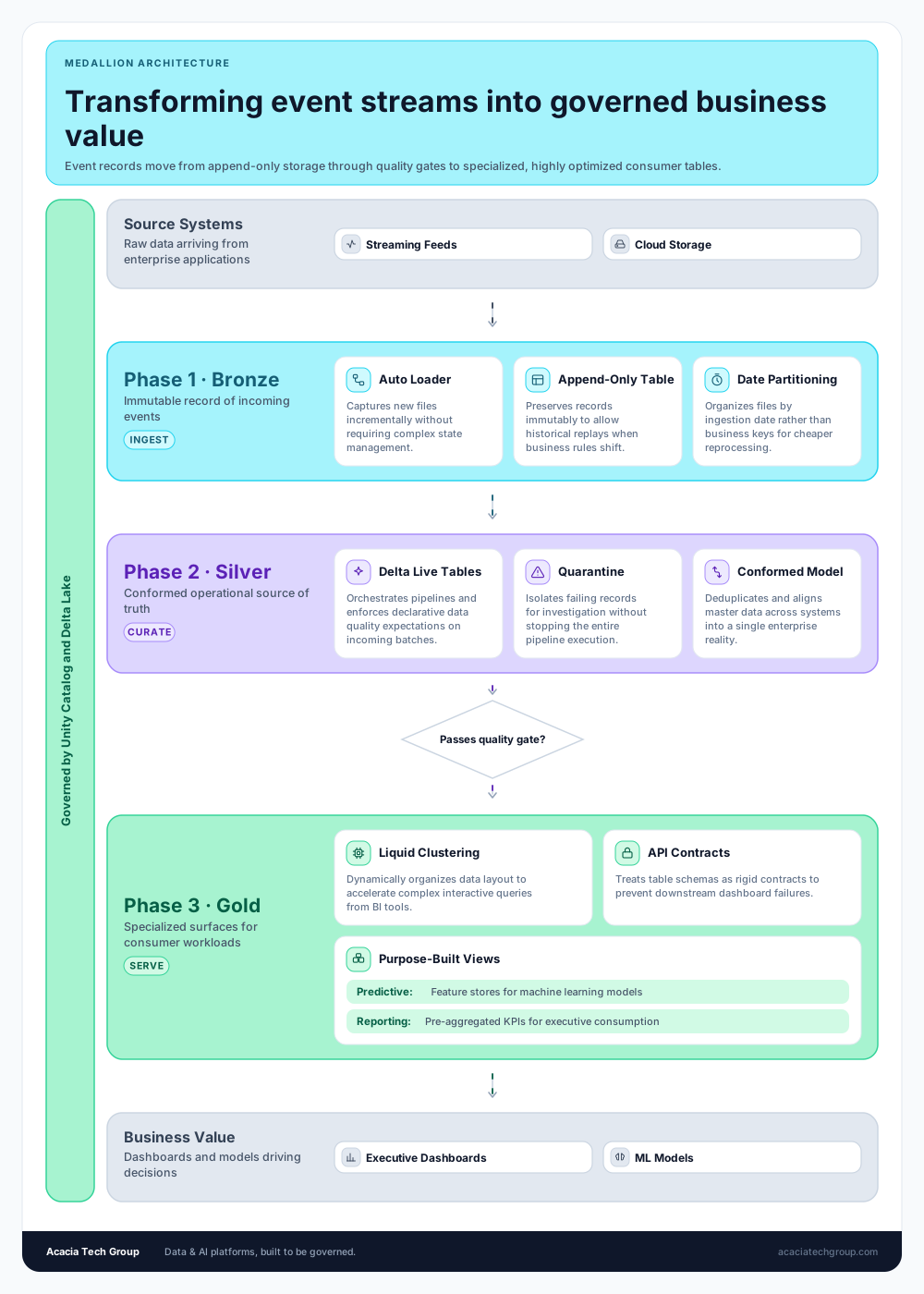
Event records move from append-only storage through quality gates to specialized, highly optimized consumer tables.
Implementing Medallion Architecture on Databricks: A Practical Guide
Databricks medallion architecture is the pattern most large enterprises adopt when they need a governed, cost-predictable path from raw ingestion to executive dashboards. Databricks provides the Databricks data lakehouse engine—Delta Lake medallion storage for ACID transactions, Unity Catalog for governance, and Delta Live Tables for automated pipeline quality. Still, the architecture delivers business value only when the Databricks bronze, silver, and gold layers map to clear ownership, service-level objectives, and data contracts.
This guide is a practical companion to our general overview of medallion architecture. It assumes you have already chosen a layered model and now need to know exactly how to execute a Databricks medallion architecture implementation without overspending on compute or creating governance gaps auditors will flag later.
Why Databricks Fits the Medallion Pattern
Databricks is not the only platform that supports medallion layers. Still, it is the one most often chosen when an organization needs both streaming ingestion and complex batch transformation on the same tables. The reasons are structural:
Delta Lake gives you ACID transactions, time travel, and schema enforcement on every layer within your Databricks data lakehouse. A failed Silver job rolls back cleanly instead of leaving half-transformed records in a dashboard.
Unity Catalog applies fine-grained access control at the table and column level so that data engineers can see a Bronze table. At the same time, the same data in Gold is restricted to executive consumers.
The Photon engine and predictive I/O reduce query costs as volumes grow, which matters because Databricks medallion architecture multiplies table counts by three.
For a broader comparison of cloud data platforms, see why businesses are choosing Snowflake for modern data analytics.
Bronze — Ingest Once, Replay Forever
The Bronze layer is an append-only, immutable record of every event or row that arrives from source systems. In a standard Delta Lake medallion setup, this is usually implemented with Delta Lake tables and Auto Loader or structured streaming jobs that land files from cloud storage.
Executive stakeholders should care about three decisions here:
Partitioning strategy: partition by ingestion date, not by business key. Date partitions make it cheap to reprocess yesterday’s feed if a source system sends a late correction.
Format: Delta Lake is the default for a Databricks Bronze-Silver-Gold workload. Do not use CSV in Bronze; schema evolution and merge operations become expensive to debug at scale.
Retention: keep Bronze for as long as compliance requires. Delta time travel and VACUUM policies let you balance storage cost against auditability.
A well-run Bronze layer is insurance. When business rules change six months later, you can replay from Bronze instead of re-requesting historical data from a source system that may no longer retain it.
Silver — Curate with Confidence
Silver is where raw data becomes trustworthy. This layer deduplicates, conforms schemas, applies data-quality rules, and aligns master data across systems. On Databricks, Delta Live Tables (DLT) is the most common choice for a medallion architecture implementation because it combines pipeline orchestration with expectations—declarative quality checks that automatically fail or quarantine bad records.
The business valueSilverlver is eliminating the “my numbers do not match yours” problem. A single conformed customer table, enforced by DLT expectations and Unity Catalog lineage, becomes the operational source of truth that finance, marketing, and product all reference.
For organizations that also need full historical traceability and auditabiliSilverlver is the natural integration point with Data Vault 2.0 modeling. Organizations can build raw hubs and links directly from Bronze, while conformed satellites and point-in-time tables liveSilverlver.
Gold — Serve the Business
Gold is the curated surface that business consumers actually touch: KPI dashboards, machine-learning feature stores, executive reporting views, and customer-360 aggregates. Within the Databricks data lakehouse, Gold tables are typically materialized views or Delta tables optimized with Liquid Clustering and Predictive I/O so that BI tools and model-training jobs query them in seconds, not minutes.
Key implementation choices:
One Gold table per use case: resist the temptation to build a single “universal” Gold layer. A churn-prediction model and a quarterly board report need different grain, different columns, and different freshness guarantees.
Clear ownership: assign a named data-product owner to every Gold table. That owner decides what goes in, what freshness is acceptable, and who has access.
Stable interface: treat Gold schemas as an API contract. If a downstream dashboard breaks because you renamed a column, the problem is in your governance model, not the dashboard.
Governance, Cost, and Reliability
Databricks medallion architecture strategies triple the number of tables in your estate, so governance and cost discipline are not optional. On Databricks, three controls keep spending and risk in line:
Unity Catalog lineage: every query, every job, and every user access is logged. When an auditor asks where a board-level KPI came from, lineage answers in seconds.
Cluster policies and auto-termination: restrict job clusters to right-sized instances and terminate idle compute. Bronze batch jobs do not need the same hardware as interactive Gold queries.
Per-layer SLOs: define freshness, accuracy, and availability targets separately for the Databricks Bronze, Silver, and Gold tiers. See our reliability playbook on SLOs and data freshness for a template.
Cost surprises usually come from one of two places: running expensive interactive clusters on Bronze batch jobs, or storing years of unpartitioned history without a VACUUM policy. Both are preventable with a day of design review.
What to Avoid on Databricks
Even experienced teams make these mistakes during a medallion architecture Databricks implementation:
Skipping Bronze: landing data directly iSilverlver seems faster until a source system changes its schema and you have no historical baseline to replay.
Putting business logic in Gold: every transformation in Gold is a transformation that every consumer pays for at query time. Move complex logic to Silver and keep Gold as thin, curated projections.
Ignoring streaming-batch unification: Databricks handles both, but only if you design for it. A batch-only Silver pipeline will struggle when the business suddenly needs real-time alerts.
If you are also evaluating transformation tools, our comparison of dbt vs SQLMesh explains how each fits into a Delta Lake medallion pipeline.
When to Look Beyond Databricks
Databricks excels at unified batch and streaming on a lakehouse, but it is not the right choice for every workload. If your data volume is moderate, your team is SQL-first, and your primary need is governed BI with minimal infrastructure overhead, a cloud-native warehouse such as Snowflake may deliver the same outcome with less operational surface area. The medallion pattern works on both; your existing skill set and volume trajectory should drive the decision, as should whether you need native Spark for advanced analytics.
For a deeper look at how Databricks compares to other platforms for specific enterprise scenarios, explore our case studies.
Conclusion
A Databricks medallion architecture succeeds when each layer has a clear contract, a named owner, and a measurable service-level objective. Bronze preserves truth. Silver enforces quality. Gold delivers decision-ready products. The technology is capable, but the business outcome depends on governance discipline and cost controls that most teams under-invest in during the first sprint.
If your team is planning a Databricks medallion architecture implementation and wants to avoid the common cost and governance pitfalls, schedule a consultation to review your current architecture and map a layered model to your specific environment.