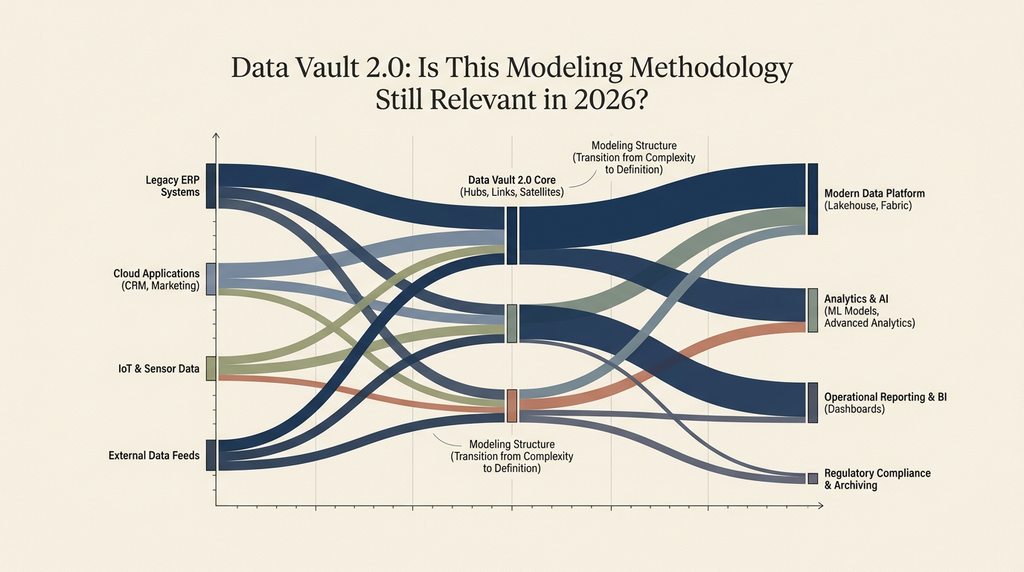
Data Vault 2.0: Is This Modeling Methodology Still Relevant in 2026?
In the evolving landscape of enterprise data modeling, Data Vault 2.0 has maintained a devoted following since its formal launch in 2013. Initially conceived by Dan Linstedt at Lockheed Martin in the 1990s, this methodology promises to solve the perennial challenges of building an agile, scalable data warehouse architecture that adapts to changing business requirements without breaking.
But here's the question that keeps data architects up at night: Is Data Vault 2.0 the right choice for your organization, or are you signing up for unnecessary complexity?
I faced this exact decision while leading the data engineering team at a major LLP organization. We were undertaking two massive initiatives simultaneously: building a cloud data platform from scratch and migrating our ERP and HR systems. A senior architect suggested we adopt Data Vault 2.0 for both projects. It was my first introduction to the methodology, and I'll admit—I was intrigued by the flexibility it promised.
But after careful evaluation, I chose a different path. We opted for traditional dimensional modeling, and that decision proved right for our specific circumstances. The project succeeded not because we chose the most sophisticated architecture, but because we selected one that matched our constraints, our team's capabilities, and, most importantly, our business needs. When comparing dimensional modeling vs data vault, the right choice depends heavily on your specific use case.
This article cuts through the hype to examine Data Vault 2.0's pros and cons, explore modern alternatives that might serve you better, and answer a critical question for today's data teams: Does Data Vault work in Python-first environments, or is it forever married to SQL? I'll share the lessons from that pivotal architecture decision, and when choosing simplicity over sophistication is the smarter move.
Understanding Data Vault 2.0: The Core Principles
Data Vault 2.0 is more than just a data modeling technique—it's a comprehensive methodology that encompasses architecture, modeling, and implementation patterns. At its heart, it separates your data into three fundamental building blocks:
Hubs store unique business keys for core business concepts. Think of them as stable anchors—such as a customer ID, product code, or employee number. Hubs contain minimal information: just the business key and metadata for lineage and auditing.
Links capture relationships between business keys. These are essentially many-to-many relationship tables that connect two or more hubs. A customer placing an order creates a link between the customer hub and order hub.
Satellites hold all the descriptive attributes and their complete history. Every time a customer's address changes or a product's price is updated, a new satellite record is appended. Nothing gets updated—ever. This append-only approach preserves every change, similar to Type 2 slowly changing dimensions in Kimball methodology.
The architecture also includes specialized constructs, such as the Raw Vault (a source-driven integration layer) and Business Vault (where business rules are applied), as well as Point-in-Time (PIT) tables and bridge tables that optimize query performance.
The Promise: Why Organizations Choose Data Vault 2.0
Data Vault 2.0 emerged to address real pain points in enterprise data warehouse architecture. Here's where it genuinely shines:
Exceptional Agility for Changing Sources
Adding a new data source doesn't require refactoring your entire model. Need to integrate data from a newly acquired company? Create new satellites for their version of customer data and attach them to your existing customer hub. The original structure remains untouched—a game-changer for organizations undergoing mergers or rapidly implementing new systems.
Complete Auditability and Compliance
Every record includes load timestamps and source information. The append-only nature means you can reconstruct your data as it existed at any point in time. For regulated industries—such as healthcare, finance, and pharmaceuticals—this level of traceability is invaluable. You can prove exactly where every data point originated and when it was updated.
Parallel Loading for Performance
Hash keys eliminate loading dependencies. Unlike dimensional models that require dimension lookups before loading facts, Data Vault components can load simultaneously. This architecture supports near-real-time data loading and scales from terabytes to petabytes.
Integration-First Design
Data Vault 2.0 excels when you're combining data from 30+ source systems. It stores "all the data, all of the time" without making judgments about data quality upfront. Insufficient data gets loaded alongside good data, with cleansing happening downstream in the Business Vault.
Future-Proof Flexibility
Business relationships evolve. That one-to-many relationship between customers and orders? What happens when you launch a family account where multiple customers can share an order? In traditional models, this requires significant refactoring. In Data Vault, you close one link and create another; the historical data remains intact.
The Reality Check: Data Vault 2.0's Significant Drawbacks
The methodology isn't without serious trade-offs. Here's a look at some common Data Vault 2.0 pros and cons that the sales pitch often glosses over:
Extreme Complexity and Table Explosion
A simple model with four tables in 3NF or dimensional modeling can explode into nine or more tables in Data Vault. Organizations report having 2-3x as many tables as with traditional approaches. This semantic complexity makes the database harder to understand and navigate. New team members face a steep learning curve as they try to comprehend which satellites contain the correct data for a given analysis.
Abysmal Query Performance Without Optimization
Here's the uncomfortable truth: Data Vault's highly normalized structure creates query nightmares. Reconstructing useful datasets requires joining many tables—often seven or more for simple queries. Database query optimizers struggle with these complex join patterns, particularly when handling date-range queries across multiple satellites.
Critics of this enterprise data modeling style have been blunt. One data engineer described watching a "very long SQL command" generated by Data Vault tooling and "laughed out loud, thinking it was a good joke." The punchline? It wasn't a joke. Running analytics directly on Data Vault structures is impractical for most use cases.
The solution? Build separate bridge tables, Point-in-Time tables, or full Kimball-style dimensional marts on top of the vault. However, now you're maintaining multiple copies of data, which adds significant storage costs.
Not for Direct Consumption
Data Vault is designed as an integration layer, not a consumption layer. Business users and BI tools can't work directly with the raw vault structure. You'll need to build additional layers—such as dimensional marts, data products, or aggregation tables—for actual analytics work. When debating dimensional modeling vs data vault, remember that dimensional models are often ready for end-user consumption much faster.
Mandatory Automation or Project Failure
Manual coding of Data Vault ETL is essentially impossible at scale. You need metadata-driven code generation, which means adopting specialized tools and frameworks. Without rigorous automation and naming conventions, human error will accumulate. The discipline required to maintain consistency across hundreds of vault tables is substantial.
Overkill for Small to Medium Projects
If you have fewer than 10 source systems, a small team, and straightforward analytics requirements, Data Vault 2.0 is almost certainly the wrong choice. The implementation overhead, the learning curve, and the need for specialized tooling outweigh the benefits. Traditional dimensional modeling will serve you better.
The Methodology Baggage
Data Vault 2.0 comes with extensive methodology overhead, including CMMI Level 5 processes, Six Sigma practices, Agile principles, and function point analysis. While these best practices can improve project outcomes, they also add process weight. Some organizations find this structure helpful; others find it constraining.
A Real-World Decision: When Data Vault Wasn't the Answer
Let me share the decision I faced that led me to write this article. As the lead data engineer at a major LLP, I was responsible for two high-stakes projects running in parallel: building our first cloud data platform and migrating our ERP and HR systems to modern cloud-based solutions.
A respected architect who'd been with the organization for years made a compelling case for enterprise data modeling via Data Vault 2.0. His argument was sound: we had multiple source systems, we'd need to track historical changes, and we wanted flexibility as the business evolved. The methodology seemed purpose-built for exactly our scenario.
I spent weeks studying Data Vault. I read the books, examined implementations, and genuinely appreciated the elegance of the hub-link-satellite model. The flexibility was appealing—theoretically, we could adapt to any change the business threw at us.
However, when I stepped back and examined our actual situation, the decision became clear: Data Vault was not the right choice for us.
Why We Chose Dimensional Modeling Instead:
Time Was Not on Our Side
We had aggressive timelines for both migrations. Learning Data Vault 2.0, establishing standards, building automation tooling, and training the team would consume months we didn't have. Our developers were already experienced with dimensional modeling, so we could move quickly.
The Developer Learning Curve Was Real
My team was skilled, but Data Vault would require significant retraining. Hash keys, satellite loading patterns, point-in-time tables—these aren't trivial concepts. I'd be asking them to learn a new paradigm while simultaneously delivering two critical projects. That's a recipe for delays and burnout.
Our Entities Were Known and Stable
Here's what surprised me most during the business analysis: despite migrating to new ERP and HR systems and undergoing lengthy evaluation periods, the business chose to make only minor changes to their charts of accounts and existing processes. These were well-understood, mature business operations. The entities weren't going to change dramatically. We didn't need Data Vault's flexibility for structures that had been stable for decades.
The Historical Data Challenge
One of my key deliverables was to bridge the gap between historical data and current operations. The business decided—correctly—to load only current, active records into the new cloud ERP and HR systems. Historical transactions, closed projects, former employees, and old vendors—all of which would live exclusively in the data warehouse.
Data Vault enthusiasts might argue that this is ideal for their methodology. But I saw it differently: with historical records living only in the warehouse and never updated again, the very thing Data Vault is built for—absorbing constant change from live source systems—simply did not apply to that data. It was frozen. A well-designed set of dimensional models, loaded once and preserved as Type 2 history where it mattered, captured everything the business needed without the table explosion and join complexity that Data Vault would have introduced.
So, Is Data Vault 2.0 Still Relevant in 2026?
Yes—but selectively. Data Vault 2.0 remains a powerful methodology for large enterprises integrating dozens of volatile source systems, operating under strict audit and compliance requirements, and staffed with teams able to invest in the automation and discipline it demands. In those environments, its agility and auditability are genuinely hard to beat.
For everyone else, the honest answer is that the complexity rarely pays for itself. If your entities are stable, your timelines are tight, your team already knows dimensional modeling, or your historical data is effectively frozen, a simpler architecture will deliver value faster and cost far less to maintain. Modern tooling—dbt for transformation, columnar cloud warehouses, and open lakehouse table formats—has also closed much of the flexibility gap that made Data Vault so compelling a decade ago.
The lesson from my own decision still holds: choose the architecture that fits your constraints, your team, and your business needs—not the one with the most impressive pedigree. Sophistication is not the same as fit, and the best data platform is the one your organization can build, query, and trust.