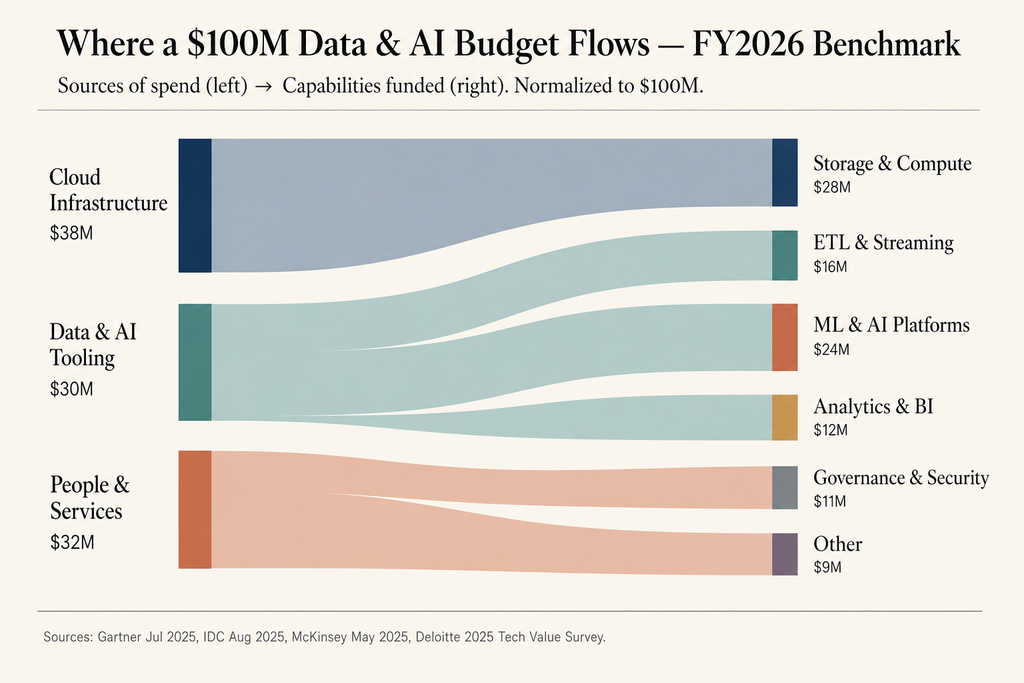
Most data leaders cannot answer a deceptively simple board question: "If we spend a dollar on data and AI, where does it land?" Below is a benchmark income-statement view — sources on the left, capabilities on the right, ribbons in between — calibrated against Gartner, IDC, McKinsey, and Deloitte FY2025–FY2026 spend research and normalized to a $100M data platform budget.
The headline numbers — and why they sit where they do
- Cloud Infrastructure — $38M. Gartner forecasts worldwide IT spending of $5.43T in 2025, with data center systems growing 42.4% on the back of AI-optimized servers — the single fastest-growing IT segment [1]. The cloud line dominates because the underlying compute layer is being repriced upward, not because workloads are inflating in volume.
- Data & AI Tooling — $30M. IDC projects AI spending to grow at a 31.9% CAGR through 2029, reaching $1.3T and exceeding 26% of worldwide IT spend [3]. Lakehouse engines, vector databases, observability, and orchestration tools are the visible edge of that curve inside enterprise budgets.
- People & Services — $32M. Gartner's $1.69T IT services line [1] and McKinsey's finding that US enterprise tech spend has grown ~8% per year since 2022 [4] both point to the same shift: dollars are moving from generic headcount toward specialized platform engineering and managed services.
Where the dollars actually land
On the right side of the Sankey, six destinations consume the entire budget. Two patterns dominate the FY2026 FinOps benchmark picture.
1. ML & AI Platforms ($24M) is the new center of gravity
At nearly a quarter of the budget, ML platform investment is now the second-largest destination — behind only Storage & Compute. IDC attributes this to a logarithmic (10x) increase in the number and complexity of agents enterprises will deploy over the next five years, with service providers absorbing 80% of the underlying infrastructure build-out [3]. McKinsey's State of AI 2025 confirms that "almost all" surveyed organizations are now using AI, though most remain early in scaling enterprise-level value [5]. The dollars are real; the returns lag.
2. Governance & Security ($11M) is the silent breakout
Small in absolute terms, steep in growth rate. Every executive team we work with has added at least one of data contracts, lineage, PII classification, or AI policy enforcement to their FY2026 roadmap. Deloitte's 2025 Tech Value Survey notes that AI is "capturing the digital dollar" — raising direct questions about whether the rest of the technology estate, including controls, is keeping pace [6]. Expect this line to roughly double next year as audit and regulatory pressure catches up to deployment.
Three uncomfortable truths the chart reveals
- Storage & Compute is not your problem — orchestration is. $28M flows to compute, but the bottleneck on most platforms is the $16M in ETL & streaming pipelines that feed it. Battery Ventures' 2025 enterprise tech survey shows pipeline reliability and data quality consistently ranking among the top blockers to AI value capture [7]. Compute is elastic; pipelines are not.
- Analytics & BI ($12M) is being absorbed into AI. Gartner observes that GenAI is "sliding toward the trough of disillusionment," with CIOs preferring plug-and-play functionality from incumbent software vendors over net-new BI investments [1]. The marginal dollar increasingly buys an LLM-powered answer rather than another dashboard.
- "Other" ($9M) is shrinking — and that is good news. Two years ago, "Other" was the dumping ground for shadow IT, departmental SaaS, and POCs. Its decline is the clearest signal that the platform consolidation McKinsey describes as the "new economics of enterprise technology" [4] is finally landing in real budgets.
What a healthy ratio looks like in 2026
Across the platforms we benchmark — and corroborated by the cited research — the high-performing quartile shares a recognizable data platform budget shape:
- Cloud Infrastructure ≤ 38% of total — driven by reserved capacity, FinOps discipline, and the recurring-spend stability Gartner highlights as one of the few resilient lines in the current "uncertainty pause" [1].
- ML & AI Platforms 20–28% — enough to be serious, not so much that experiments outpace governance. Aligns with IDC's trajectory toward AI as ~26% of worldwide IT by 2029 [3].
- Governance & Security ≥ 10% — the leading indicator that AI initiatives will survive their first audit, consistent with Deloitte's call to rebalance the technology portfolio [6].
- "Other" ≤ 10% — a clean platform has very little it cannot categorize.
How to read your own Sankey
Before your next planning cycle, build the same picture for your organization. Three steps:
- Sources (left). Pull twelve months of cloud bills, tooling contracts, and fully-loaded people cost. Three buckets are enough to determine your data and AI spend.
- Destinations (right). Map every dollar to one of six capabilities. Resist the urge to add a seventh — granularity is the enemy of executive clarity.
- Ribbons (middle). Allocate. The arguments you have during allocation are the strategy conversation.
The chart is not the answer. It is the question your executive team has been trying to ask for two years.
References
- Gartner. Forecasts Worldwide IT Spending to Grow 7.9% in 2025. Press Release, July 15, 2025.
- Gartner. Forecast Analysis: Enterprise Infrastructure Software, Worldwide, 2025. Published November 12, 2025.
- IDC. Agentic AI to Dominate IT Budget Expansion Over Next Five Years, Exceeding 26% of Worldwide IT Spending, and $1.3 Trillion in 2029. August 26, 2025.
- McKinsey & Company. The New Economics of Enterprise Technology in an AI World. May 16, 2025.
- McKinsey QuantumBlack. The State of AI in 2025: Agents, Innovation, and Transformation. November 2025.
- Deloitte Insights. AI Is Capturing the Digital Dollar: 2025 Tech Value Survey.
- Battery Ventures. State of Enterprise Tech Spending. April 2025.