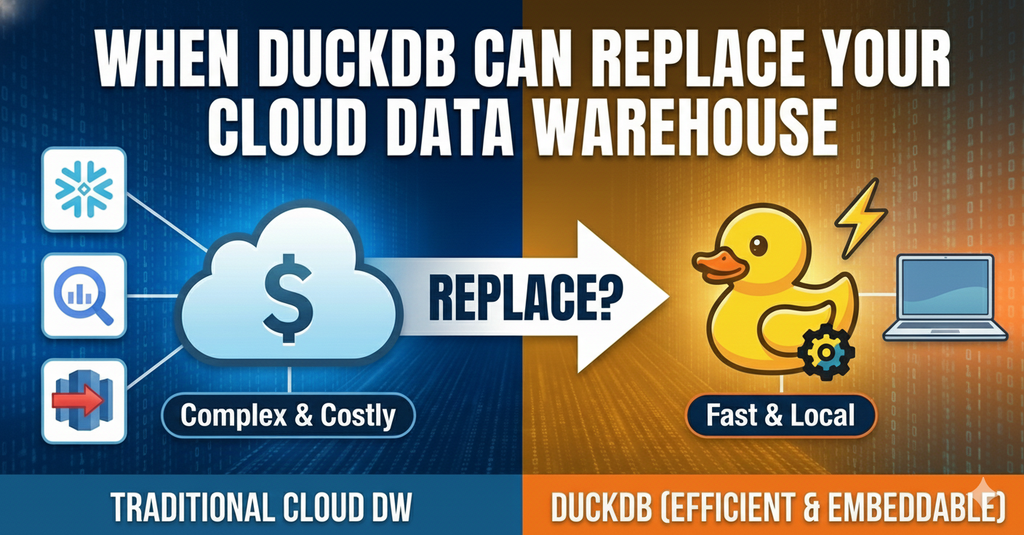
The conversation happens in every data leadership meeting: "Our Snowflake bill increased 45% this quarter." Or Databricks. Or Azure Synapse. The response is usually some combination of optimization efforts, usage policies, and resigned acceptance that modern data infrastructure costs this much.
But here's the uncomfortable question most organizations avoid: Do you actually need an enterprise cloud data platform for all your workloads? Or have you defaulted to expensive infrastructure because that's what the market says you should use?
The reality is that many organizations are running workloads on $50,000-per-month platforms that could execute just as effectively on $500-per-month infrastructure. The difference isn't capability—it's understanding what you actually need versus what vendors tell you to buy.
Understanding the Cloud Platform Cost Drivers
Before exploring alternatives, you need to understand where cloud data platform costs actually come from. It's rarely computing or storage. It's the combination of factors that adds up to budget-breaking bills.
Compute costs dominate most invoices. Every query execution, every transformation job, every dashboard refresh consumes compute credits. Snowflake charges for warehouse usage by the second. Databricks bills for cluster uptime. Azure Synapse meters DWU hours. The pattern is the same: you pay continuously for processing power, whether you're using it efficiently or not.
Storage costs seem reasonable initially, but scale with your data volume, replication strategy, and retention policies. Time-travel features, fail-safe periods, and cross-region replication all add to costs. What starts at $0.02 per GB becomes significant when you're storing 500 TB with multiple copies.
Concurrency costs hit organizations hardest during periods of growth. Each additional user or concurrent query typically requires scaling up compute resources. More analysts running reports means larger warehouses or more clusters, which means exponentially higher costs.
The hidden costs matter too: data egress fees when moving data out, premium support tiers, monitoring and observability tools, and the opportunity cost of vendor lock-in. A $30,000 monthly platform bill often represents $50,000 in total data infrastructure spending.
The DuckDB Alternative: When and Why It Works
DuckDB fundamentally changes the cost equation because it's an in-process analytical database. There's no separate server, no compute layer to scale, no complex pricing model. You install it like a library, and it runs within your application or script.
The cost model is straightforward: you pay only for the infrastructure running your code. A $50/month VM on AWS, Azure, or GCP. Your existing development machines. A CI/CD runner you're already paying for. DuckDB itself costs nothing. It's open source with no commercial licensing.
This works brilliantly for specific workload patterns. Batch analytics running on schedules (daily reports, weekly aggregations) don't always need an always-on infrastructure. Development and testing environments rarely justify the costs of an enterprise platform when developers need to validate logic. Departmental analytics serving 5-10 users doesn't require the concurrency capabilities you're paying for. ETL pipelines transforming data files can run perfectly well on modest compute instances.
What doesn't work? Real-time streaming analytics requiring sub-second latency. Hundreds of concurrent users are running ad-hoc queries simultaneously. Multi-petabyte datasets that exceed single-node processing capabilities. Workloads require advanced governance features, such as column-level security and automatic PII detection.
The key insight: DuckDB isn't trying to replace cloud data platforms for everything. It's offering an alternative for the 40-60% of workloads that don't actually need enterprise scale.
Real-World Cost Comparison
Let's examine specific scenarios with actual numbers to understand the magnitude of potential savings.
Scenario 1: Daily Batch Analytics
A financial services company runs 50 analytical queries every morning to generate reports from 200GB of transaction data. Currently running on Snowflake with a Medium warehouse (4 credits/hour) for approximately 2 hours daily.
- Snowflake cost: 4 credits × 2 hours × 30 days × $3/credit = $720/month (compute only)
- DuckDB cost: $50/month for an 8-core VM + $20 object storage = $70/month
- Savings: $650/month or 90%
The DuckDB implementation queries Parquet files in Azure Blob Storage, performs in-memory transformations, and writes results back to storage. Total processing time: 45 minutes. No always-on infrastructure required.
Scenario 2: Development and Testing Environments
A data engineering team of 12 developers each maintains a Snowflake development warehouse for testing dbt models. Each developer uses a Small warehouse (2 credits/hour), averaging 4 hours daily.
- Snowflake cost: 12 developers × 2 credits × 4 hours × 20 days × $3/credit = $5,760/month
- DuckDB cost: Runs locally on developer machines = $0 additional cost
- Savings: $5,760/month or 100%
Developers test dbt models against local DuckDB databases populated with sample data. Production deployments still go to Snowflake, but the entire development lifecycle happens locally.
Scenario 3: Departmental Analytics for Marketing
A marketing team of 8 analysts queries customer data to build segments and analyze campaign performance. They access 50GB of customer data through a shared Tableau dashboard backed by Snowflake.
- Snowflake cost: Small warehouse running 8 hours/day = 2 credits × 8 hours × 30 days × $3/credit = $1,440/month
- DuckDB cost: $100/month VM + $50 orchestration = $150/month
- Savings: $1,290/month or 90%
The DuckDB instance serves a REST API that Tableau connects to, querying Parquet files refreshed nightly. Eight concurrent users present no performance issues for pre-aggregated analytical queries.
Scenario 4: ETL Pipeline Processing
A healthcare company transforms 500GB of claims data monthly through a multi-stage ETL pipeline. Currently running on Databricks with a 4-node cluster for approximately 40 hours of processing monthly.
- Databricks cost: 4 nodes × 40 hours × $0.75 DBU-hour × 3 DBUs/node = $360/month (compute only)
- DuckDB cost: $150/month for 16-core VM during processing window = $150/month
- Savings: $210/month or 58%
The pipeline reads source files from Azure Data Lake, applies transformations using DuckDB's SQL engine, and writes final outputs back to storage as Parquet. Processing completes in 6 hours instead of 40 due to DuckDB's columnar execution efficiency.
These aren't theoretical scenarios. They represent actual workload patterns where organizations routinely overspend because they've adopted a "cloud data platform for everything" strategy without evaluating alternatives.
Implementation Patterns That Reduce Risk
Moving workloads from established cloud platforms to DuckDB requires strategic thinking rather than wholesale replacement. The most successful implementations follow proven patterns that minimize risk while maximizing cost savings.
The hybrid development pattern keeps production workloads on your cloud platform while moving all development and testing to DuckDB. Developers work faster with local databases, CI/CD pipelines run cheaper, and you maintain production-grade infrastructure where it matters. This typically reduces total platform costs by 30-40% while improving developer experience.
Strategic workload replacement identifies specific use cases that don't require enterprise features. Start with scheduled batch jobs that run during off-hours. Move them to DuckDB on dedicated VMs, measure performance and reliability for 30 days, then expand to similar workloads. This methodical approach builds confidence before larger migrations.
Data lake optimization leverages DuckDB's exceptional ability to query Parquet files directly from object storage. Keep your data lake on S3, Azure Blob, or GCS. Run transformation logic using DuckDB instances that spin up on demand, process data, and shut down. You eliminate the "data warehouse on top of data lake" redundancy that drives costs up.
The dbt + DuckDB + cloud storage pattern has become particularly popular. Your dbt models run against DuckDB for development and testing. Scheduled production runs execute dbt against DuckDB instances in the cloud, reading from and writing to your data lake. Your BI tools query the resulting Parquet files through DuckDB REST APIs or direct Parquet connectors. Total infrastructure cost: typically under $500/month for workloads previously costing $5,000-15,000.
These patterns share a common principle: use the right tool for each requirement rather than forcing everything through an expensive enterprise platform.
Decision Framework: Cloud Platform vs DuckDB
Making the right architectural choice requires evaluating your workload against multiple dimensions. Here's a framework for determining when DuckDB makes sense:
Data Volume Assessment
- Under 100GB: DuckDB handles easily with standard hardware
- 100GB - 1TB: DuckDB works well with proper hardware (16+ cores, 64GB+ RAM)
- 1TB - 10TB: DuckDB is possible but requires careful optimization
- Over 10TB: Cloud platforms are typically more practical for query performance
Concurrency Requirements
- 1-10 concurrent users: DuckDB excellent
- 10-50 concurrent users: DuckDB is viable with proper architecture
- 50-200 concurrent users: Hybrid approach recommended
- Over 200 concurrent users: Cloud platform advantages become significant
Latency and Real-Time Needs
- Batch processing (hourly/daily): DuckDB is ideal
- Near real-time (5-15 minute latency): DuckDB works
- Real-time (sub-minute latency): Cloud platforms are better suited
- Streaming analytics: Cloud platforms required
Team Size and Technical Capability
- 1-5 person data team with strong engineering: DuckDB excellent fit
- 5-15 person team with mixed skills: Hybrid approach works well
- 15+ person team with varied technical depth: Cloud platforms provide easier management
- Non-technical business users as primary consumers: Cloud platforms offer better self-service tools
Governance and Compliance
- Internal analytics: DuckDB is sufficient with proper access controls
- Customer-facing analytics: Consider audit requirements carefully
- Healthcare/financial data: Cloud platform governance features are valuable
- PII/sensitive data with complex rules: Cloud platforms offer more sophisticated controls
The decision isn't binary. Most organizations benefit from a hybrid strategy in which DuckDB handles appropriate workloads while cloud platforms serve requirements that truly justify their costs.
What You Give Up (Honest Assessment)
Reducing costs means accepting trade-offs. Understanding what you're sacrificing helps you make informed decisions rather than discovering limitations after migration.
No web-based management interface. Snowflake, Databricks, and Synapse provide polished web UIs for query execution, monitoring, and user management. DuckDB has command-line tools and programmatic APIs. You'll build or adopt open-source tools for user-facing interfaces. For many teams, this is actually preferable—infrastructure-as-code rather than click-ops—but it requires engineering capability.
Single-node processing limitations. DuckDB doesn't distribute queries across clusters. The resources of a single machine constrain you. For many workloads, a 32-core VM with 256GB RAM provides more performance than needed, but you can't scale horizontally for truly massive datasets or computational requirements.
Manual orchestration. Cloud platforms include job scheduling, dependency management, and monitoring. With DuckDB, you'll use Airflow, Prefect, Dagster, or similar orchestration tools. This adds complexity but also provides flexibility and avoids vendor lock-in.
Reduced governance features. Column-level security, dynamic data masking, automatic PII detection, and complete audit trails—these enterprise governance capabilities either don't exist in DuckDB or require custom implementation. If regulatory requirements mandate these features, cloud platforms justify their cost.
No enterprise support. When your Snowflake warehouse doesn't start, you can call support. With DuckDB, you're relying on community forums, documentation, and internal expertise. For mission-critical workloads, this risk matters. For development environments and batch analytics, it's usually acceptable.
These trade-offs aren't failures of DuckDB—they reflect its design philosophy. It's a focused tool that excels at analytical query processing without trying to be a complete enterprise platform.
Migration Strategy and Quick Wins
The path to cost reduction starts with low-risk, high-impact changes that build organizational confidence.
Start with development environments immediately. This is the easiest win. Developers install DuckDB locally, populate it with representative sample data, and run dbt models or transformation scripts against local databases: no production impact, no migration risk, immediate elimination of development infrastructure costs. Most organizations see a 70-90% reduction in development environment spending within 30 days.
Move scheduled reporting and analytics next. Identify batch jobs that run on schedules—daily KPI calculations, weekly aggregation jobs, and monthly reports. These workloads have predictable resource needs and clear success criteria. Migrate one at a time, validate results against existing outputs, monitor for 30 days, then move to the next. Each successful migration builds confidence and reduces costs incrementally.
Use DuckDB for ETL pipeline transformations. If you're already storing data in Parquet format on object storage, you can run transformation logic using DuckDB without moving data into a separate warehouse. Spin up a VM, run transformations, write results back to storage, shut down the VM. This pattern is particularly effective for pipelines that run on schedules rather than continuously.
Keep cloud platforms for what they do best. Real-time streaming analytics, customer-facing dashboards with hundreds of concurrent users, workloads requiring sophisticated governance—these justify cloud platform costs. The goal isn't to eliminate cloud data platforms; it's to right-size your architecture to match actual requirements.
The migration path matters as much as the destination. Organizations that succeed start small, measure results, validate savings, and expand systematically. Those who fail typically try to replace everything at once without understanding their workload requirements.
Right-Sizing Your Data Infrastructure
The broader lesson extends beyond DuckDB versus cloud platforms. It's about challenging the assumption that modern data infrastructure must be expensive.
The past decade taught us that cloud data platforms could replace on-premises data warehouses with better performance and easier scaling. That lesson was correct. But we over-learned it, defaulting to enterprise platforms for every analytical workload without questioning whether the scale and features justify the cost.
DuckDB represents a different philosophy: match your infrastructure to your actual requirements. If you need enterprise-scale, buy enterprise-scale. If you're running batch analytics on modest datasets, use infrastructure that costs accordingly.
For most organizations, the correct answer is hybrid. Cloud platforms for workloads that genuinely require their capabilities. DuckDB for everything else. The total cost savings typically range from 40-70% while maintaining or improving performance for appropriate workloads.
Start by auditing your current cloud platform usage. Identify workloads that don't require real-time performance, massive concurrency, or advanced governance. Calculate what those workloads currently cost. Then evaluate whether DuckDB running on dedicated VMs or local infrastructure could serve those requirements at a fraction of the cost.
The vendors won't offer this analysis. They're incentivized to expand platform usage, not reduce it. But your CFO and board are asking why data infrastructure costs keep climbing faster than revenue. Having a framework for matching workloads to appropriate infrastructure provides defensible answers and fundamental cost-reduction strategies.
Technology decisions should be economic problems. When you're paying $100,000 annually for capabilities you're not using, that's not a platform problem—it's a requirements analysis problem. DuckDB gives you an alternative. Whether you use it depends on whether you're willing to question your assumptions about what modern data infrastructure should cost.