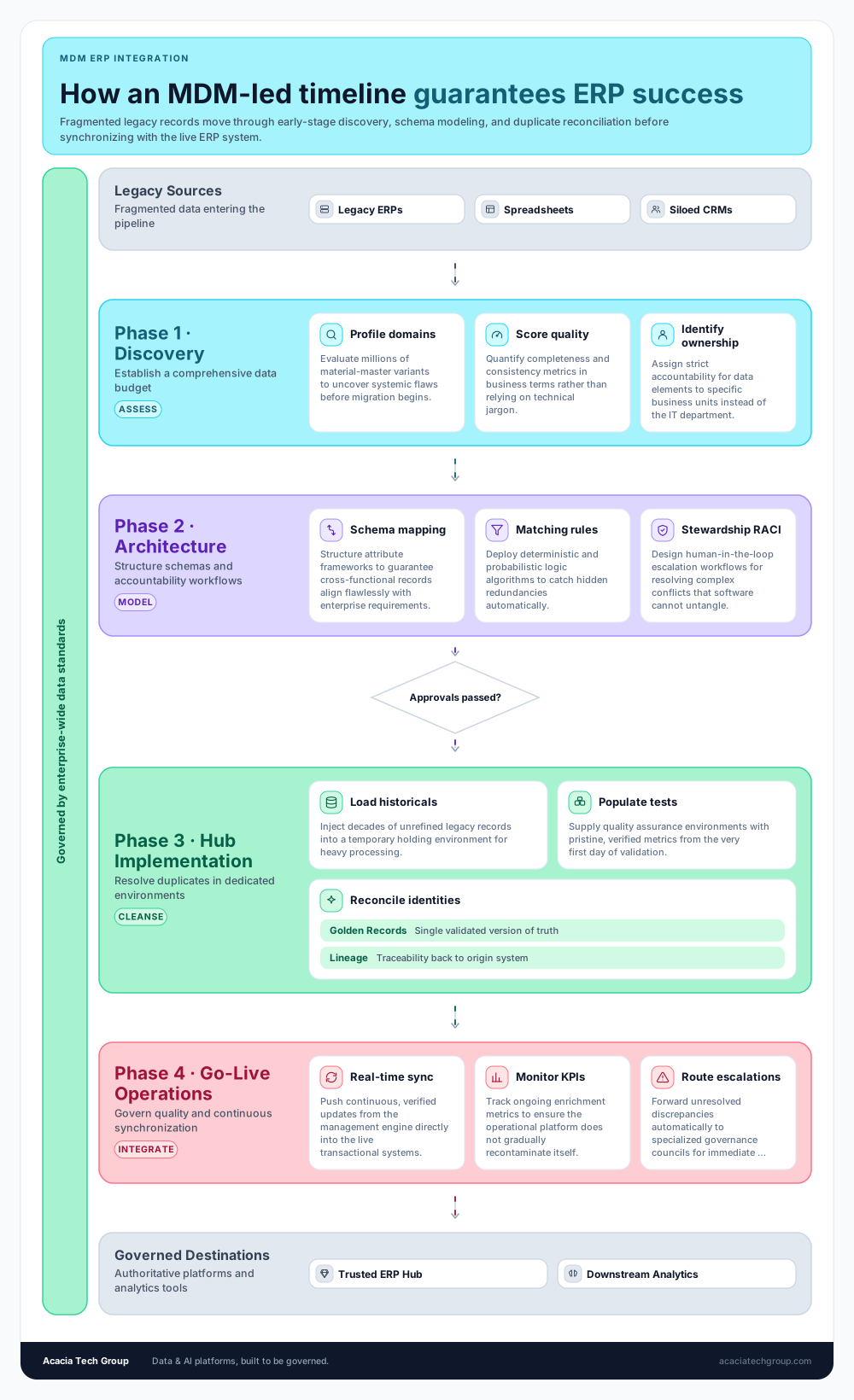
Fragmented legacy records move through early-stage discovery, schema modeling, and duplicate reconciliation before synchronizing with the live ERP system.
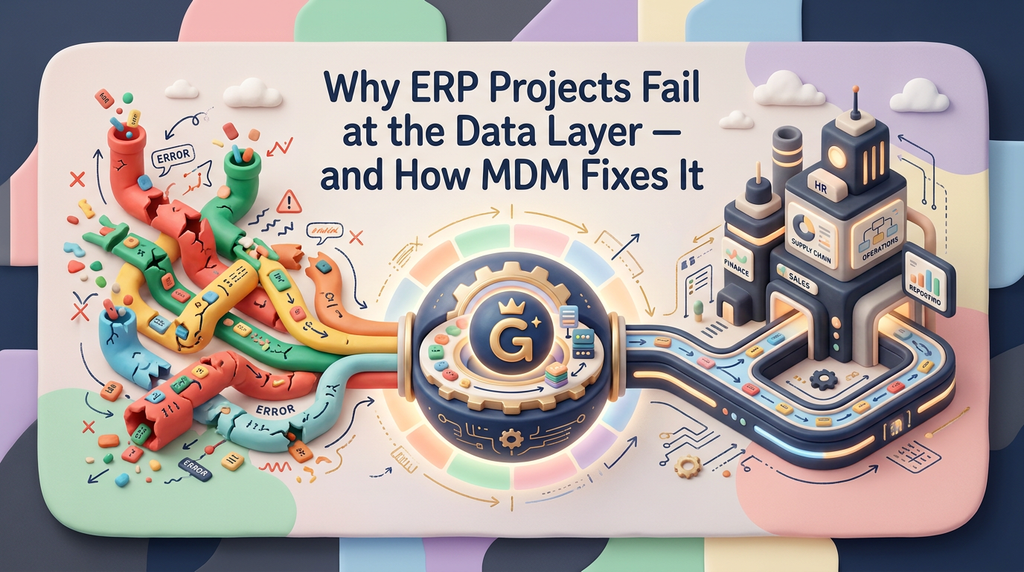
Why ERP Projects Fail at the Data Layer — and How MDM Fixes It. A new ERP is one of the largest technology investments an enterprise will make. Yet industry research consistently shows that data issues — not software bugs — are the leading cause of ERP implementation failure. The problem is rarely the ERP itself. The assumption is that existing data can be "migrated" without first being understood, standardized, and governed. This is where a strategic MDM ERP implementation becomes the deciding factor between a rollout that delivers ROI and one that drifts into scope creep, delays, and user abandonment.
Why ERP and Data Are Inseparable
An ERP is only as reliable as the data flowing through it. When customer records exist in three formats, product codes vary by region, and supplier data lives in spreadsheets with no validation rules, the ERP cannot reconcile them automatically. It imports what it is given—including inconsistencies, duplicates, and obsolete records. The result is predictable:
Finance closes books more slowly because the chart-of-accounts mappings are ambiguous.
Procurement over-orders or pays duplicate invoices because vendor master records are fragmented.
Sales misses cross-sell opportunities because customer hierarchies were never rationalized.
Operations cannot trust inventory counts because unit-of-measure definitions conflict across plants.
These are not training problems. They are data architecture problems that require robust ERP data governance before the first table is loaded.
The MDM Gap in Most ERP Implementations
Most ERP programs treat data migration tasks as a technical workstream: extract, transform, load, and validate. What they miss is that transformation without governance is temporary. If the source systems that caused poor data quality remain in operation, the new ERP will recontaminate itself within months. A proper MDM ERP implementation closes this gap by establishing a persistent, governed layer that sits above transactional systems — including the ERP — and defines:
Golden records: A single validated version of every customer, vendor, product, and account.
Data stewardship workflows: Human-in-the-loop processes to resolve conflicts and approve changes.
Lineage and auditability: Traceability from any ERP field back to its source and last modification.
Hierarchy management: Consistent roll-ups for reporting, compliance, and analytics.
Without master data management, ERP becomes the next silo. With MDM, it becomes the hub that consumes clean, authoritative data.
Integrating MDM into the Data Pipeline
A critical architectural decision in modern ERP rollouts is where MDM and the broader data-processing stages converge. Best practice suggests treating master data as a specialized, high-integrity process that runs in parallel with standard domain processing. While transactional data may move through bronze and silver stages for general analytics, master data domains are typically refined in their own dedicated MDM process. Once the "Golden Record" is established and governed within the MDM hub, it is shared with the rest of the business domains during silver-stage processing. This ensures that when the ERP consumes data, it is not just raw info, but a governed asset synchronized with the enterprise-wide data model.
When to Introduce MDM in the ERP Timeline
The most expensive mistake is treating MDM as a "phase two" initiative. By then, the ERP is live, users have adapted to workarounds, and the political will to re-engineer data flows has evaporated. The correct sequencing is essential for a clean data ERP rollout:
Phase | MDM Activity | ERP Impact |
|---|---|---|
Planning | Assess data domains, quality scores, and ownership gaps | Informs scope, realistic timelines, and data budget |
Design | Define golden-record schemas, matching rules, and stewardship RACI | ERP configuration aligns with the unified data model |
Build | Implement MDM hub, load historical masters, and reconcile duplicates | ERP test environments load clean data from day one |
Deploy | Sync MDM hub to ERP in real time; enable ongoing stewardship | Users see consistent, trusted data at go-live |
Operate | Monitor data quality KPIs; iterate on matching and enrichment | ERP ROI is protected as business rules, and sources evolve |
Common Pitfalls to Avoid
Underestimating data volume: A mid-market manufacturer may have millions of material-master variants accumulated over decades. Profiling this early prevents surprises during the data migration ERP phase.
Ignoring organizational ownership: Data quality is not an IT metric. It is a business accountability. Without a chief data steward or equivalent, MDM becomes shelfware.
Over-customizing the ERP: Every custom field added to accommodate messy legacy data creates technical debt. MDM rationalizes requirements so the ERP stays closer to standard.
Neglecting downstream analytics: The ERP is not the final destination. Data must also feed the data warehouse, AI/ML pipelines, and regulatory reports. MDM ensures consistency across all consumers.
How Acacia Tech Group Helps
Acacia works with enterprises and government agencies to build MDM-ready data foundations before the ERP contract is even signed. Our approach to master data management ERP rollouts is not tool-specific — we have implemented MDM on Informatica, Reltio, Semarchy, and custom cloud-native stacks — but it is always business-first:
Data Discovery & Quality Baseline: We profile every master domain, score it for completeness, uniqueness, and consistency, and present the findings in business terms rather than technical jargon.
MDM Architecture & Integration Design: We design the hub, matching engines, and APIs so that the ERP can consume golden records without custom ETL spaghetti.
Governance Operating Model: We help stand up ERP data governance stewardship councils, escalation workflows, and quality SLAs that outlast the implementation team.
ERP Co-Delivery: We align MDM sprint schedules with ERP milestones so clean data is available for each test cycle, not just at go-live.
Post-Launch Optimization: We monitor data-quality KPIs, tune match rules as the business evolves, and extend the MDM hub to new domains and systems.
Bottom Line
An ERP implementation transforms how the enterprise operates. The data layer is where that transformation succeeds or fails. MDM is not a side project — it is the structural discipline that makes the ERP investment durable, auditable, and scalable. If your organization is planning or already executing an ERP rollout, the question is not whether you can afford the MDM ERP implementation. It is whether you can afford not to have it.
FAQ
Can we add MDM after the ERP is already live?
Yes, but the cost and disruption are significantly higher. Retrofitting MDM requires reconciling data that has already diverged in the new system, retraining users who have formed workarounds, and often rebuilding integrations. Early adoption is strongly recommended.
Do we need a separate MDM product, or can the ERP handle master data?
Most ERPs include basic data management capabilities, but they are designed for transactional efficiency, not for enterprise-wide consolidation across multiple systems. A dedicated MDM hub provides cross-domain matching, stewardship workflows, and API distribution that ERP modules alone cannot match.
How long does MDM implementation take relative to an ERP project?
Typically, 30–50% of the ERP timeline runs in parallel. The MDM hub must be ready before ERP data-loading cycles begin, but design and governance work can start even earlier during ERP vendor selection.
What is the typical ROI of MDM in an ERP context?
Enterprises commonly report reduced invoice processing costs, faster financial close cycles, lower procurement leakage, and improved customer-campaign accuracy. The ROI case is usually built on operational efficiency and risk reduction rather than top-line growth.
Does Acacia work with specific ERP vendors?
We are vendor-agnostic. Our team has delivered MDM alongside SAP S/4HANA, Oracle Fusion, Microsoft Dynamics 365, and Workday, as well as niche government and industry-specific ERP platforms. The principles remain the same; the integration patterns adapt.