In the early 2000s, "Big Data" emerged as the next frontier for organizations eager to harness the vast amounts of information generated by digital activities. From social media posts and transaction records to machine-generated data, Big Data promised unprecedented insights, fueled decision-making, and drove innovation.
Fast forward to the 2020s, and there is growing discussion about whether big data is dead. While foundational concepts like Apache Hadoop no longer hold the same prominence, the industry is undergoing a metamorphosis rather than an end. Recent industry analysis suggests Big Data is shifting toward cloud-native solutions, ensuring its continued relevance as it evolves into the next wave of innovation.
What Is Big Data?
Big Data refers to the massive volumes of structured, semi-structured, and unstructured data that traditional data processing tools cannot handle efficiently. The defining characteristics of Big Data are often referred to as the "4 Vs":
Volume: The sheer amount of data generated from various sources.
Velocity: The speed at which new data is generated and processed.
Variety: The different data types, including text, images, video, and sensor data.
Veracity: The quality and trustworthiness of the data.
Beyond the basic 4 Vs, differentiation between standard and big data often comes down to the tools required. While normal datasets might fit in spreadsheets, big data requires dedicated databases and sophisticated software to be evaluated effectively.
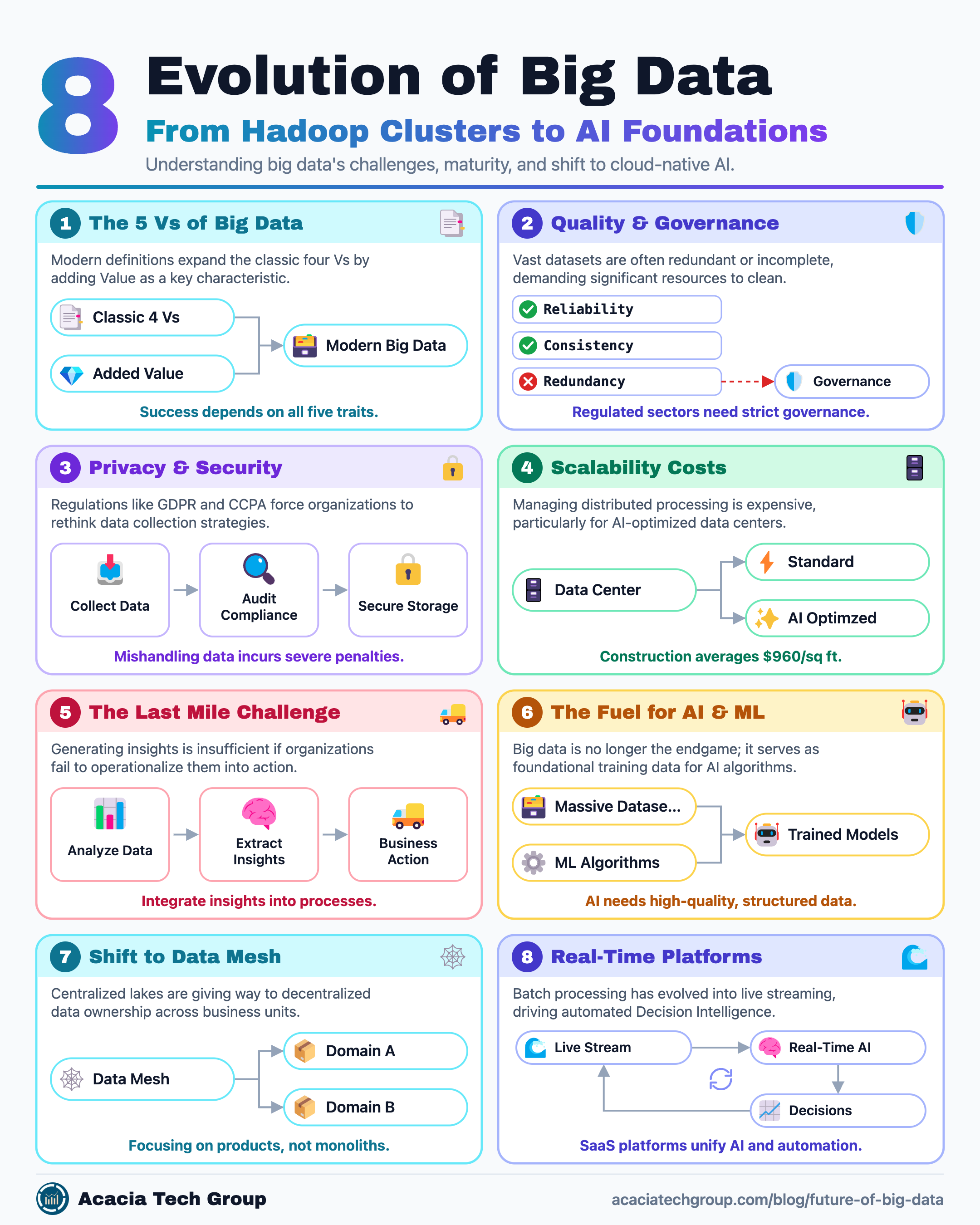
While the "4 Vs" are foundational, modern definitions have expanded to include Value and Veracity. As data has become essential capital for the world's largest tech companies, success now depends on all five characteristics to drive operational efficiency and new business initiatives.
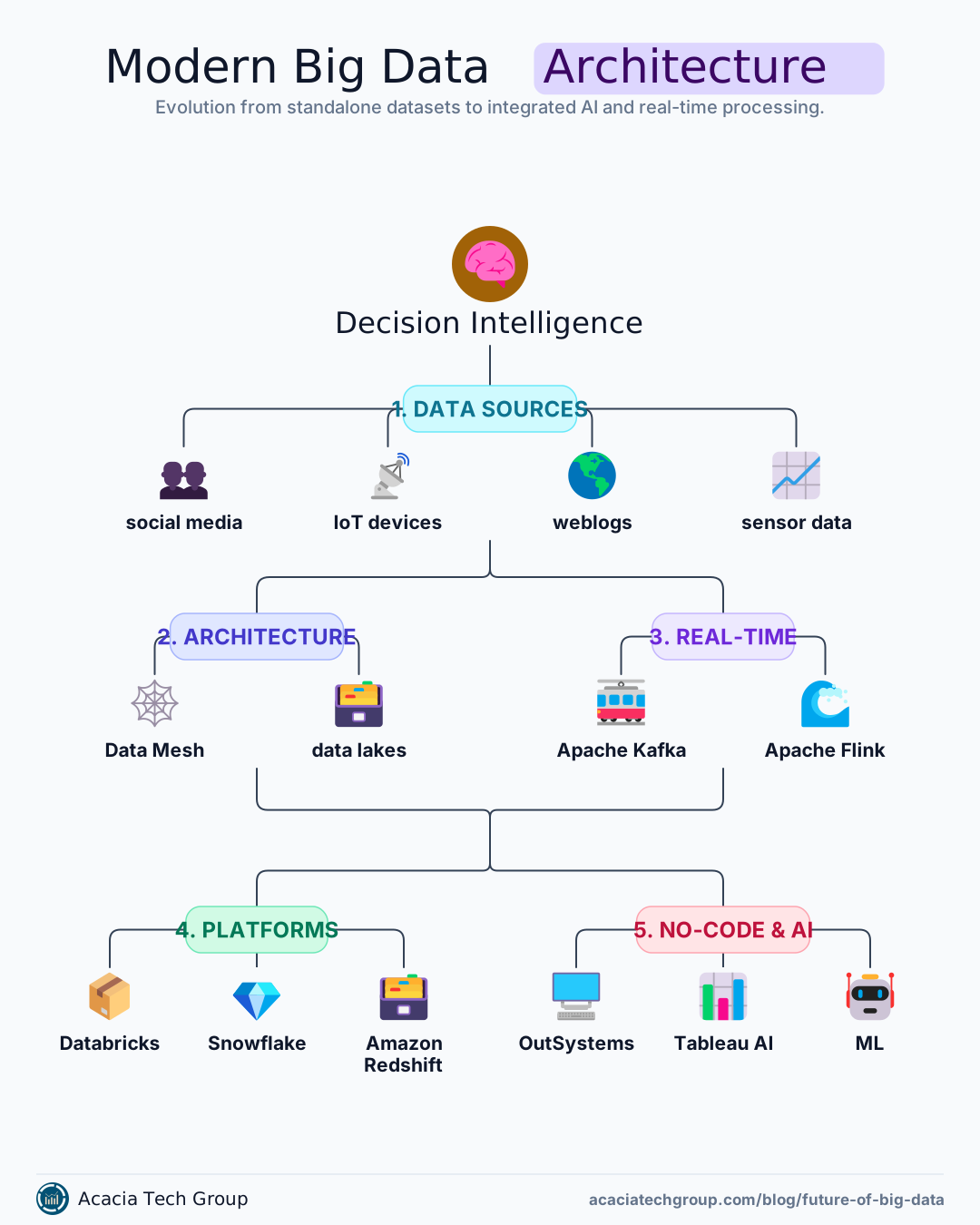
Big Data often originates from diverse sources, including social media, IoT devices, financial transactions, and weblogs. This evolution in big data analytics aims to uncover hidden patterns, correlations, and actionable insights that would be impossible to discern from smaller datasets.
In healthcare, these actionable insights are already proving their worth. For instance, analytics initiatives have successfully used big data to reduce patient readmission rates by 15%, demonstrating the tangible impact of operationalizing large-scale datasets.
Challenges with Big Data
Despite its potential, Big Data has faced significant challenges that question its long-term viability as a standalone concept:
1. Data Quality and Governance
One of Big Data's biggest hurdles is data quality. Organizations collect vast amounts of data, but much of it can be redundant, incomplete, or inaccurate. Managing and cleaning this data to ensure reliability and consistency requires significant resources. Ensuring proper data governance—particularly in regulated industries like healthcare and finance—adds another layer of complexity.
2. Data Privacy and Security
The increasing focus on data privacy, particularly with regulations such as GDPR (General Data Protection Regulation) and CCPA (California Consumer Privacy Act), has compelled organizations to reassess their data collection strategies. Consumers are increasingly aware of how their data is used, and mishandling sensitive information can result in severe legal and financial consequences.
Security considerations are also maturing through standardized frameworks and ethical mandates. Addressing ethical concerns regarding data privacy and security now requires robust governance frameworks to maintain stakeholder trust and ensure responsible practices as these technologies become increasingly actionable.
3. Scalability and Infrastructure
Processing massive amounts of data requires specialized infrastructure and computing power. While cloud computing has made scalability more accessible, organizations still face high costs and complexity in managing distributed storage and processing systems. The rise of streaming data (real-time analytics) also demands faster, more sophisticated processing frameworks.
As of 2026, data center construction costs average $960 per square foot, a sharp increase from $630 in 2025. For organizations building AI-optimized facilities, costs can run 50–100% higher due to increased power density and advanced cooling requirements.
4. Talent Shortage
Data scientists, machine learning engineers, and data governance experts are in high demand but short supply. The specialized skill sets needed to manage Big Data ecosystems are rare, and many organizations struggle to hire and retain talent that can navigate large-scale data analysis.
5. Moving Beyond Analytics
While analyzing vast datasets is valuable, organizations often fail to operationalize big data insights. Generating insights is one thing; integrating them into business processes and decision-making frameworks is another. The "last mile" challenge in analytics—translating insights into action—remains persistent.
Is Big Data Dead?
Declaring big data dead misinterprets its evolution. Some argue the era is over because modern hardware lets single machines handle what once required clusters, but the need for advanced data analytics keeps growing. Big Data has become so embedded in modern data architecture that the term itself is fading into the background of Artificial Intelligence (AI), Machine Learning (ML), and Internet of Things (IoT) discussions.
1. The Shift to AI and ML
Big Data is no longer the endgame—it's now the fuel for AI and ML algorithms. These technologies require massive datasets to train and optimize models, making Big Data foundational for AI advancements. As AI becomes more sophisticated, the need for high-quality, well-structured data is more critical than ever.
2. Data Mesh and Modern Architectures
Traditional data lakes and centralized architectures are giving way to modern approaches like Data Mesh, which decentralizes data ownership and governance across business units. This evolution in big data analytics lets organizations manage Big Data more flexibly and efficiently by focusing on data products rather than monolithic datasets.
3. The Rise of Real-Time Analytics
While batch processing of Big Data was the standard for years, the shift toward real-time analytics and streaming data is redefining how businesses derive value and operationalize big data insights. Technologies such as Apache Kafka, Apache Flink, and Apache Spark Streaming now enable organizations to act on data as it's generated, moving away from static, retrospective analysis.
By 2026, real-time analytics is evolving from a competitive advantage into a core necessity. Organizations are moving toward Decision Intelligence (DI), a market projected to reach $36.34 billion by 2030, that connects business logic with live data and uses simulation to prevent high-stakes mistakes.
4. SaaS and No-Code Solutions
The declining use of "Big Data" as a buzzword reflects the widespread adoption of Software-as-a-Service (SaaS) platforms and no-code/low-code solutions. Instead of building custom infrastructure, organizations now leverage unified environments. By 2026, platforms like Databricks, Snowflake, Microsoft Fabric, and Google BigQuery continue to dominate because they integrate AI, automation, and governance into a single environment, reducing the need to stitch together multiple products.
This shift lets even non-technical teams process large datasets with tools like OutSystems or Tableau AI, delivering the scalability and flexibility needed to move beyond heavy engineering investments. Major cloud providers have further standardized this by offering specialized services for diverse needs, from Amazon Redshift's data warehousing to Google Cloud's unified batch and stream processing.
The Future of Big Data
Rather than questioning whether big data is dead, we should see it as matured. The focus has shifted from mere data size to its utility. Organizations are moving toward hyperscale data processing, aiming to maintain full data richness to feed future AI models rather than just store aggregates.
Market projections support this continued relevance; the global big data market is expected to grow from $324.59 billion in 2026 to $516.29 billion by 2031. This 9.7% CAGR reflects a sustained reliance on data platforms for real-time operations and regulatory compliance across financial services and healthcare.
In the upcoming years, we can expect the future of big data to be driven by:
Data democratization: As data tools become more accessible, non-technical teams will engage directly with Big Data.
Advanced analytics and AI: Big Data will fuel more advanced AI models, particularly in natural language processing, autonomous systems, and predictive analytics.
Edge computing: As IoT devices generate real-time data, edge computing processes data closer to the source, reducing latency and enabling faster decision-making.
A growing pitfall in this expansion is the environmental impact of large-scale processing. Future strategies must address sustainability, as the tech industry faces pressure to reduce the carbon footprint of green data centers while managing increasingly complex AI systems. Organizations are now treating AI-powered analytics as products, investing in proper evaluation, ownership, and monitoring rather than disconnected proofs of concept.
Conclusion
The "Big Data" era may be over as a buzzword, but its impact and relevance remain undeniable. The challenges surrounding Big Data—from governance to scalability—are real but solvable through a modern data architecture. The future of big data lies not in managing massive amounts of data, but in extracting meaningful insights and actionable intelligence, and operationalizing those insights for business growth.
While the term "Big Data" may fade, its principles will continue to shape tomorrow's data-driven organizations.
Further reading
What Is Big Data? — A comprehensive look at the evolution of data from 1960s relational databases to modern open-source frameworks.
Evolution of Big Data Technologies — A systematic review of trends and challenges in distributed systems and parallel processing.
Big Data White Paper — Detailed technical analysis of data asset management, security standards, and industry convergence.