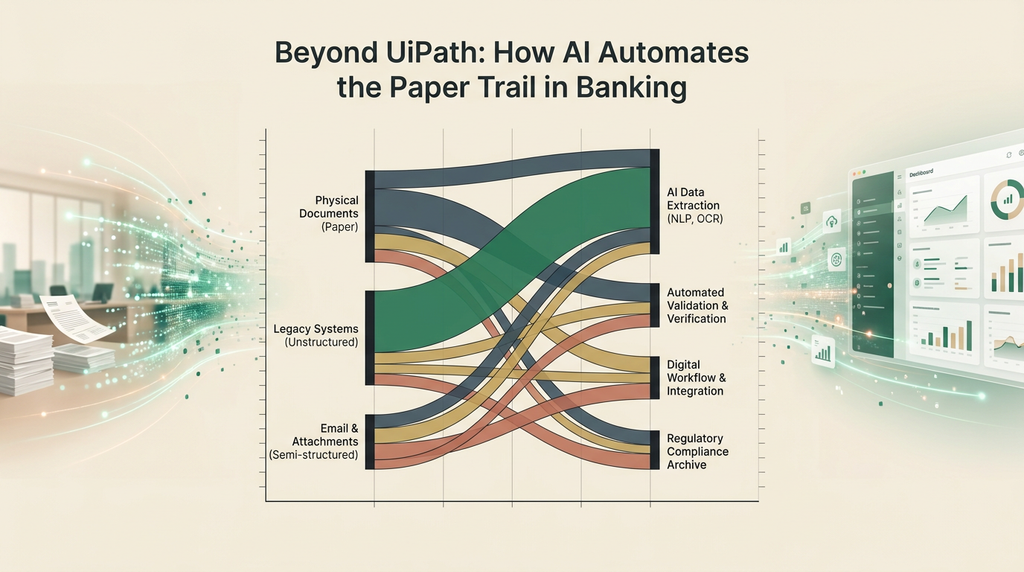
Beyond UiPath: How AI-Driven Automation Eliminates the Paper Trail in Banking
Banks still run on paper — or, more precisely, on the digital ghosts of paper. Loan files, KYC packets, wire confirmations, mortgage documents, trade tickets, and compliance attestations move through institutions as scanned PDFs, faxes, and email attachments that humans must read, key in, reconcile, and file. Robotic process automation (RPA) platforms like UiPath, Automation Anywhere, and Blue Prism have proven that software robots can handle repetitive clicking. The next leap — combining RPA with modern AI — is what finally lets banks retire the paper trail rather than just speeding it up.
At Acacia Tech Group, we help financial institutions design and operate the data and AI infrastructure that turns document-heavy back-office work into measurable, auditable automation. This article explains where the opportunity is, how AI extends what UiPath-style tools already do, and how to roll it out without creating new compliance risk.
Why Banking Is Drowning in Paper
Despite a decade of "digital transformation," document processing remains one of the most labor-intensive functions in banking. A single commercial loan can generate hundreds of pages across financial statements, tax returns, entity documents, and signed disclosures. Every one of those pages typically passes through a human who extracts data, checks it against a system of record, and flags exceptions.
The cost shows up in three places:
Labor: Skilled analysts spend the majority of their time on data entry and reconciliation rather than judgment.
Cycle time: Manual handoffs add days to loan decisions, account openings, and dispute resolution — directly affecting customer experience and win rates.
Risk: Manual transcription introduces errors, and inconsistent processes make audits and regulatory exams more expensive.
What RPA Solved — and Where It Stops
Tools like UiPath excel at deterministic, rules-based tasks: log into a system, copy a field, paste it somewhere else, click submit. When the inputs are structured and predictable, RPA delivers fast, reliable savings.
The problem is that most banking paperwork is unstructured. A robot can move a PDF from one folder to another, but it cannot reliably understand that "borrower" on one form and "applicant" on another refer to the same entity, or interpret a hand-annotated financial statement. Traditional RPA breaks the moment a document layout changes or a field is ambiguous. That brittleness is why so many automation programs stall after the easy wins.
How AI Extends UiPath-Style Automation
Modern AI closes the gap between rigid robots and messy documents. Three capabilities matter most:
1. Intelligent Document Processing (IDP)
Machine learning models for optical character recognition, layout understanding, and entity extraction can read documents the way a person does — identifying parties, amounts, dates, and clauses regardless of where they appear on the page. This turns a scanned mortgage packet into structured, queryable data.
2. Large Language Models for Comprehension and Summarization
LLMs add reasoning on top of extraction: classifying document types, summarizing a 60-page credit file into a decision brief, reconciling conflicting values, and answering natural-language questions about a customer's file. This is where automation moves from "data entry" to genuine decision support.
3. Agentic Workflows
Rather than a single robot following a single script, AI agents can orchestrate multi-step processes — fetch a document, extract it, validate it against the core banking system, route exceptions to a human, and update every downstream record. UiPath itself is moving in this direction; the durable advantage comes from designing these workflows on a governed data foundation. We cover the engineering discipline required in The Agent Engineer's Playbook.
High-Value Use Cases in Banking
Process | Manual Pain Point | AI + RPA Outcome |
|---|---|---|
Loan & mortgage origination | Manual extraction from income, tax, and entity documents | Auto-populated applications with exception-only review |
KYC / AML onboarding | Re-keying IDs and proof-of-address documents | Straight-through verification with audit trail |
Trade & wire confirmations | Matching tickets across systems by hand | Automated reconciliation and break detection |
Dispute & chargeback handling | Reading customer correspondence and statements | Auto-classified cases with drafted responses |
Regulatory reporting | Assembling evidence from scattered documents | Continuously assembled, traceable evidence |
The Foundation: Governance, Not Just Bots
Automating regulated workflows is not a plug-and-play exercise. In banking, every automated decision must be explainable, auditable, and reversible. That means the AI layer has to sit atop well-governed data — with lineage, access controls, and quality checks — rather than scraping documents in isolation.
This is exactly why document automation programs succeed or fail on data engineering, not on the bot tool. A reliable pipeline that lands extracted data into a governed platform, validates it, and tracks every transformation is what makes the automation trustworthy. Our perspective on building that backbone is detailed in Data Engineering Services: Building Production-Grade Data Pipelines and in our guide to AI governance that actually works.
How Acacia Helps Banks Automate the Paper Trail
Acacia Tech Group partners with financial institutions to move document-heavy processes from manual to autonomous — safely. Our approach typically follows four stages:
Opportunity assessment: We map your highest-volume, highest-friction document workflows and quantify the time, cost, and risk associated with each.
Architecture & integration: We design the data and AI layer that connects intelligent document processing and LLMs to your existing RPA investments (including UiPath) and core banking systems — on a governed, auditable foundation.
Pilot to production: We stand up a focused pilot on a single workflow, prove the accuracy and savings, then harden it for production with monitoring, exception handling, and human-in-the-loop controls.
Scale & operate: We extend automation across processes and ensure reliability through service-level objectives and observability.
The result is not "robots replacing people," but skilled staff freed from transcription to focus on credit judgment, customer relationships, and risk, while the institution gains faster cycle times and a cleaner audit trail.
Frequently Asked Questions
Is AI document automation different from RPA tools like UiPath?
They are complementary. RPA platforms like UiPath automate structured, rules-based clicks and system interactions. AI — intelligent document processing and large language models — adds the ability to read, understand, and reason over unstructured documents. The most effective banking automation combines both: AI interprets the document, and RPA carries the data into downstream systems.
Is this safe for regulated banking processes?
Yes, when it is built on a governed data foundation. Every extracted value should be traceable to its source document, access should be controlled, and ambiguous cases should route to a human reviewer. Properly designed, automation improves auditability compared to manual processes because every step is logged and consistent.
How quickly can a bank see results?
A focused pilot on a single high-volume workflow — such as loan document extraction or KYC onboarding — can typically demonstrate measurable accuracy and time savings within a few weeks, before scaling to additional processes.
Do we have to replace our existing automation investments?
No. We design the AI layer to extend the RPA tools you already own. The goal is to make existing robots dramatically more capable by enabling them to understand documents, not to rip and replace your platform.