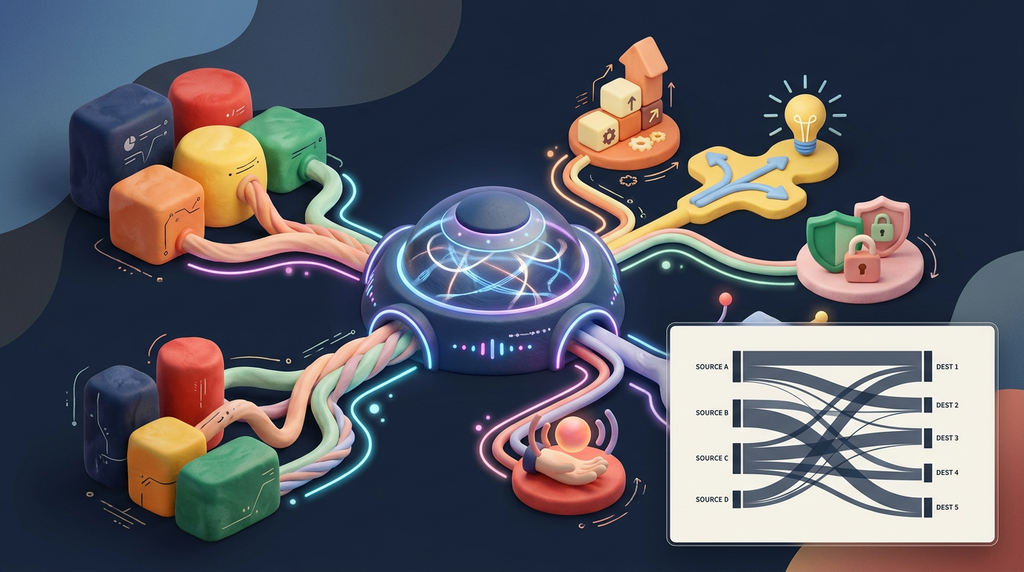
From Data Platforms to Decision Platforms: The Rise of AI-Led Systems
Organizations today are not lacking data. They lack timely, consistent decision-making.
Over the past decade, enterprises have invested heavily in data platforms, dashboards, and analytics tools. These investments have delivered visibility—but visibility alone does not drive outcomes.
The next evolution is clear:
From data platforms to AI-led decision platforms.
The Gap: Insight vs Action
Most organizations operate in a familiar pattern:
- Data is collected and processed
- Dashboards are generated
- Teams interpret insights
- Decisions are made manually
This model introduces friction:
- Delays between insight and action
- Inconsistent decision-making across teams
- Over-reliance on key individuals
- Limited ability to scale
In fast-moving environments, this latency has a measurable cost.
What Is an AI-Led System?
An AI-led system moves beyond reporting and into execution.
It is a system where:
- Data is constantly processed
- Machine learning models provide predictions in real time
- Decisions are automatically made within set guardrails
- Actions are carried out without manual input
- Outcomes are recorded and used to improve future decisions
This isn't about replacing humans. It's about scaling decision-making.
The Architecture Behind AI-Led Platforms
A modern AI-led platform generally consists of the following layers:
1. Unified Data Foundation
A blend of scalable processing and governed storage:
- Databricks for large-scale processing and feature engineering
- Snowflake for structured, governed data access
This forms a single, reliable data backbone.
2. AI and Machine Learning Layer
Models are built to:
- Forecast outcomes (risk, demand, behavior)
- Suggest or determine next steps
The result is no longer just data—it becomes decision-ready intelligence.
3. Decisioning Layer
This is the most important—and often overlooked—component.
Here, model outputs are turned into actions using:
- Business rules
- Confidence thresholds
- Contextual data
This layer decides what should happen next.
4. Execution Layer
Decisions are operationalized through:
- Workflow orchestration
- API integrations
- Automated triggers
Examples include:
- Creating tasks in operational systems
- Sending alerts or notifications
- Initiating transactions or updates
If a system stops at dashboards, it is not AI-driven.
5. Feedback Loop
Every action produces an outcome.
That outcome is recorded and fed back into the system to:
- Retrain models
- Enhance accuracy
- Improve future decisions
This establishes a continuous learning cycle.
Real-World Application: Healthcare
Consider a patient risk management scenario:
- Data is collected from clinical systems
- Models assess patient deterioration risk in near real time
- The decision layer evaluates risk alongside business rules
- The system automatically initiates interventions and alerts, care teams
What once took manual review cycles now happens in minutes—with greater consistency and scale.
Business Impact
Organizations adopting AI-driven systems gain tangible benefits:
- Decision delays shortened from days to minutes
- Reduced operational costs via automation
- Better outcomes—clinical, financial, or customer satisfaction
- Greater scalability without increasing staff
- Ongoing performance enhancements over time
This is where data becomes a genuine competitive edge.
Why Most Organizations Fall Short
Many companies stop at creating data platforms and dashboards.
The missing elements are:
- Decision-making frameworks
- Workflow integration
- Continuous learning cycles
Without these, data remains insightful but isn't transformative.
The Leadership Shift
The move toward AI-powered systems is both technical and organizational.
Leaders need to shift from:
- “How do we report on data?” to
- “How do we act on data in real time?”
This involves:
- Strong governance and clear policies
- Well-defined ownership of decision-making areas
- Collaboration across business and technology teams
Final Thought
The future of enterprise data isn't about better dashboards.
It's about creating systems that:
- Decide
- Act
- Learn
Transitioning from insight-driven to action-driven operations.
That forms the basis of an AI-led enterprise.