How to Evaluate an Enterprise Data Analytics Platform: Snowflake vs Databricks vs Microsoft Fabric
Choosing a data analytics platform is one of the highest-leverage decisions an enterprise makes. The platform you standardize on shapes your cost curve, your governance posture, and how quickly teams can turn raw data into decisions. This enterprise data platform comparison explores how most evaluations collapse into feature checklists and vendor demos that reward whoever tells the best story rather than the platform that best fits your organization.
This guide gives you a vendor-neutral framework for how to evaluate data platforms, then applies that framework to the three platforms most commonly shortlisted today: Snowflake vs Databricks and Microsoft Fabric.
Why a Framework Beats a Feature List
Every modern platform can ingest data, run SQL, and connect to a BI tool. Feature parity is high and rising, so a checklist rarely produces a clear winner. What actually differentiates platforms is how they behave under your conditions — your workloads, your team's skills, your governance requirements, and your five-year cost trajectory.
When considering an enterprise data platform comparison, a framework forces the conversation onto those conditions. It replaces "which platform has the most features?" with "which platform makes our specific goals cheaper, safer, and faster to reach?"
The Seven-Criteria Evaluation Framework
Score each candidate platform against these seven criteria, weighted to your priorities. A simple 1–5 scale per criterion, multiplied by a weight, produces a defensible shortlist that survives executive scrutiny.
1. Workload Fit
Map your real workloads before you score anything. Are you primarily running BI and SQL analytics, or heavy data science, machine learning, and streaming? Platforms optimized for warehousing behave differently from those built around a lakehouse and Spark. The best data analytics platform for a BI-heavy finance org is rarely the best one for an ML-driven product team.
2. Total Cost of Ownership
Look past the sticker price of compute. Real TCO includes storage, idle-cluster waste, data egress, the cost of specialist talent, and the migration effort to get there. Model three years, not three months, and stress-test the pricing model against your peak and growth scenarios.
3. Governance and Security
Enterprise adoption lives or dies on governance. When learning how to evaluate data platforms, you must specifically assess fine-grained access control, data lineage, cataloging, audit logging, and how the platform handles regulated data. A platform that makes governance a first-class capability reduces both risk and the hidden cost of compliance work.
4. Openness and Lock-In
Assess how easily data and workloads move in and out. Open table formats such as Apache Iceberg and Delta Lake, standard SQL, and portable pipelines lower switching costs and protect negotiating leverage. Openness is no longer just a philosophy; it is a technical requirement for multi-engine interoperability.
5. Ecosystem and Integration
The platform must fit the estate you already run — cloud provider, BI tools, orchestration, and identity. Native integration with your existing stack removes friction; forcing a platform against the grain of your ecosystem creates permanent tax.
6. Talent and Operating Model
The right platform matches your team's skills or a realistic hiring plan. A SQL-first analytics team and a Spark-first engineering team will thrive on different platforms. Factor in training, the depth of the talent market, and how much platform engineering the tool demands to run reliably.
7. Time to Value
How quickly can a new team ship a governed data product? Serverless options, managed services, and strong defaults shorten the path from procurement to production. Time to value is often the criterion executives feel most directly.
Applying the Framework: Snowflake vs Databricks vs Microsoft Fabric
The three platforms below dominate enterprise shortlists. None is universally "best" — each earns its place under different conditions.
Snowflake
Snowflake built its reputation as a cloud data warehouse with near-zero operations and clean separation of storage and compute. In any snowflake vs databricks debate, Snowflake excels at SQL analytics, BI workloads, and secure data sharing. While it has recently embraced open standards like Apache Iceberg and expanded its AI/ML capabilities, its center of gravity remains governed, highly automated, SQL-first analytics.
Strongest when: BI and SQL analytics dominate, low operational overhead is a priority, and zero-copy data sharing across partners matters.
Watch for: credit consumption on heavy, continuous ingestion workloads and the complexity of managing costs as usage scales.
Databricks
Databricks pioneered the lakehouse — one platform spanning data engineering, analytics, and machine learning on open Delta Lake foundations. It is the natural fit for organizations with serious data science, streaming, and large-scale transformation needs. Its unified governance through Unity Catalog provides a consistent layer across all data and AI assets.
Strongest when: machine learning, streaming, and complex data engineering are central, and open formats are a strategic priority. See our practical guide to medallion architecture on Databricks.
Watch for: the need for maturing SQL capabilities compared to dedicated warehouses and the requisite investment in Spark/engineering talent.
Microsoft Fabric
Microsoft Fabric is an all-in-one analytics solution for enterprises that includes everything from data movement to data science, Real-Time Analytics, and business intelligence. It is a unified SaaS experience anchored by OneLake. For organizations already standardized on the Microsoft stack, its deep integration with Power BI and Microsoft 365 provides a friction-less path to adoption.
Strongest when: the enterprise is Microsoft-centric, Power BI is the reporting standard, and a single integrated SaaS experience is preferred over managing multiple services.
Watch for: the roadmap status of specific specialized features and potential lock-in to the Azure/Microsoft ecosystem.
A Side-by-Side Summary
Use this as a starting orientation, not a verdict — your weighted scores against the seven criteria should drive the decision.
SQL and BI analytics: Snowflake and Microsoft Fabric lead; Databricks SQL has made significant strides in performance.
Data science and ML: Databricks leads; Snowflake and Fabric are rapidly expanding their native AI frameworks.
Openness and portability: Databricks (Delta) and Snowflake (Iceberg) both now offer strong support for open table formats.
Ecosystem fit: Microsoft Fabric for Microsoft shops; Snowflake for cloud-agnostic or multi-cloud estates; Databricks for engineering-led teams.
Time to value: Fabric and Snowflake for fast, SaaS-based starts; Databricks rewards investment in data engineering maturity.
How to Run the Evaluation in Practice
Turn the framework into a decision with a structured proof of concept by considering how to evaluate data platforms through hands-on testing:
Define weighted criteria first — agree the weights before you see a single demo so vendors can't reframe your priorities.
Run a bake-off on real workloads — use representative data and your hardest queries, not the vendor's sample dataset.
Measure TCO on the POC — capture actual compute and storage consumption and extrapolate to production scale.
Score governance with a real use case — implement one regulated data product end-to-end, including access control and lineage.
Once you have a foundation, the layered medallion architecture pattern works across all three platforms and keeps your design portable as priorities evolve.
The Bottom Line
There is no single best enterprise data analytics platform — only the best fit for your workloads, your team, and your governance and cost constraints. A weighted, criteria-based enterprise data platform comparison run against real workloads consistently produces a decision that survives both the executive review and the next three years of operation.
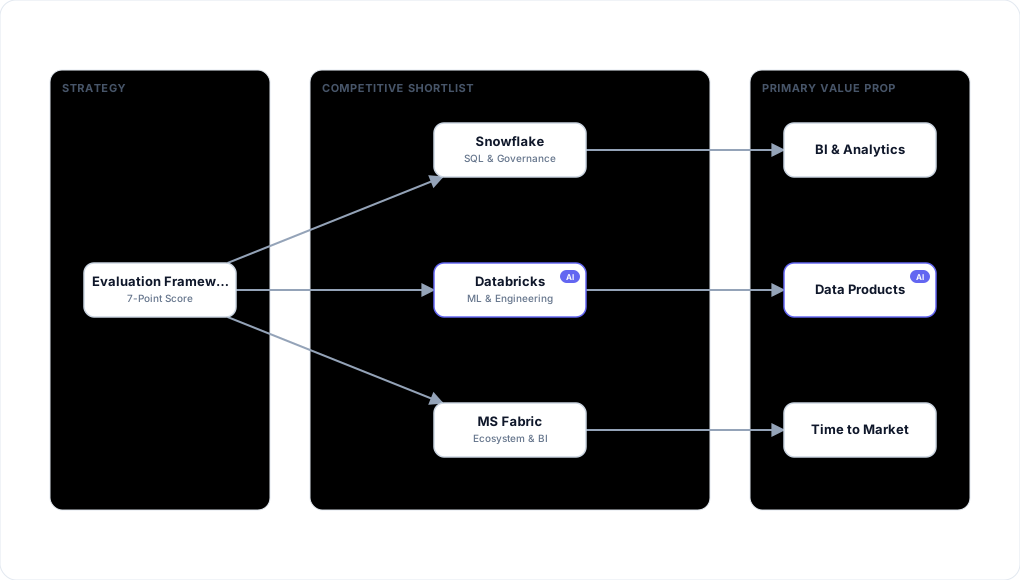
The diagram illustrates a strategic mapping of the evaluation framework against the three dominant platforms, highlighting where each vendor excels in delivering specific business outcomes.