Understanding Data Warehousing: Architecture, History, and Practical Use Cases
Introduction
In today’s data-driven world, organizations generate information from countless systems—sales platforms, customer feedback tools, IoT devices, HR applications, and more. While cloud infrastructure and global connectivity make it easy to set up operations across regions, the real challenge lies in bringing all this fragmented data together to extract meaning from it.
That’s where data warehousing comes in.
A well-designed data warehouse acts as the single source of truth for an enterprise—integrating, cleansing, and organizing data from multiple systems into a central, consistent repository. It allows decision-makers to view their business holistically, identify trends, and make confident, data-backed decisions.
What Is a Data Warehouse?
A Data Warehouse retrieves data from multiple sources and consolidates it into a centralized location.
It eliminates duplicates, organizes information, and ensures that the data is consistent and ready for analysis.
Examples of popular data warehouse platforms include Azure Data Factory, Amazon Redshift, Snowflake, Oracle, IBM Infosphere, and Teradata—each designed to manage large-scale data storage and transformation.
Real-World Example
Imagine a multinational retailer with operations spanning multiple regions. It collects data from stores, online transactions, and customer reviews. This data exists in different formats and systems, making it difficult to analyze efficiently.
By implementing a Data Warehouse, the company can bring all of that information together. Analysts and executives can now visualize global performance, identify purchasing trends, and forecast demand across regions—all from a single, unified view.
Deploying Data Warehousing Solutions
Where Are These Solutions Deployed?
In the early days, organizations hosted data warehouses on-premises, using local servers to extract, clean, and store data. These setups required substantial investment in hardware and maintenance.
Today, most companies deploy cloud-based data warehouses, which eliminate the need for physical infrastructure. The cloud provider manages scalability, availability, and performance—allowing teams to focus on analytics rather than maintenance.
Cloud-based platforms like Snowflake and Redshift can scale on demand, making them ideal for businesses of all sizes.
History of Records
Are Historical Records Also Stored?
One of the key benefits of a data warehouse is its ability to maintain historical data.
By archiving changes to information over time, organizations can analyze trends, measure performance, and make more informed decisions.
Data typically includes both static and dynamic dimensions. For example, a customer’s birth date never changes (static), but their address or spending category might (dynamic). The latter is managed through a concept called Slowly Changing Dimensions (SCDs)—which track changes and maintain history.
Types of Slowly Changing Dimensions
- Keeping the original (no change)
- Overwriting the existing value
- Adding a new row to preserve the old record
- Using a history table to maintain versions
- Combining multiple approaches
For instance, “adding a new row” allows analysts to see both current and past values, enabling precise time-based comparisons—essential for financial forecasting and performance analytics.
Data Warehousing Three-Tier Architecture
Let’s Delve Into the Architecture
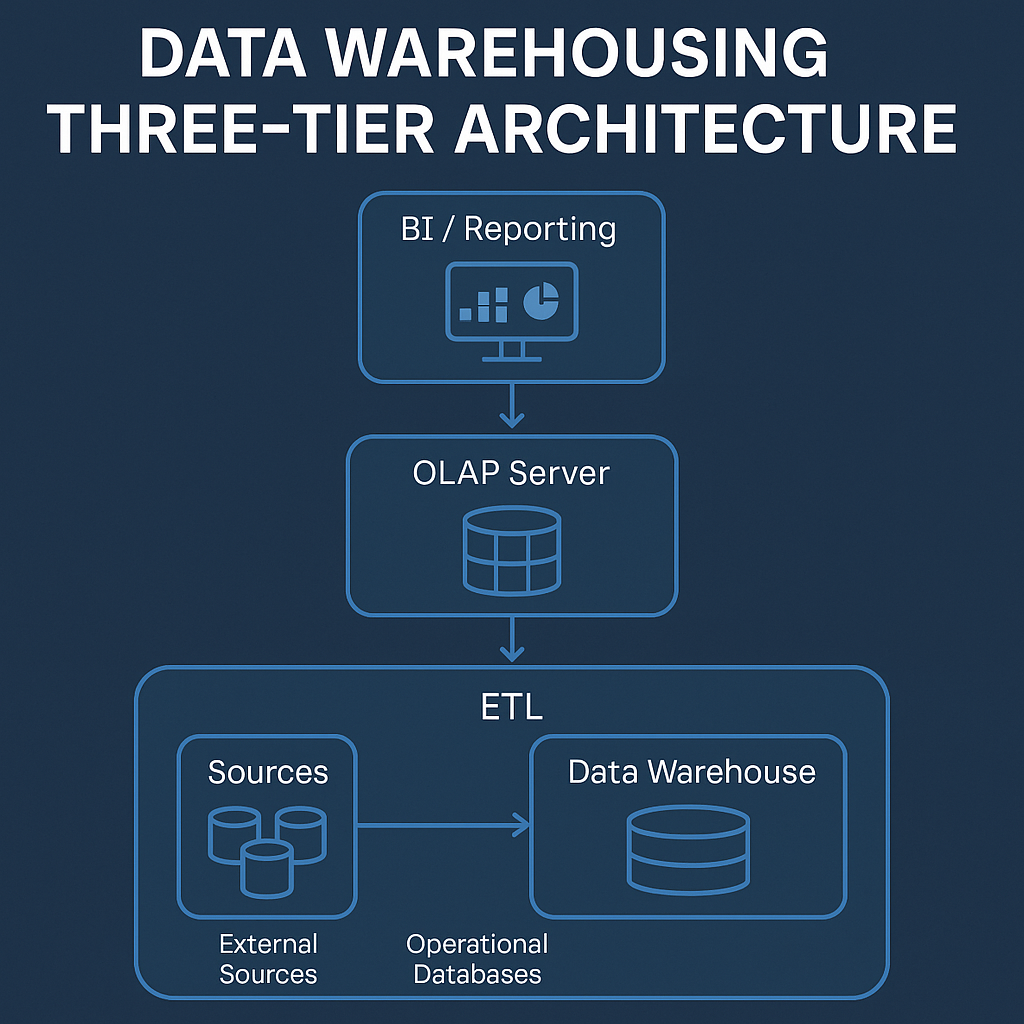
Modern data warehouses typically follow a three-tier architecture that separates data storage, processing, and presentation layers. This separation ensures scalability, performance, and clarity in design.
Bottom Tier – Data Storage
This layer consists of a relational database or data lake that stores the raw and transformed data.
It includes ETL (Extract, Transform, Load) tools that pull data from various sources, cleanse it, and load it into the warehouse.Middle Tier – Data Processing
The middle layer hosts the OLAP (Online Analytical Processing) server, which structures the data into multidimensional cubes.
This enables complex analytical queries and fast aggregations across different dimensions like region, time, or product.Top Tier – Data Presentation
The top layer consists of reporting and visualization tools. It delivers insights to business users through dashboards, KPIs, and interactive reports—making data accessible and actionable.
Returning to our retail example:
Without such an architecture, engineers would have to query dozens of systems manually. The three-tier model automates this process, transforming complexity into simplicity.
Source-driven vs. Destination-driven Architectures
There are two primary ways data flows into a warehouse:
- Source-driven (Push Model): Data is sent automatically or on a schedule from source systems.
- Destination-driven (Pull Model): The warehouse requests data when needed.
Choosing between these models depends on the organization’s data freshness needs and system architecture.
Dimensional schemas are not the only way to model a warehouse. Teams that need scalable, auditable historization often evaluate Data Vault 2.0 as an alternative methodology.
Summary
Data warehousing has evolved from on-premises infrastructure to powerful, cloud-native platforms capable of scaling globally.
It serves as the foundation for modern analytics, enabling organizations to unify scattered data, maintain historical accuracy, and derive insights that drive innovation.
Whether analyzing customer behavior, tracking operational KPIs, or forecasting demand, a robust data warehouse turns raw data into a strategic asset.