Introduction
Smartphones have become extensions of ourselves. We rely on them not only to communicate, but to navigate, create, learn, and remember.
By 2026, that relationship has fundamentally shifted: phones have transformed from smart devices into intelligent companions. The fusion of generative AI, on-device learning, and context-aware agents now lets smartphones anticipate intent, act autonomously, and personalize experiences in real time — often without a cloud connection. Analysts at Wedbush have called 2026 the start of the AI supercycle, the most significant mobile hardware refresh in over a decade.
This article explores how this shift is unfolding, from everyday applications to executive implications for innovation, privacy, and strategy.
The Evolution of AI on Smartphones
Early virtual assistants like Siri and Google Assistant relied heavily on cloud-based processing to interpret voice commands. They handled requests such as “set an alarm” or “send a text” — useful but limited.
In 2026, flagship smartphones routinely exhibit agentic AI behaviors: planning multi-step tasks, summarizing inboxes, dynamically tuning camera pipelines, and generating text, images, and code across modalities — often without touching the cloud.
Deloitte’s Technology, Media & Telecom Predictions observed that “on-device generative AI will redefine what ‘smart’ means in smartphones,” citing advances in energy efficiency and neural processing power. Updated 2026 forecasts from Canalys and Omdia now project that more than 60% of new smartphones shipped by 2028 will be AI-capable at the hardware level — and that the majority of flagships sold in 2026 already meet that bar.
How On-Device AI Works
At the heart of this evolution lies the Neural Processing Unit (NPU) — a specialized chip that performs billions of operations per second to run AI models locally. Combined with lightweight language and vision models, this enables fast, private computation without constant cloud connectivity.
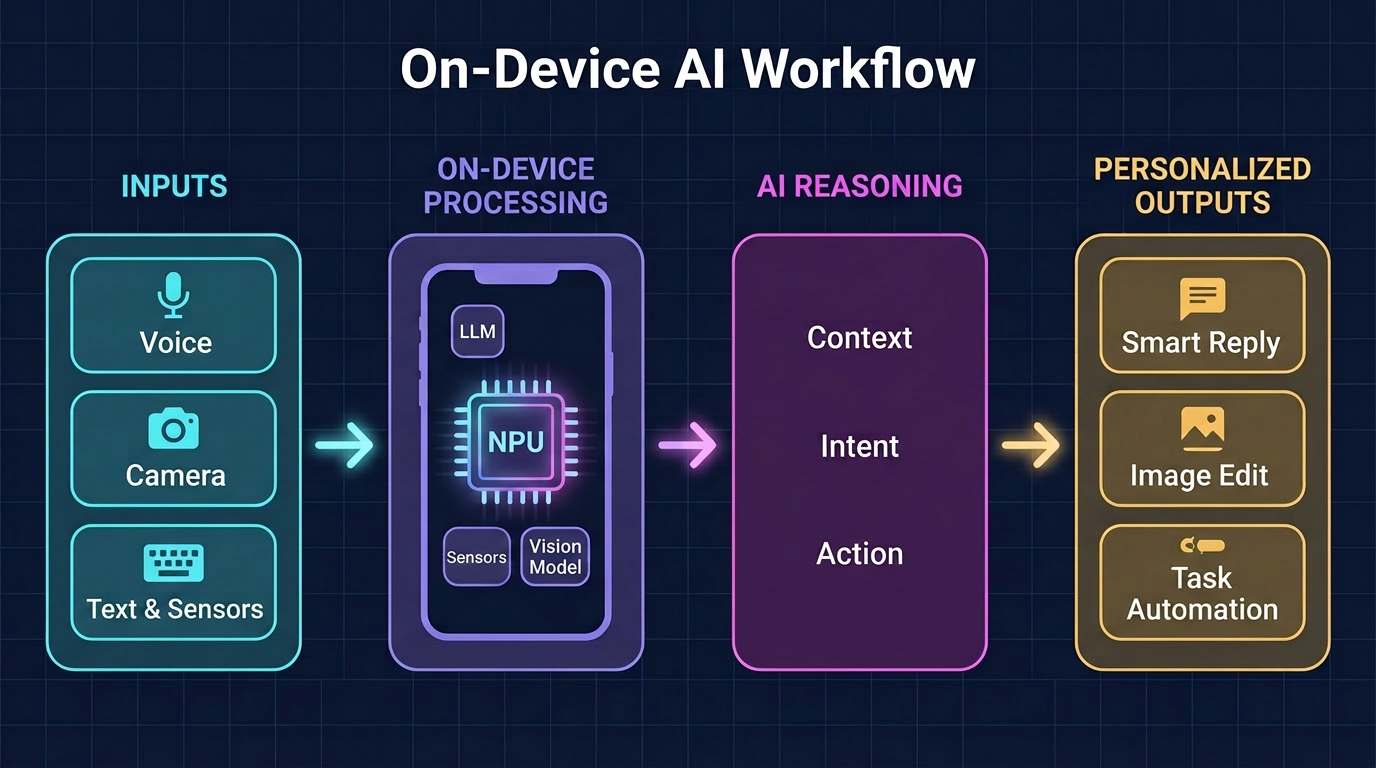
Conceptual diagram showing user inputs (voice, text, camera) flowing into on-device AI components like NPU and sensors, producing secure personalized outputs.
These on-device systems enable:
Speed: Responses in milliseconds since no server round-trip is needed.
Privacy: Sensitive data (photos, biometrics, messages) never leaves the device.
Resilience: Offline AI means translation, transcription, or image recognition can still run without network access.
Apple’s A19 Pro (with a second-generation Neural Engine in the iPhone 17 Pro), Google’s Tensor G5 in the Pixel 10, Qualcomm’s Snapdragon 8 Elite Gen 5 powering the Galaxy S26 and OnePlus 15, and MediaTek’s Dimensity 9500 in the OPPO Find X9 Pro and Vivo X300 series all ship with dedicated NPUs purpose-built for local inference. In essence, your phone now hosts its own AI — not merely connects to one.
Everyday AI Experiences
1. Smarter Assistants
Next-generation assistants like GPT-5-powered ChatGPT, Gemini 3 Nano on Pixel devices, and Apple Intelligence on iOS 26 have moved well beyond command-and-response. Following Apple’s multi-year partnership with Google — reportedly worth roughly $1 billion per year — the next iteration of Apple’s foundation models is being co-developed on Gemini infrastructure, with iOS 27 expected to deepen that integration. They interpret context, summarize conversations, compose drafts, and chain actions across apps from a single prompt. For example, you can say:
“Reschedule my 3 PM call, summarize today’s meeting notes, and text the update to my manager.”
And your phone orchestrates the workflow seamlessly.
2. Enhanced Photography
AI now drives every step of mobile photography:
Scene detection automatically tunes ISO, exposure, and color grading.
Generative fill can remove or reconstruct elements in a shot.
Real-time HDR fusion creates balanced images in complex lighting.
Google’s Pixel 10 and Samsung’s Galaxy S26 show how these AI-driven pipelines now rival — and in some cases exceed — professional desktop editing.
3. Personalization Everywhere
From news feeds to streaming recommendations, personalization is now deeply contextual. AI learns not just what you like — but when and where. It might prioritize quiet-mood music after late meetings, or show shorter articles during commute hours.
4. Health and Fitness
AI-enabled sensors interpret motion, sleep, and vitals to generate wellness insights. For instance, Apple’s Health app can now flag irregular heart rhythms, while Samsung’s Galaxy AI suggests micro-goals based on daily movement trends. These insights remain local, preserving sensitive biometric data.
5. Security and Privacy
AI enhances security through adaptive biometrics that recognize you under different conditions. It also detects suspicious patterns — failed unlocks, phishing attempts — and isolates threats in real time. Privacy dashboards now visualize what data AI models access and allow granular control over sharing.
6. Multimodal Communication
Smartphones are becoming universal translators and interpreters. AI translates text, voice, and even images in real time. Google’s Live Translate and Microsoft’s Copilot integration with Skype illustrate how AI bridges communication globally.
7. Navigation and Travel
AI optimizes routes, predicts congestion, and suggests local points of interest using real-time data. Paired with generative capabilities, it can craft contextual itineraries:
“Plan a 2-hour walking tour of Kyoto with coffee stops and cultural sites.”
The Smartphone-AI Workflow
AI doesn’t just execute commands — it interprets, decides, and acts. The workflow below illustrates how smartphones transform input into intelligent outcomes.
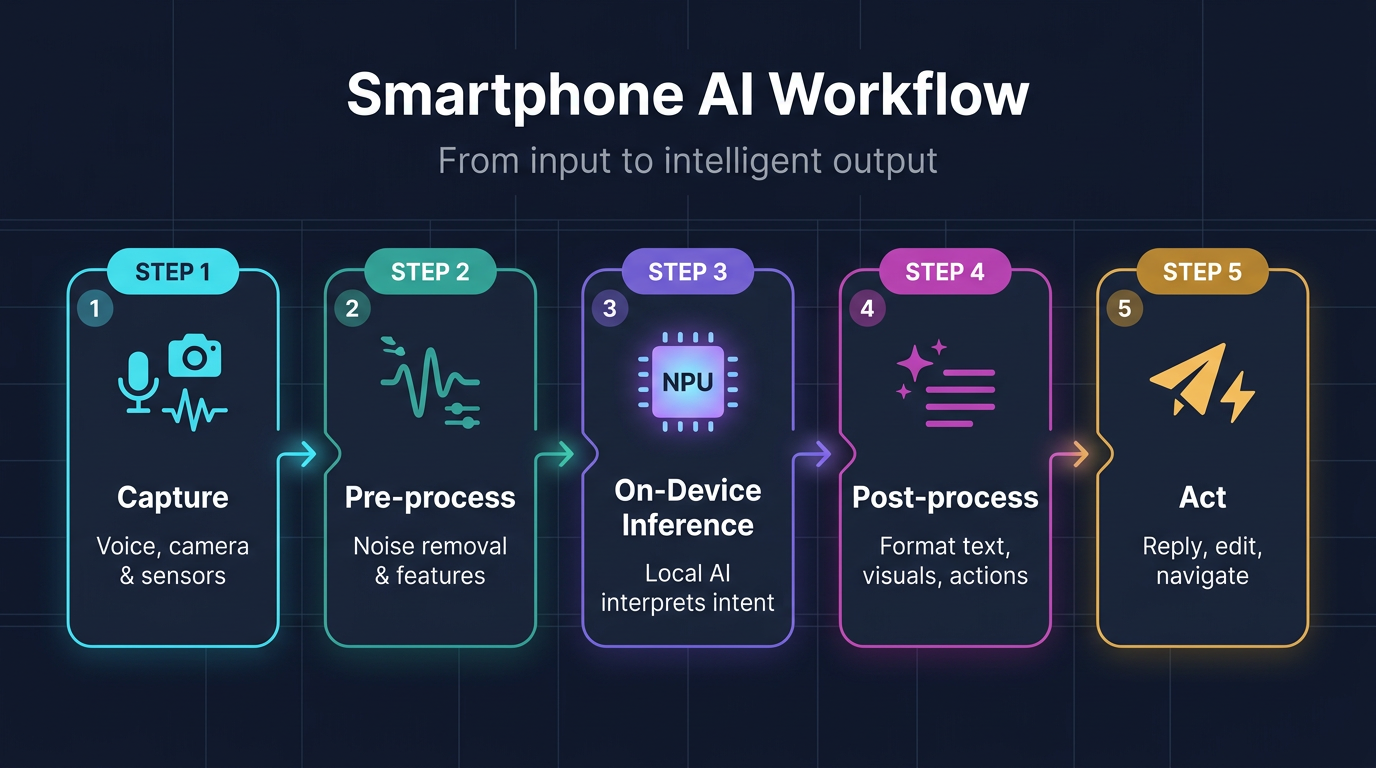
Infographic showing smartphone AI workflow from user input (voice, text, camera) through preprocessing, on-device inference, and contextual output such as summaries or translations.
Step 1: Capture
Voice, camera, or sensor data is collected securely.
Step 2: Pre-process
Noise reduction, compression, and feature extraction prepare input for AI models.
Step 3: On-Device Inference
The AI model interprets intent or content locally, minimizing latency and exposure.
Step 4: Post-process
Results are formatted into natural text, visuals, or actions.
Step 5: Act
The phone generates outputs — a message, edit, suggestion, or route — optionally enhanced by cloud resources for more complex tasks.
ChatGPT, Gemini, and the Rise of Generative Mobile AI
Generative AI is reshaping how smartphones assist users:
OpenAI’s ChatGPT app, now powered by GPT-5 and fully multimodal, integrates directly with iOS and Android keyboards — drafting, summarizing, and reasoning over voice, image, and screen context inside any app.
Google’s Gemini 3 Nano, embedded in Pixel and partner devices, runs entirely on-device for contextual replies, photo Q&A, live transcription, and cross-app actions — even offline.
Microsoft Copilot, paired with GPT-5 and Microsoft’s Phi family for on-device tasks, extends agentic productivity to mobile — rewriting emails, extracting meeting actions, building decks, and triggering workflows in Microsoft 365 directly from a phone.
These integrations mark a shift from assistants that follow commands to agents that anticipate context.
Leadership and Strategy Perspective
From an executive lens, this evolution signals more than consumer innovation — it represents a strategic shift in digital interaction models.
Key Leadership Insights
Mobile as an Intelligence Hub: Smartphones now serve as edge nodes for enterprise AI. Field workers, sales reps, and clinicians can process data securely without relying on central systems.
Privacy as a Differentiator: Companies that prioritize on-device computation position themselves as trusted stewards of user data.
Experience as Ecosystem: Seamless AI workflows require alignment across hardware, software, and cloud ecosystems — a competitive moat for Apple, Google, and Samsung.
Design for Human-AI Collaboration: The future interface is conversational and multimodal. Leaders should design around fluid interaction, not rigid navigation.
Governance and Ethics: With AI acting autonomously, organizations must define boundaries — ensuring explainability, auditability, and responsible data handling.
Summary and Takeaways
AI is moving from the cloud to the palm of your hand, delivering faster, private, and contextual intelligence.
Generative models like ChatGPT and Gemini Nano transform smartphones into creative and operational agents.
On-device AI chips make computation sustainable and secure, while also extending battery life and performance.
The smartphone’s evolution redefines both user experience and business strategy — making mobile intelligence a new competitive frontier.
With the majority of 2026 flagships already AI-capable at the silicon level — and 60%+ of all new smartphones expected to follow by 2028 — organizations that adapt now will define the next era of mobile innovation.
References
Deloitte (2025). On-device Generative AI Predictions. deloitte.com
Canalys / Omdia (2025). Now and Next for AI-Capable Smartphones. omdia.tech.informa.com
The Guardian (2025). Google Launches Pixel 10 with AI Tools. theguardian.com
Reuters (2025). Arm Launches New Generation of AI Mobile Chips. reuters.com
Qualcomm (2024). AI on the Edge: 7 Biggest Tech Trends. qualcomm.com
Franklin College (2025). Research Improves AI for Smartphones. franklin.uga.edu
Assurant (2025). Consumers Upgrading Devices Faster as AI Features Grow. assurant.com