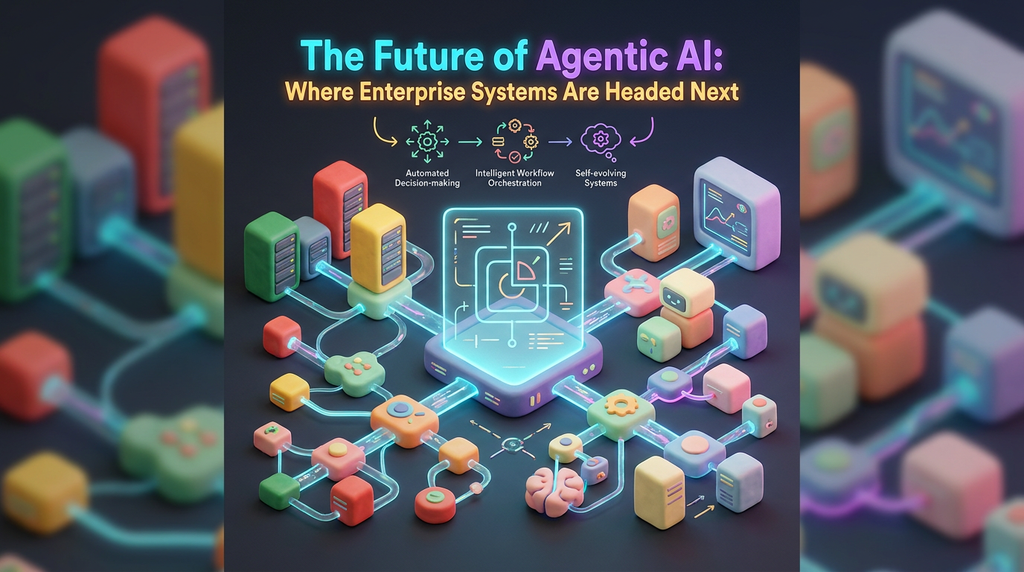
The Future of Agentic AI: Where Enterprise Systems Are Headed Next
Agentic AI has moved fast. What started as narrow, scripted automation has evolved into systems that reason, adapt, and coordinate with far less hand-holding than just a few years ago. But as these systems mature, the conversation is shifting — from "what can an agent do?" to "how do we build enterprise agentic AI that is scalable, trustworthy, and genuinely ready for the enterprise?"
Here's where agentic system design is headed, and what organizations should consider as they invest in this space.
From Scripted Pipelines to Adaptive Architectures
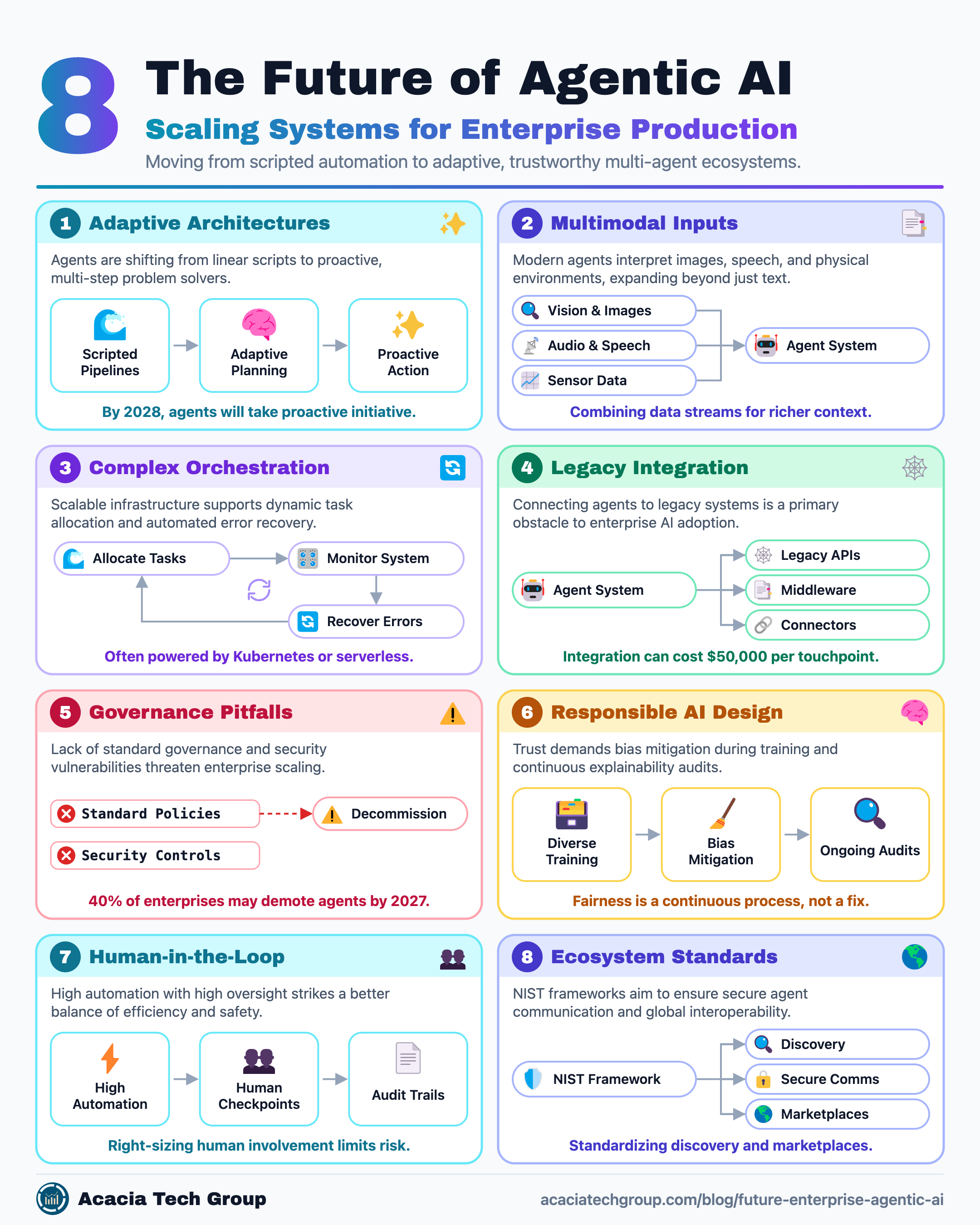
Early automation relied on tightly defined workflows: if X happens, do Y. Advances in large language models have given autonomous agents stronger reasoning capabilities, better context retention across multi-turn interactions, and the ability to generalize to new tasks with minimal supervision — a shift that's opened the door to real deployment in healthcare, finance, and customer service.
By 2025, agentic AI is expected to drive autonomous data engineering, enabling enterprise data pipelines to self-configure and automate business processes with significantly higher quality than manual workflows.
By 2028, these adaptive systems are projected to move from merely following instructions to taking proactive initiative and suggesting strategies. This includes a transition from linear automation to managing complex, multi-step problems through dynamic, adaptive planning. Crucially, these systems will automate activities accounting for 60–70% of employee time in high-volume sectors like banking and insurance by augmenting long-horizon execution.
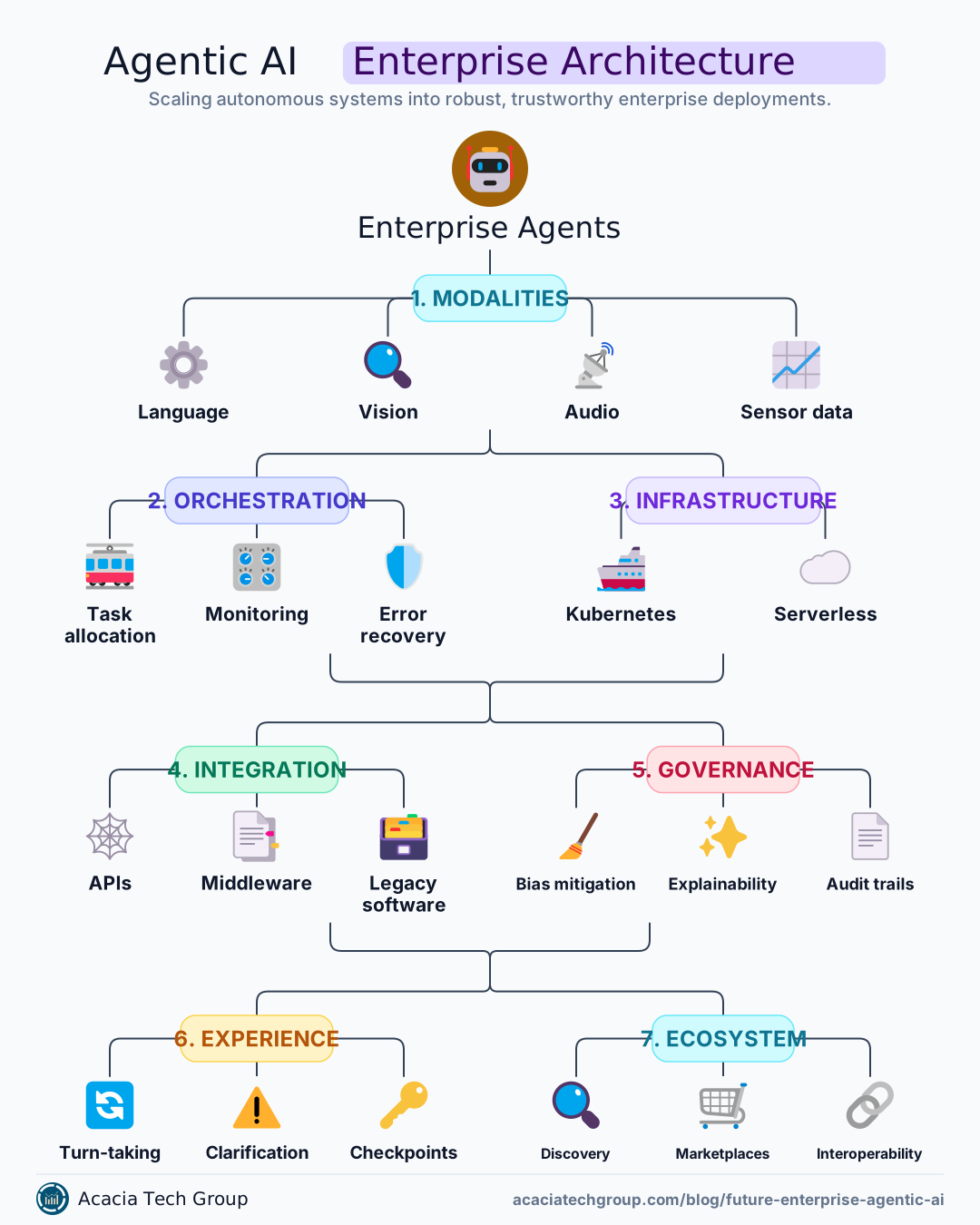
Language is no longer the whole story, either. Modern agents increasingly combine:
Vision — interpreting images and video
Audio — processing speech, tone, and environmental sound
Sensor data — connecting to physical environments
Orchestration layers on top: dynamic task allocation, real-time monitoring, and plug-and-play integration. To meet demand for instant recall, modern architectures are shifting toward memory-first designs where agent states and message histories live in in-memory stores rather than traditional databases, avoiding latency in high-stakes environments like fraud detection or autonomous data pipelines.
Scaling in the Real World
Building an agent is one thing. Running it in production is another. Enterprises deploying agentic AI have to navigate reliability, cost, compliance, and integration with legacy systems—and scalability quickly becomes as much an organizational challenge as a technical one.
Building enterprise-grade multi-agent systems typically requires an investment of $500,000 or more, with annual maintenance costs ranging between $120,000 and $200,000. Organizations must also account for integration expenses; while simple API connections cost $2,000 to $5,000, integrating with legacy enterprise infrastructure can add up to $50,000 per touchpoint.
A quick SWOT view of where things stand:
Strengths: high adaptability and automation potential, especially with scalable cloud infrastructure
Weaknesses: resource constraints, model drift, integration complexity
Opportunities: distributed computing and multi-tenant cloud deployments
Threats: data privacy, latency, and regulatory pressure
Interoperability deserves special attention here. Most organizations cite integration challenges—connecting agentic systems to legacy software through APIs, middleware, and custom connectors—as one of the biggest obstacles to scaling AI adoption. Solving for this isn't optional; it's foundational.
A critical pitfall in current deployments is the lack of standardized governance. Gartner forecasts that 40% of enterprises will demote or decommission their autonomous agents by 2027 due to these governance gaps. Furthermore, security remains a vulnerability; a 2026 survey found that 1 in 8 reported AI breaches are now linked specifically to agentic systems.
To manage these risks, leading indicators for success are shifting toward forward-looking metrics. Organizations now measure cross-functional adoption velocity and exception-handling effectiveness rather than just uptime or throughput.
Trust Isn't Optional
As agents take on more autonomy, responsible AI design becomes a core requirement, not an afterthought. That means:
Bias mitigation through diverse data, bias detection, and fairness constraints during training
Ongoing audits and explainability tools post-deployment, since fairness is a continuous process, not a one-time fix
Transparency as the foundation of trust — users, auditors, and stakeholders need to understand how and why decisions are made.
Another useful way to think about risk: high automation paired with low oversight carries the greatest risk of undetected errors or misuse. High automation paired with high oversight — human-in-the-loop checkpoints, audit trails — strikes a better balance between efficiency and safety. Low automation is safer still. Still, it sacrifices much of the productivity upside. The real design question isn't "how autonomous can we make this?" It's "what's the right level of human involvement for this context?"
In security-focused architectures, agents now automatically collect evidence artifacts and maintain traceability to reduce audit burdens. Recent data shows that 73% of organizations demand explainable, accountable systems. This "policy-first" design allows agents to continuously check infrastructure against compliance standards and propose immediate fixes for policy drift.
Designing for People, Not Just Performance
Even a highly capable agent will fail if it's hard to understand, control, or trust. The shift from Large Language Models (LLMs) to Large Action Models (LAMs) is key here; LAMs let agents orchestrate and complete actions across systems rather than generate text responses. Visual, drag-and-drop development tools like agent studios are lowering the barrier, letting companies create and manage digital teammates that operate across ERP, HR, and supply chain functions.
What's Next: Marketplaces and Ecosystems
Looking further out, enterprise agentic AI systems are increasingly expected to operate across organizational and platform boundaries. That is driving new standards around:
Discovery — how agents find and identify one another
Secure communication — reliable, protected information exchange using policy-aware connectors
Marketplace frameworks — reducing vendor lock-in and encouraging interoperable ecosystems
To address these needs, NIST announced the AI Agent Standards Initiative on February 17, 2026. This initiative focuses on establishing frameworks for secure agent-to-agent communication and ensuring that next-generation AI can interoperate securely across the global digital ecosystem. By 2028, one-third of enterprise software platforms are expected to include agentic AI capabilities.
This transformation marks the rise of Agentic Enterprise Solutions, where software evolves from a tool that supports work into a system that performs work on behalf of employees. As these standards mature, managerial work will likely shift from assigning tasks to designing human-agent systems and setting boundaries for non-human actors.
The Bottom Line
The future of Enterprise agentic AI sits at the intersection of better architecture, enterprise-grade scalability, ethical responsibility, and human-centered design. Transparency, adaptability, and user trust aren't nice-to-haves — they're prerequisites for any organization that wants agentic systems to succeed at scale.
The challenge for builders and adopters alike isn't just making agents more capable. It's making them trustworthy, interoperable, and aligned with the people they're meant to serve.
Explore More on Agentic AI and Data Strategy
Have questions about how agentic AI fits into your organization's roadmap? Contact Acacia Tech Group to talk through what's possible.
Further reading
Agentic AI architecture in the Enterprise — A reference architecture from AWS on implementing production-grade capabilities with governance.
Agentic AI and the Future of Enterprise IT — A report on how agents are shifting IT from an operational function to a strategic profit driver.
Agentic automation: Transforming enterprise workflows — Insights into the transition from rule-based systems to intelligent, collaborative environments.
References
AI Strategy: Agentic Intelligence & the Future of Enterprise AI
The 2026 Enterprise AI Outlook: Where Agentic Systems Are Headed Next