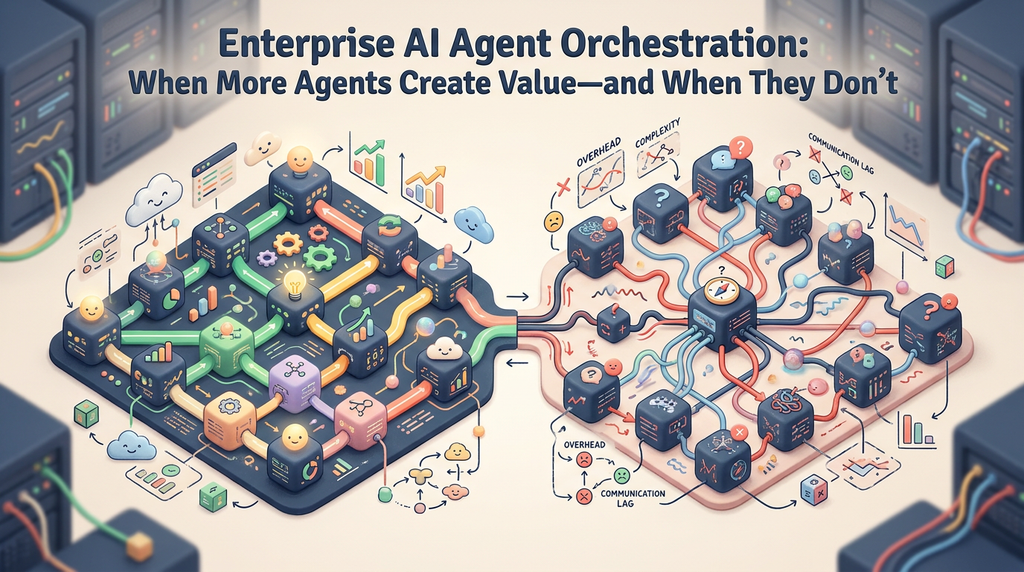
Building a capable AI agent is only the beginning. The harder enterprise question is how to make that agent part of a dependable system: one that connects to business applications, delegates work appropriately, preserves context, and handles failure without leaving people stranded. That shift is from agent to enterprise AI agent orchestration. This strategic control plane manages state, communication, and execution flow across specialized agents to complete tasks no single model could handle alone.
The central lesson of this article is simple: the goal is not maximum autonomy. The goal is the least complex design that reliably meets the business need. Higher on the agent autonomy levels ladder is not automatically better — it is more expensive to run, harder to govern, and easier to break.
A 2026 Anthropic survey of over 500 tech leaders highlights a rapid market shift: 57% of organizations already run multi-step agents in production. However, practitioners warn that intelligence is no longer the primary bottleneck; organizational readiness—specifically, who is accountable when agents act—remains the critical choke point for scaling these systems effectively.
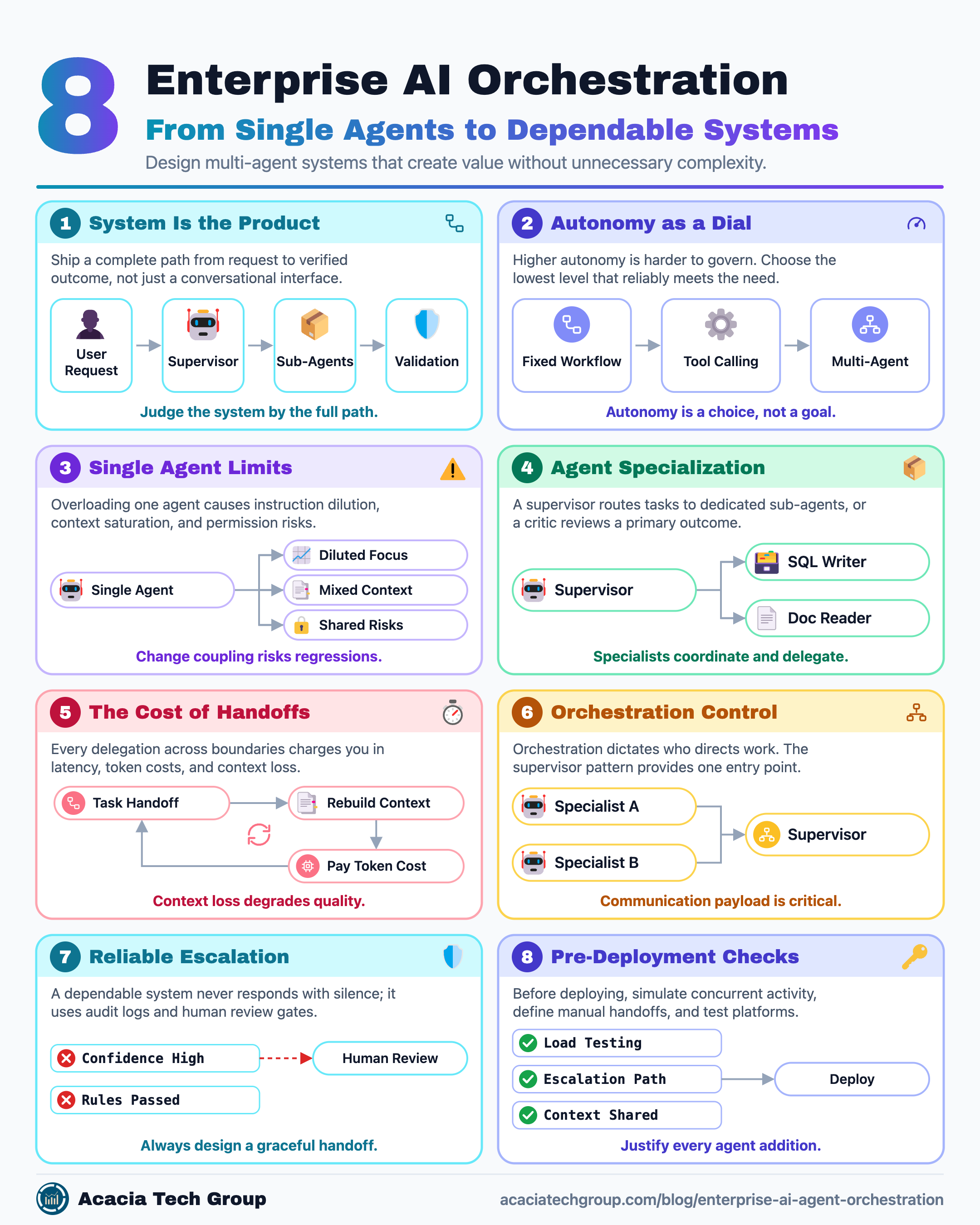
The Agent System Is the Product
What you ship is never just the screen the user talks to. It is the complete path from request to verified outcome: the connections to systems of record where the organization stores the handoffs between agents, the context that survives each delegation, and the route a request takes when no agent can resolve it. Judge the system by that full path, not by the quality of the conversation.
Autonomy Is a Dial, Not a Destination
It helps to place every design on a five-step continuum, defining specific agent autonomy levels from least to most autonomous:
Deterministic workflow. Fixed steps, no model decisions. Reliable and auditable, but brittle the moment reality stops matching the script.
Conversational agent. The model handles language; rules and people handle the actions.
Tool-calling agent. The model chooses actions from a set you have defined — where most enterprise builds sit today.
Planning agent. The model sequences multiple actions toward a goal nobody scripted.
Multi-agent system. Specialists coordinate, delegate, and return results to each other.
The right level is the lowest rung that reliably meets the need. Treat the choice as one you must be able to justify, not a preference.
Four Signs a Single Agent Is Reaching Its Limit
Why not keep adding to one agent? Four failure modes show up as symptoms, signaling a need for more robust multi-agent systems architecture:
Instruction dilution. Responsibilities pile up, instructions grow, and behaviors start interfering. An agent handling ten processes handles each one worse than a dedicated agent would.
Context saturation. Knowledge sources for unrelated domains compete during retrieval. Add a facilities handbook to help one topic and the password-reset answers get worse, because retrieval now has more plausible wrong context to choose from.
Permission collision. An agent that does everything needs every permission — an enterprise AI governance problem and an attractive target in one.
Change coupling. Every change risks regressing everything else, because all instructions, knowledge, and tests are shared.
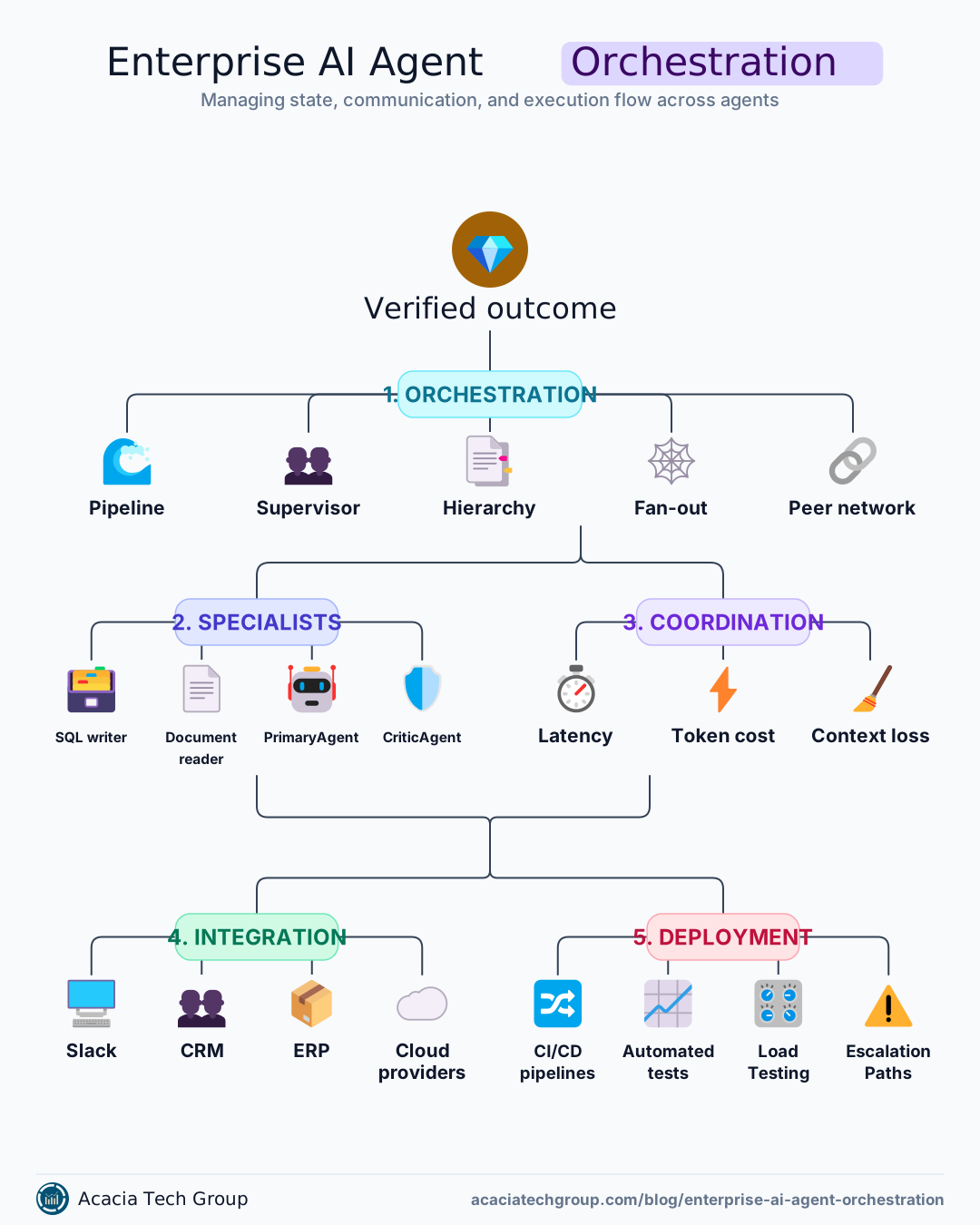
Enterprise implementations illustrate this specialization: Uber's Finch uses a supervisor agent to route finance data requests from Slack to dedicated sub-agents, such as a specialized SQL writer and a document reader. Similarly, Netguru's Ome uses a three-agent trio in which a CriticAgent reviews outcomes produced by a PrimaryAgent, adding a layer of internal validation before final delivery. Organizations that successfully transition to these multi-agent systems report 35% faster task completion compared to those relying on single agents.
These are the same reasons no organization has one employee who does everything. Specialization exists because, past a certain scale, AI agent coordination costs are less than the cost of dilution.
Every Handoff Charges You Three Ways
Coordination isn't free; it bills you in three currencies.
Latency: every delegation is a full model round trip, so a three-agent chain can triple the time a user waits.
Token cost: context is re-established at every boundary, and you pay for the same information again and again.
Context loss: whatever you do not explicitly pass across the boundary is gone — the most common cause of degraded quality in multi-agent systems, and usually a design omission rather than a bug.
Current 2026 benchmarks indicate that development costs for production-grade, regulated implementations often exceed $300,000, with integration and enterprise AI governance typically consuming 60% of the initial budget. Beyond initial builds, teams must integrate agents into existing CI/CD pipelines and use automated tests to validate outputs against expected contracts before deployment.
Dilution pushes you to split; coordination cost pushes you to consolidate. Hold both at once — neither one alone gives you a design.
Orchestration and Communication Are Two Different Decisions
If you do split, you are deciding two things. Orchestration is who directs the work: a pipeline with fixed stages, a supervisor that interprets, delegates, and assembles, a hierarchy of supervisors, a fan-out that runs branches in parallel, or a peer network with no center. Comprehensive enterprise AI agent orchestration often converges on the supervisor pattern because it keeps one accountable entry point for the user.
Communication is the half people forget. The task must start without the conversation that produced it; only the context you hand over survives. The result must be usable, and there must be a signal when the work can't be done. The right pattern with a sloppy payload performs worse than one agent.
Reliability Includes Knowing When to Stop
A dependable system has an explicit answer for the requests it cannot resolve: escalation to a person, a ticket, a graceful handoff — never silence. Adopting low-code tools doesn't remove architectural decisions; it only makes them easier to click past.
In highly regulated sectors like healthcare, compliance now demands enterprise AI agent orchestration playbooks that maintain dynamic audit logs and trigger pre-defined human review gates at specific escalation thresholds. For large enterprises, these regulatory compliance efforts can total $8 million to $15 million; treating documentation and reconciliation methods—such as confidence scoring or rule-based overrides—as core technical requirements is essential for managing conflict in production.
The Judgment Rule
Start simple. Identify the specific limitation — which of the four failure modes is actually showing up? Add a specialist only when the benefit of the split clearly justifies the additional coordination, and be willing to decline the more autonomous option when a simpler rung does the job.
Next Step
Before adding another agent to your multi-agent systems architecture, review one workflow. Identify where the current design falls short, what a specialist would improve, and what information must survive the handoff. If those answers are unclear, adding agents is unlikely to solve the underlying problem.
Pre-Deployment Checklist
Load Testing: Perform tests that simulate concurrent agent activity to surface orchestration bottlenecks.
Escalation Paths: Define the manual handoff route when agents fall below the required confidence threshold.
Interoperability: Ensure context can be shared across disparate platforms, including CRM, ERP, and cloud providers.
Further reading
Guidance for Multi-Agent Orchestration on AWS — A technical overview of implementing supervisor routing and domain-specific specialists with real-time streaming.
AI Agent Orchestration: A Guide for Enterprise Systems — Strategic advice on creating role matrices and selecting patterns based on an organization's.
AI Agent Orchestration Explained — A deep dive into the mechanical execution loops and coordination patterns for distributed agent systems.
AI Workflow Orchestration Platforms: 2026 Comparison — A breakdown of modern execution standards, including the Agent Protocol and durable execution for long-running tasks.