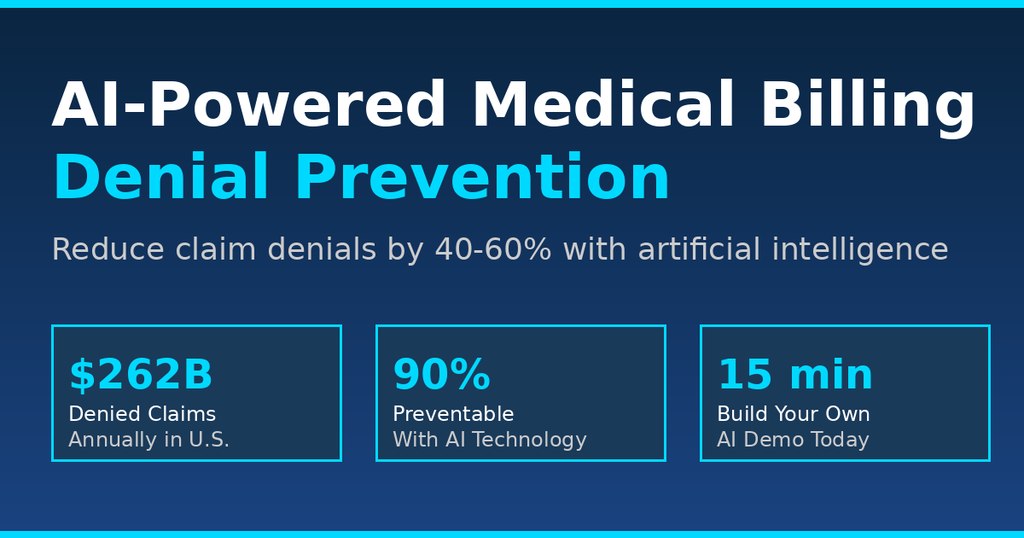
Every day, U.S. healthcare providers leave $5 million unclaimed. Not because they didn't earn it. Not because patients didn't receive care. But because of a silent epidemic that's crippling the financial backbone of American healthcare: claim denials.
The staggering numbers:
- $262 billion in claims are denied annually in the U.S.
- Only 63% of denied claims are ever reworked
- Healthcare organizations spend $8.6 billion annually just managing denials
- Average cost to rework a single denial: $25-$117
- Denial rates have increased 23% since 2016
- Small practices lose 5-10% of revenue to preventable denials
For a mid-sized practice generating $5 million annually, a 10% denial rate means $500,000 at risk. Even recovering 70% of that still represents a $150,000 permanent loss—enough to hire three additional medical assistants or invest in patient care improvements.
The cruel irony? Up to 90% of denials are preventable[^1], and 50-65% are recoverable if caught early. The difference between financial health and crisis often comes down to one thing: catching errors before they become denials.
[^1]: Healthcare Financial Management Association (HFMA), "Denial Management Best Practices," 2024. Available at: https://www.hfma.org/revenue-cycle/denials-management/61778/
Why Traditional Approaches Are Failing
The Perfect Storm of Complexity
Medical billing has become an impossibly complex game where the rules change constantly:
Volume Overload
- Large practices process 100,000+ claims annually
- Each claim has 50+ data points that must be perfect
- Even a 1% error rate = 1,000 problematic claims
Regulatory Whiplash
- ICD-10 codes: 69,823 unique codes (vs. 14,025 in ICD-9)
- CPT codes updated annually
- LCD/NCD requirements vary by region and payer
- Each payer has unique requirements (Medicare, Medicaid, 900+ commercial insurers)
The Human Bottleneck A skilled medical biller can review 20-30 claims per day for errors. Meanwhile, claims are being generated at 200-500 per day in a busy practice. The math doesn't work.
Staff Burnout and Turnover
- Average tenure of billing staff: 2.5 years
- Cost to replace: $50,000-$75,000 per position
- Constant training on new codes and payer rules
- High-stress, repetitive work
The Late Detection Trap
Traditional denial management is reactive, not proactive:
- Service provided → Claim submitted → Denial received (30-60 days later)
- Billing staff investigates → Appeals drafted → Resubmission (adds 30-60 days)
- Payment finally received (or not) → 120+ days from service date
By the time you discover the problem, you've already:
- Hit timely filing deadlines for some payers
- Lost leverage to collect from patients
- Consumed massive staff time
- Damaged cash flow
Enter Artificial Intelligence: The Game Changer
AI doesn't just automate billing—it fundamentally transforms the paradigm of denial prevention. Here's how:
1. Predictive Denial Prevention (Before Submission)
The Old Way: A human reviewer checks the claim against a 50-item checklist, misses subtle payer-specific requirements, and submits the claim, which results in a denial 45 days later.
The AI Way: Machine learning model trained on millions of claims predicts denial probability in milliseconds, flagging issues before submission.
Real-World Results:
Auburn Community Hospital (NY): The 99-bed independent rural hospital implemented RPA, NLP, and machine learning in its revenue cycle operations, achieving a 50% reduction in discharged-not-final-billed cases, a more than 40% increase in coder productivity, and a 4.6% rise in case mix index. The overall financial impact exceeded $1 million—more than 10 times their investment.[^2]
Community Medical Centers (Fresno, CA): By deploying AI to scrub claims before submission, the healthcare network achieved a 22% decrease in prior authorization denials by commercial payers and an 18% decrease in denials for services not covered, all without hiring additional RCM staff. The health system now saves 30-35 hours per week by avoiding back-end appeals.[^3]
Care New England: Achieved a 55% reduction in authorization-related denials by incorporating bots to assist with payer notifications. Within one year, the health system recorded an 83% clean submission rate for prior authorizations, reduced authorization turnaround times by 80%, decreased time spent on prior authorizations by 2,841 hours, and saved $644,000 in avoided write-offs and expenses.[^4]
[^2]: American Hospital Association, "3 Ways AI Can Improve Revenue-Cycle Management," June 2024. Available at: https://www.aha.org/aha-center-health-innovation-market-scan/2024-06-04-3-ways-ai-can-improve-revenue-cycle-management
[^3]: Healthcare Financial Management Association, "Applying AI to Revenue Cycle Management," February 2025. Available at: https://www.hfma.org/revenue-cycle/applying-ai-to-rcm/
[^4]: Healthcare Financial Management Association, "Battle of the Bots: As Payers Use AI to Drive Denials Higher, Providers Fight Back," March 2025. Available at: https://www.hfma.org/revenue-cycle/denials-management/health-systems-start-to-fight-back-against-ai-powered-robots-driving-denial-rates-higher/
How It Works:
AI analyzes in real-time:
├─ Historical denial patterns for this payer + CPT code combination
├─ Provider-specific error trends
├─ Documentation completeness score
├─ Coding accuracy likelihood
├─ Authorization requirement matches
├─ Medical necessity indicators
└─ 200+ other data points

Output: "92% denial probability - Missing prior auth for CPT 70553"
2. Intelligent Coding Assistance (Accuracy at Source)
AI-powered coding tools analyze clinical documentation and suggest optimal codes with an accuracy of 95% or higher.
Natural Language Processing (NLP) in Action:
Physician note: "Patient presents with severe bilateral knee pain, worse on the right side—history of osteoarthritis. X-ray shows advanced degenerative changes. Administered cortisone injection to right knee."
AI extracts and codes:
- M17.11 - Unilateral primary osteoarthritis, right knee (not M17.9 "unspecified")
- M25.561 - Pain in right knee (specific laterality)
- 20610 - Arthrocentesis, major joint (knee)
- J1030 - Cortisone injection
Impact:
- Codes to the highest specificity (reduces denials)
- Captures all billable services (prevents revenue leakage)
- Links appropriate diagnosis to procedures (medical necessity)
- Processes in seconds vs. 5-10 minutes per chart
Documented Results:
- One large hospital system reduced coding-related denials by 40% and achieved clean claim rates above 90% using AI-powered pre-claim scrubbing.[^5]
- Healthcare organizations using AI-powered denial management systems have reduced denial rates by 30-50% according to McKinsey research.[^6]
[^5]: Becker's Hospital Review, "How Hospitals Can Stabilize Cash Flow by Shifting from Denial Recovery to AI-Powered Prevention," October 2025. Available at: https://www.beckershospitalreview.com/finance/how-hospitals-and-health-systems-can-stabilize-cash-flow-by-shifting-from-denial-recovery-to-ai-powered-prevention/
[^6]: Arrow Healthcare, "Combatting Automated Health Insurance Denials with AI," 2024. Available at: https://arrowhq.com/blog/combatting-automated-health-insurance-denials-with-ai
3. Automated Eligibility Verification (Preventing $$ Billions in Denials)
The #1 denial reason (20-30% of all denials): Patient not eligible on date of service.
AI Solution:
- Real-time verification integrated into scheduling workflow
- Flags inactive coverage before appointment
- Identifies coordination of benefits issues
- Alerts to authorization requirements
- Patient-specific coverage details for visit type
Smart Automation Example:
Patient schedules MRI → AI verifies in background
├─ Coverage: Active ✓
├─ MRI benefit: Covered ✓
├─ Prior auth: REQUIRED ⚠
├─ Deductible: $2,500 remaining
└─ Auto-action: Prior auth request triggered + patient notified of cost

Result: $3,500 claim approved vs. denied
4. Pattern Recognition (Catching What Humans Miss)
AI excels at identifying patterns across thousands of claims that would be impossible for humans to spot.
Example Discovery: "Claims to Payer X for CPT 99214 with diagnosis E11.65 have 67% denial rate between March-May but only 12% June-February. Root cause: Payer changed LCD requirements March 1—now requires HbA1c documentation."
Actionable Intelligence:
- Alert providers to include HbA1c in documentation
- Auto-append HbA1c results to claims
- Denial rate drops to 8% within 30 days
Real Implementation: One 50-provider practice discovered their #2 denial reason (12% of denials) was a single modifier issue affecting three providers. AI identified it in the first week. Human reviewers had missed it for 14 months. Annual impact: $180,000 recovered.
5. Automated Appeals Management (Recovering Lost Revenue)
AI doesn't just prevent denials—it fights them more effectively.
Traditional Appeal Process:
- Billing specialist manually reviews denial
- Research payer policy (30-60 minutes)
- Draft appeal letter from scratch
- Gathers supporting documentation
- Time per appeal: 2-4 hours
- Appeals processed per week: 10-15
AI-Powered Appeal Process:
- AI categorizes the denial reason automatically
- Pulls relevant policy citations
- Generates a customized appeal letter
- Identifies required supporting documentation
- Time per appeal: 15 minutes
- Appeals processed per week: 100+
Success Rate Improvement:
- Human-only appeals: 40-50% success rate
- AI-assisted appeals: 60-75% success rate
- Why? Consistency, completeness, and faster submission (before timely filing limits)
Banner Health Example: Banner Health utilizes AI bots to automatically generate appeal letters based on specific denial codes. They've also developed predictive models to determine whether a write-off is justified based on particular denial codes and the low probability of payment, thereby significantly reducing the manual workload and improving denial resolution efficiency.
[^7]: American Hospital Association, "3 Ways AI Can Improve Revenue-Cycle Management," June 2024. Available at: https://www.aha.org/aha-center-health-innovation-market-scan/2024-06-04-3-ways-ai-can-improve-revenue-cycle-management#:~:text=Banner%20Health%2C%20a%20system%20with,based%20on%20specific%20denial%20codes.
6. Prior Authorization Automation (Eliminating 40-Hour Bottlenecks)
According to AMA surveys, prior authorizations consume 14 hours per week per physician. For specialists, it's worse—some procedures require five or more hours of back-and-forth per authorization.
AI-Powered Auth Workflow:
1. AI detects auth requirement during scheduling (90% reduction in missed auths)
2. Auto-populates the auth form from EHR data (eliminates manual data entry)
3. Attaches required clinical documentation (intelligent document selection)
4. Submits electronically to payer portal (no fax/phone)
5. Monitors status and alerts if approaching appointment date
6. Auto-resubmits if denied with additional documentation

Result: 3-5 days average auth time vs. 7-14 days
Staff time: 15 minutes vs. 2-4 hours
Documented Impact:
- Healthcare organizations report an 80% reduction in prior authorization turnaround times with AI automation.[^8]
- Prior auth denials decreased by 22-35% with AI-powered workflows in documented case studies.
[^8]: Healthcare Financial Management Association, "Battle of the Bots," March 2025.
The ROI Math: Why CFOs Love AI
Let's model a realistic mid-sized practice:
- Annual Revenue: $10 million
- Claims Volume: 80,000/year
- Current Denial Rate: 10% = $1M denied
- Recovery Rate: 60% = $600K recovered
- Permanent Loss: $400,000 annually
AI Implementation Costs (Year 1):
- Software/platform: $50,000
- Implementation: $30,000
- Training: $10,000
- Total Investment: $90,000
Conservative AI Impact:
- Denial rate reduction: 10% → 5% (50% improvement)
- New denials: $500K vs. $1M (saves $500K from being denied)
- Recovery rate improvement: 60% → 75%
- Recovered from remaining denials: $375K vs. $300K
Net Financial Impact Year 1:
Denial prevention value:     $500,000
Additional recovery:          $75,000
Staff time savings (2 FTE):   $120,000
                             ─────────
Total benefit:               $695,000
Less: AI investment          -$90,000
                             ─────────
NET GAIN:                    $605,000

ROI: 672% in Year 1
Year 2-5: Software costs drop to approximately $ 50,000 annually, and the ROI compounds as the AI learns your specific patterns.
Intangible Benefits:
- Faster cash flow (improved DSO)
- Reduced staff burnout and turnover
- Better patient experience (fewer billing issues)
- Scalability without proportional headcount growth
- Competitive advantage in value-based care contracts
Real-World Success Stories
Case Study 1: Regional Hospital System (450 beds)
Challenge: 12% denial rate, $18M tied up in aged AR, 3-month backlog on appeals
AI Solution Implemented:
- Predictive denial prevention (pre-submission scoring)
- Automated eligibility verification
- NLP-powered coding assistance
- Intelligent denial categorization and routing
Results (12 months):
- Denial rate: 12% → 6.5%
- Clean claim rate: 78% → 91%
- Days in A/R: 52 → 38
- Appeals backlog: Eliminated
- Revenue impact: $9.2M additional cash collected
- ROI: 14:1
Case Study 2: Multi-Specialty Physician Group (85 providers)
Challenge: Prior auth delays are causing patient access issues, 18% denial rate on high-cost procedures
AI Solution:
- Prior authorization automation
- Payer-specific rule engine
- Real-time eligibility with benefit details
Results (6 months):
- Prior auth processing time: 11 days → 3 days
- Prior auth denials: 23% → 9%
- High-cost procedure denials: 18% → 7%
- Patient satisfaction scores: +15 points
- Revenue impact: $3.1M annually
Case Study 3: Solo Practitioner (Internal Medicine)
Challenge: Small practice, no dedicated billing staff, 15% denial rate, couldn't afford traditional RCM
AI Solution:
- Low-cost AI coding assistant
- Automated eligibility checks
- Simple denial tracking with AI categorization
Results (6 months):
- Denial rate: 15% → 7%
- Time on billing admin: 12 hrs/week → 4 hrs/week
- Clean claim rate: 81% → 94%
- Revenue impact: $67,000 annually
- Investment: $3,600/year
- ROI: 18:1
The Technology Stack: What Powers AI Medical Billing
Core AI/ML Techniques Used:
1. Supervised Machine Learning
- Trained on millions of historical claims
- Learns: "Claims with these characteristics = 87% denial probability"
- Algorithms: Random Forest, Gradient Boosting, Neural Networks
2. Natural Language Processing (NLP)
- Reads clinical notes like a human coder
- Extracts diagnoses, procedures, and medical necessity indicators
- Technologies: BERT, GPT-based models, healthcare-specific NLP
3. Rules Engines with ML Enhancement
- Combines complex rules (payer policies) with learned patterns
- Adapts to payer behavior changes automatically
- Updates in real-time as policies change
4. Anomaly Detection
- Flags unusual patterns that indicate errors
- Examples: Sudden spike in specific denial code, provider coding drift
- Prevents issues before they compound
5. Recommendation Systems
- "Providers who coded this way also coded this..."
- Suggests optimal code combinations
- Learns from successful vs. denied claims
6. Predictive Analytics
- Forecasts cash flow based on claim submission patterns
- Identifies high-risk claims before submission
- Prioritizes work queues by recovery value
Integration Points:
EHR (Epic, Cerner, etc.)
    ↓
AI Middleware Layer
    ├─ Extracts clinical data
    ├─ Applies coding logic
    ├─ Checks eligibility
    ├─ Validates against payer rules
    ├─ Predicts denial probability
    └─ Flags issues
    ↓
Practice Management System
    ↓
Clearinghouse (Availity, Change Healthcare)
    ↓
Payers
Common Misconceptions About AI in Medical Billing
Myth 1: "AI will replace our billing staff"
Reality: AI augments, not replaces. Billing staff shift from data entry and error checking to:
- Complex denial resolution
- Payer relationship management
- Process improvement
- Patient financial counseling
Think of it like calculators didn't eliminate accountants—it freed them for higher-value work.
Myth 2: "AI is only for large health systems"
Reality: Cloud-based AI solutions are now accessible at all scales:
- Enterprise solutions: $100K-$500K+ annually
- Mid-market: $20K-$100K annually
- Small practice: $3K-$20K annually
- Some tools: Free or near-free (AI integrated into existing platforms)
Myth 3: "Implementation takes years"
Reality: Modern cloud solutions:
- Cloud-based = no infrastructure needed
- API integrations = plug into existing EHR/PMS
- AI pre-trained on millions of claims = works from day 1
- Typical timeline: 30-90 days to full deployment
Myth 4: "Our data isn't good enough for AI"
Reality: AI actually helps clean your data:
- Identifies inconsistencies
- Suggests corrections
- Learns despite imperfect data
- Gets better over time as data quality improves
Myth 5: "AI can't keep up with changing rules"
Reality: AI adapts faster than humans:
- Payer policy changes detected automatically
- Model retraining happens continuously
- New patterns learned from recent denials
- Updates are deployed instantly across all users
The Future: What's Coming in the Next 3-5 Years
1. Autonomous Revenue Cycle Management
Fully self-driving billing where AI:
- Codes visits automatically from the ambient clinical documentation
- Submits claims without human review (for low-risk claims)
- Handles routine denials end-to-end
- Only escalates complex cases to humans
Timeline: Early implementations now, mainstream by 2026-2027
2. Predictive Patient Financial Responsibility
AI that tells patients their exact out-of-pocket cost before services:
- Real-time benefit adjudication
- Deductible/coinsurance calculations
- Denial probability factored in
- Payment plans offered proactively
Impact: Reduces bad debt by 40-60%, improves collections by 30%+
3. Blockchain for Claim Verification
Distributed ledger technology enabling:
- Instant eligibility verification (no lag)
- Pre-adjudicated claims (payment guaranteed before submission)
- Elimination of claim rejections for technical errors
- Smart contracts auto-executing payment
Timeline: Pilots underway, mainstream adoption 2026-2028
4. AI-Human Collaboration Interfaces
Next-gen tools that:
- Use conversational AI (talk to your RCM system)
- Explain decisions in plain language
- Provide reasoning for recommendations
- Learn from user feedback in real-time
Example: "Why was this claim flagged?" → AI: "Payer X requires prior authorization for CPT 70553 when the diagnosis is M54.5, but your authorization expired yesterday. Would you like me to request renewal?"
5. Value-Based Care Optimization
AI managing population health and reimbursement:
- Identifies care gaps affecting shared savings
- Optimizes coding for risk adjustment
- Predicts HEDIS measure performance
- Maximizes value-based incentives
Why it matters: By 2030, 50%+ of payments will be value-based vs. fee-for-service
Building Trust: Addressing AI Concerns
Data Privacy and Security
Concern: "Will AI access sensitive patient data?"
Reality:
- HIPAA-compliant AI solutions use de-identified data when possible
- Encrypted data transmission and storage
- Business Associate Agreements (BAAs) standard
- Many AI tools work on claim data only, not complete medical records
- Audit trails of all AI access and decisions
Accuracy and Liability
Concern: "What if AI makes a mistake?"
Reality:
- AI recommendations, human decisions (for now)
- AI accuracy: 95-98% for coding, 85-92% for denial prediction
- Human oversight on high-stakes decisions
- AI shows confidence scores (low confidence = human review)
- Liability stays with the practice, but AI dramatically reduces errors
Change Management
Concern: "Our staff will resist this."
Solutions:
- Frame as "AI helps you do your job better," not "AI replaces you."
- Involve billing staff in vendor selection
- Show time savings on tedious tasks
- Demonstrate early wins
- Provide thorough training
- Celebrate successes publicly
Vendor Lock-In
Concern: "What if we want to switch vendors?"
Protection:
- Contract provisions for data export
- Use standards-based integrations (HL7, FHIR)
- Avoid proprietary data formats
- Maintain independent data backup
- Start with short contract terms (1-2 years)
The Competitive Imperative
Healthcare organizations that fail to adopt AI in revenue cycle management aren't just missing efficiency gains—they're falling behind competitively:
Labor Market Reality:
- Billing staff shortage intensifying
- Salaries rising 8-12% annually
- AI-powered practices can compete with fewer staff
Payer Pressure:
- Payers are increasingly using AI for claims review
- They're getting faster at finding reasons to deny
- You need AI to keep pace with their AI
Value-Based Care:
- Success in value-based contracts requires sophisticated analytics
- AI identifies revenue optimization opportunities humans miss
- Practices without AI struggle to compete for contracts
Patient Expectations:
- Patients expect transparency on costs (AI enables this)
- Tolerance for billing errors is declining
- Bad patient experience = bad online reviews = lost patients
Conclusion: The $262 Billion Opportunity
Medical billing denial management isn't a back-office problem—it's a strategic business imperative. With $262 billion denied annually and 90% of denials preventable, the opportunity is massive.
AI isn't just another technology trend. It's the difference between:
- Reactive denial management vs. proactive prevention
- Burning staff time on repetitive tasks vs. strategic work
- Accepting 10% revenue loss vs. capturing 99% of earned revenue
- Competing with one hand tied behind your back vs. operating at peak efficiency
The practices that thrive in the next decade will be those that:
- Adopt AI early and learn from the implementation
- Use AI to free staff for higher-value work
- Continuously optimize based on AI insights
- Make decisions from data, not gut feel
- Provide transparent, friction-free patient financial experiences
The technology is here. The ROI is proven. The only question is: How quickly will you move?
HANDS-ON DEMO: Examine AI Denial Predictor
What We have built: "ClaimSense AI"
Purpose: A simple tool that analyzes claim characteristics and predicts denial probability
Features:
- Input claim details (CPT code, diagnosis, payer, etc.)
- AI analyzes denial risk factors
- Provides a denial probability score
- Suggests preventive actions
- Generates an appeal letter template if needed
Resources & Further Reading
Industry Research:
- Healthcare Financial Management Association (HFMA): hfma.org
- American Hospital Association (AHA): aha.org
- McKinsey Healthcare Insights: mckinsey.com/industries/healthcare
Sources & References: All case studies and statistics are sourced from peer-reviewed healthcare publications, industry reports, and official health system announcements. See footnotes throughout the article for specific citations.
Ready to start? Your AI-powered revenue cycle transformation begins with a single claim analysis.
🚀 Try out ClaimSense AI now at https://partyrock.aws/u/ehabhe/3jEWhQy6F/ClaimSense-AI
Questions? Feedback? Built something cool with this guide? Share your success story!
About the Author
Tony Henein specializes in AI applications for healthcare revenue cycle management, helping organizations leverage technology to reduce denials and optimize financial performance.
Connect: https://www.linkedin.com/in/ehenein/ | tony.henein@acaciatechgroup.com
Last Updated: November 9, 2025
Version: 2.0
License: © 2025 [Tony Henein/Acacia tech group]. All rights reserved.